The venture market enters the last decade of October 2026 with record quarterly metrics and an increasingly high concentration of capital. Fintech Ramp raised $1.85 billion at a valuation of $60 billion, AI infrastructure remains the main magnet for investors, and the IPO window continues to expand. This overview gathers key startup news, the largest funding rounds, the closing of venture funds, and signals that investors and funds should consider when allocating capital until the end of the year.
Venture Investments in October 2026: Key Takeaways for Investors and Funds
Summary: Five Key Events of the Week
- Ramp closed a $1.85 billion round at a $60 billion pre-investment valuation.
- Modal Labs raised $750 million in Series D at a valuation of $15.75 billion.
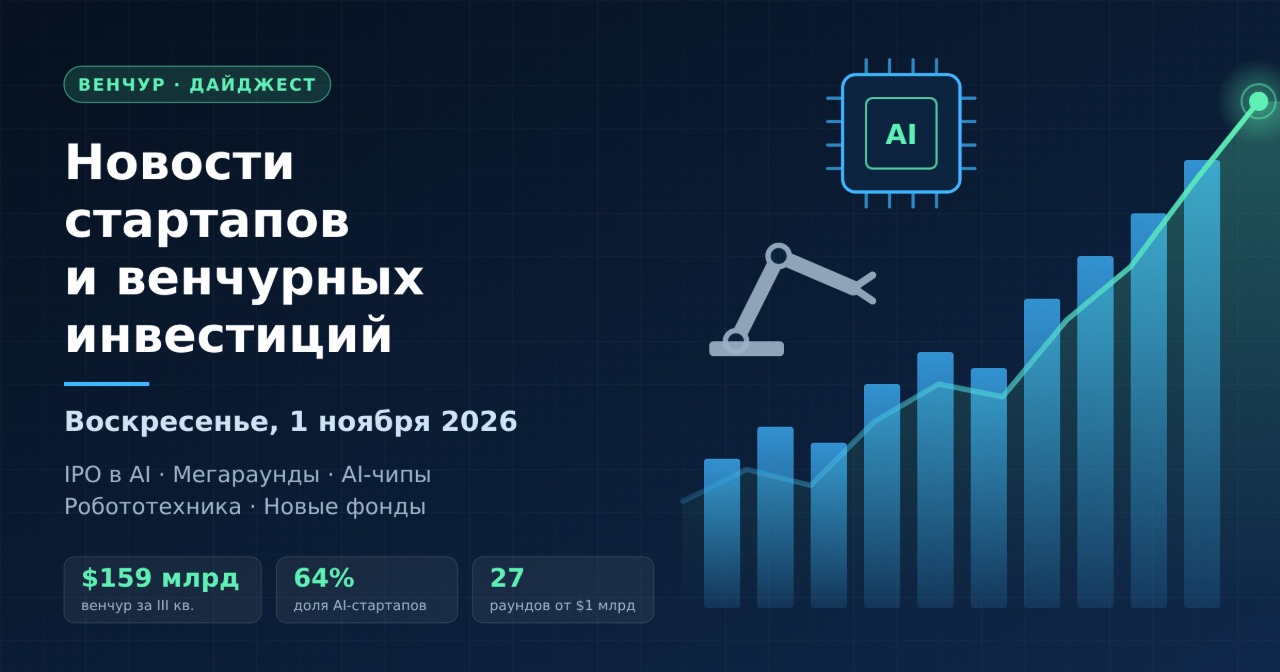
- According to KPMG Venture Pulse, global venture investments in Q3 2026 reached $170.9 billion.
- Stryker invested $400 million in UK-based CMR Surgical with an option for future acquisition.
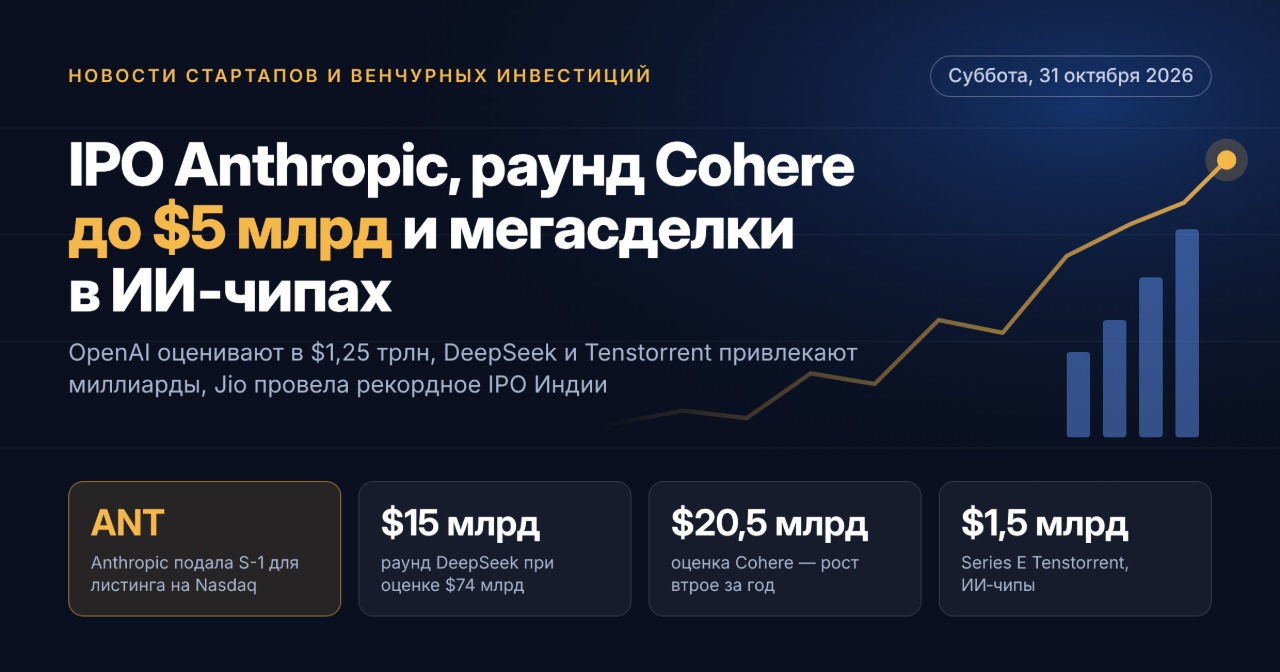
- The market awaits the public filing for IPO from Anthropic and the largest placement in Indian history by Jio.
Macro Outlook: Record Year and Rising Capital Concentration
According to the latest KPMG Venture Pulse report, global venture investments reached $170.9 billion in Q3 2026 across 8,341 deals, with the total for the first nine months hitting $728.3 billion. The year is on track for one of the best outcomes in the history of the venture market. The volume of deals involving corporate venture funds has already surpassed the previous annual record this year.
However, the market structure is changing:
- Concentration. Capital is accumulating in a small number of AI megaraounds: foundational models, data centers, robotics, defense technologies.
- Selectivity. Startups outside these areas face notably stricter selection processes.
- Outlook. Analysts anticipate further acceleration of investments in AI infrastructure, physical and industrial AI, defense tech, and alternative energy sources.
In North America, quarterly financing has decreased compared to the previous quarter, but this trend is primarily attributed to the absence of new rounds from OpenAI and Anthropic, rather than a general market cool-down.
Ramp and Fintech: A $60 Billion Valuation in Four Months
The leading deal of the week: Ramp, a corporate card and expense management platform, raised approximately $1.85 billion at a $60 billion pre-investment valuation. The round was led by Dragoneer Investment Group and Thrive Capital, with participation from Founders Fund, Sands Capital, Avenir Growth, and a broad pool of institutional investors.
Why This Matters for Investors
- In June 2026, Ramp was valued at $44 billion, marking an increase of $16 billion in just four months.
- The company serves over 70,000 businesses, with estimated annual revenue exceeding $1.5 billion.
- Close competitor Brex has moved to Capital One for $5.15 billion, leaving Ramp as the leader in the independent segment of spend management.
- The growth strategy is centered on AI in financial processes: routing tasks between models and providing tools for accounting firms.
Among other notable fintech deals, ID Finance secured $610 million in a growth round, while AI insurance platform Ledgebrook raised $200 million with co-investment from Allianz X and Rockefeller Capital Management.
AI Startups and Infrastructure: Capital Deepens in the Stack
The trend for 2026 remains: investors are shifting from applied AI to computing, optics, semiconductors, and model training tools.
Major AI Funding Rounds
- Modal Labs: $750 million in Series D led by Accel, valuation of $15.75 billion. Cloud infrastructure for AI inference.
- Manus (Butterfly Effect): over $500 million led by Boyu Capital and IDG Capital. This is the first round following a deal collapse with Meta.
- SignSplit: strategic seed round of $400 million exiting stealth mode.
- Arena: $200 million in Series B at a valuation of $3.1 billion, an AI model evaluation platform.
- Salience Labs (Oxford): $125 million in Series B for optical switching for AI data centers.
- Labelbox: over $100 million in Series E for model training and evaluation.
- Mueon: $65 million in Series A for modular semiconductor systems for hyperscale computing.
Biotech and MedTech: Strategic Investors Strengthen Positions
The life sciences sector demonstrates sustained demand for late rounds and active corporate participation.
- CMR Surgical: Stryker invests $400 million in preferred shares with an option for acquisition, expanding its presence in robotic soft tissue surgery.
- OMass Therapeutics: $310 million in Series C with participation from GV, Bain Capital Life Sciences, Forbion, and Novo Holdings.
- Matchpoint Therapeutics: $150 million in Series B.
- Soufflé Therapeutics: $135 million in Series B, including a sovereign fund and Amgen Ventures.
- Suki: $90 million in Series E for AI documentation in healthcare.
Europe and India: Regional Startup News
Europe
European venture funding has increased by approximately 40% year-on-year since the beginning of the year. Among the deals of the week:
- French Dougs raised €50 million for AI-based accounting automation;
- Hamburg's Rabot Energy closed Series B at €50 million;
- Duvo secured $32 million in Series A led by Balderton Capital;
- Skeleton Technologies attained unicorn status.
India
Enterprise AI startup RapidCanvas raised $29 million in Series B led by Vertex Ventures, while Urban Company approved raising up to ₹2,500 crore amid competition in the instant home services segment.
Venture Funds: Who Closed New Funds
GP fundraising remains selective: LPs are concentrating capital on experienced managers and niche strategies.
- Spectrum Equity: Fund XI at $2.5 billion, oversubscribed.
- Pear VC: Fifth fund at $333 million, with assets under management growing to $1.1 billion.
- Endeavor Catalyst: Fund V at $320 million.
- Balerion Space Ventures: Fund II at $200 million for space technologies.
- DIG Ventures: $120 million for European AI infrastructure.
- Nauta: First close of sixth fund at €60 million with a target of €150–200 million.
- Turbine Capital: SEK 608 million for Scandinavian deep tech, involving Saab, Scania, and Volvo Cars.
IPO and Exits: The Liquidity Window Expands
The public offering market remains the main source of liquidity for venture portfolios in 2026.
- Anthropic: According to media reports, the company may soon file publicly, with the listing anticipated for mid-November.
- Jio: An IPO of $3.2 billion with subscriptions from October 21-23 and a valuation of around $108 billion could become the largest placement in Indian history.
- Tonbo Imaging: The IPO for the defense tech company is oversubscribed, with the listing expected on October 23.
- Klook: Withdrawn its application for an approximately $400 million US IPO, reflecting selective demand.
Among major exits through M&A, AMD's acquisition of the lab World Labs for approximately $8.2 billion in stock stands out.
What This Means for Venture Investors
- Concentration Risk. The industry's returns increasingly depend on a narrow circle of AI leaders, necessitating a reevaluation of portfolio diversification.
- Infrastructure Thesis. Computing, optics, energy, and semiconductors remain a priority for later stages.
- Strategic Capital. Corporations are increasingly entering into deals with acquisition options, as seen in the case of CMR Surgical.
- Liquidity. The public offerings of Anthropic and Jio will test the demand for large IPOs until the end of 2026.
The startup and venture investment news this week confirms the main trend of the year: the market is growing at a record pace, but capital is being distributed increasingly unevenly. For funds, key factors in Q4 will be access to deals in AI infrastructure, discipline in valuations, and readiness for exits through IPO.