Oil Market: Diplomacy Pressures Prices, Geopolitics Maintains Premium
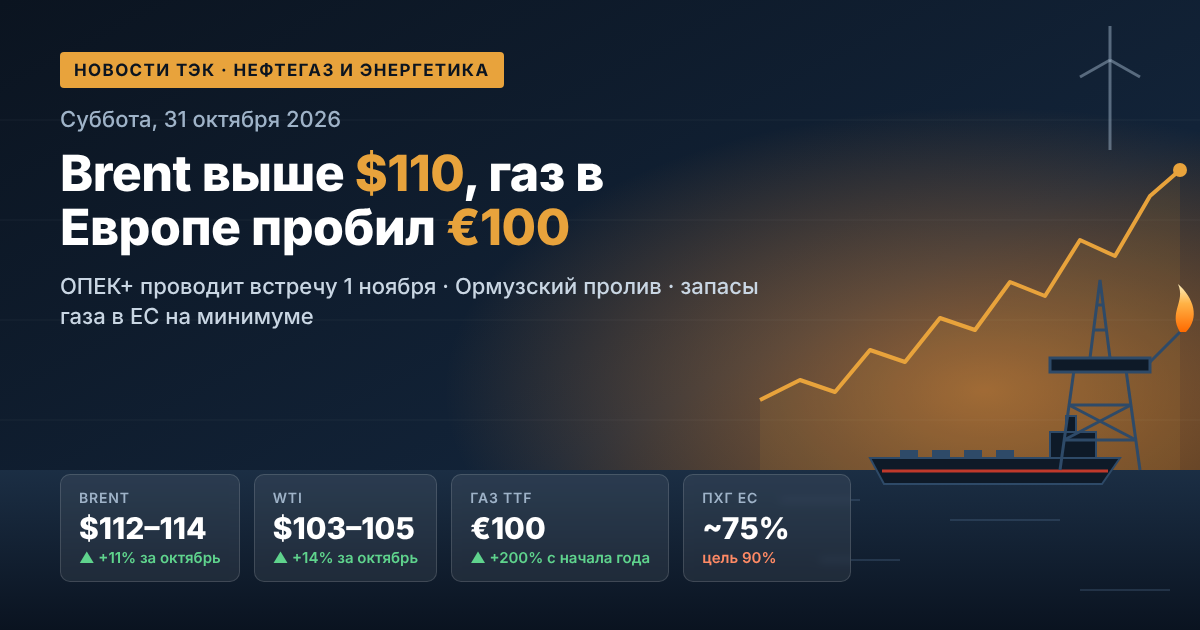
As of Tuesday, January futures for Brent dropped below $110 per barrel, while the nearby December contract traded in the $114–116 range. This gap between contracts reflects a significant backwardation: the market is paying a notable premium for immediate oil deliveries. WTI is holding around $101, and the Brent–WTI spread has narrowed to approximately $9.
Key factors influencing oil price dynamics:
- Diplomatic Track. Delegations from Saudi Arabia, Turkey, and Pakistan held talks in Tehran earlier this week, and the parties agreed to continue discussions. This marks the first substantial argument for sellers during the ongoing military rally.
- U.S. Political Calendar. Washington has previously indicated that it does not plan new strikes against Iran before the midterm elections on November 3, temporarily reducing the risk of sharp escalation.
- Monetary Policy. The Federal Reserve raised interest rates for the first time in three years in September, and high oil prices intensify inflationary pressures and expectations of further tightening, which suppress demand for commodity assets.
- Technical Picture. Prices are stagnating at the upper boundary of the annual range; some analysts foresee a correction, while renewed escalation could lead to a move towards $120 by the end of the year.
Strait of Hormuz and Persian Gulf: Physical Risks to Oil Supply
Despite diplomatic signals, infrastructure risks remain unprecedented. Over the past week, Iran reported damage to seven tankers in one night, and the IRGC announced the mining of the "unauthorized" southern route, where two supertankers carrying a total of over 4.5 million barrels were detonated. Yemeni Houthi forces continue their attacks on Saudi Aramco facilities, prompting the company to evacuate personnel from its headquarters in the eastern province.
Paradoxically, oil exports from the Middle East have rebounded: vessel tracking data indicates that, in the week ending October 18, exports exceeded 24 million barrels per day—above pre-war levels. Saudi Aramco has more than tripled throughput along the pipeline circumventing the strait to the Red Sea ports; however, the cost of insuring against military risks remains around 3% of the vessel's value.
OPEC+: Quotas on Paper and Meeting on November 1
Seven key participants in the alliance—Saudi Arabia, Russia, Iraq, Kuwait, Kazakhstan, Algeria, and Oman—have maintained their target production levels for the second consecutive month. Riyadh’s quota is set at 10.5 million barrels per day, while Russia's stands at 9.9 million. However, the actual group production in August was around 25 million barrels per day, approximately 5 million below pre-war levels. The next meeting is scheduled for November 1; the market does not expect quota changes until 2027, as the war has delayed the revision of member countries' production capacities. The discount of Russian Urals to Brent is estimated at $8–15 per barrel.
Gas Market: Europe Enters Winter with Minimal Stocks in 15 Years
The November TTF futures price rose to $1133 per thousand cubic meters on Monday—the highest since December 2022. By Tuesday, prices corrected to around $1100, and the December contract traded at approximately €96 per MWh. This is nearly three times higher than the average level from last winter.
Key drivers of gas price growth:
- Shortage of LNG from the Persian Gulf. Supplies from the region, which accounted for about 20% of the global liquefied gas supply, have plummeted; two Qatari liquefaction lines with a capacity of 12.8 million tons per year have been taken offline for three years.
- Low Storage Levels. EU storage is approximately 74.9% full (around 80 billion cubic meters)—14–15 percentage points below the five-year norm. The European Commission has already lowered the target from 90% to 80% by December 1.
- Competition with Asia. European buyers are forced to overpay for spot LNG cargoes.
- Weather Factor. Cold temperatures have prompted several EU countries to begin gas withdrawals earlier than usual.
Analysts foresee prices rising to $1200–1400 per thousand cubic meters during peak months in a cold winter.
Gas Exporting Countries Forum Summit in Moscow: Signals for the Global Gas Market
Vladimir Putin, speaking at the Gas Exporting Countries Forum summit, highlighted serious shocks within the industry and linked rising costs for European consumers to the rejection of Russian energy sources. Among the key points:
- Global gas demand could rise to 5.5 trillion cubic meters per year by mid-century, with international trade reaching 1.7 trillion;
- Stabilization of the market requires an end to conflicts and lifting of sanctions;
- Producers value stability more than a twofold increase in spot prices;
- Russia is exploring opportunities for cooperation with American partners in the Arctic.
The Kremlin stated that it is ready to discuss the resumption of gas supplies to Europe if interested buyers are available.
Refined Products and Refineries: Diesel Shortage and Regulation in Russia
The global refined products market remains noticeably tighter than the crude oil market. Futures for heating oil and diesel in the U.S. are trading around $4.9 per gallon—more than twice the level from a year ago. The shortage of middle distillates supports refining margins and benefits independent refineries with access to feedstock.
Russia has imposed a complete ban on the export of gasoline, diesel, and marine fuel until January 31, 2027. Retail fuel prices have risen by approximately 20.5% for gasoline and 13.4% for diesel since the beginning of the year. As of mid-October, the average gasoline price has decreased to 78 rubles per liter; however, the situation remains fragile: refineries are operating at maximum capacity, planned repairs have been postponed, and processing data is classified.
Electric Power and Renewables: Energy Crisis Accelerates Energy Transition
High fossil fuel prices strengthen economic arguments in favor of renewable energy. By Spring 2026, wind and solar generation is expected to outpace gas generation globally for the first time in history, accounting for 22% of electricity generation compared to gas's 20%. The U.S. expects a record installation of 86 GW of new capacity this year, over 90% of which will come from solar stations, storage, and wind. Indonesia, South Korea, and several other countries are accelerating renewable energy development programs, viewing them as tools for energy security and reducing dependence on LNG imports.
Coal: Asian Demand Supports Prices
High gas prices are stimulating a shift of part of Northeast Asia's energy systems to coal. Prices for thermal coal at the Australian Newcastle hub rose to three-year highs in October, with the average price forecast for 2026 around $130 per ton FOB. However, the growth of renewables limits imports: forecasts for coal purchases by China, India, and Japan for this year have been downgraded.
What Investors Need to Know: Key Benchmarks for the Week
- Negotiations on Iran—the main factor for oil and LNG; progress could alleviate some of the geopolitical premium.
- Weekly U.S. oil inventory data—a signal of supply and demand balance.
- ECB Decision—impacting the euro and gas prices in dollar terms.
- OPEC+ Meeting on November 1—the base scenario assumes quota maintenance.
- U.S. Elections on November 3—risk of a change in Washington's foreign policy.
- Weather and Gas Withdrawals from Storage in Europe—an indicator of winter gas and electricity prices.
The oil and gas market remains in a state of high volatility, with diplomatic news and incidents in the Persian Gulf capable of altering prices by several percent within a single session. For oil, gas, and fuel companies, as well as investors in the commodity sector, the next two weeks will serve as a test of the resilience of current price levels ahead of the heating season.