Venture Market Update October 28, 2026: Anthropic’s Public Offering, AI Mega-Rounds for Flapping Airplanes and Legora, Robotics Valuations Surge, New Venture Funds, and European Nine-Month Results
The venture market enters the final week of October with the year's most significant event. Anthropic has filed its S-1 and is preparing for an offering that may become the largest IPO in history. For venture investors and funds, this is more than a standalone deal. The valuation the public market assigns to the leader in generative artificial intelligence will set benchmarks for the entire segment, influencing late rounds, secondary deals, and exit strategies for years to come.
Meanwhile, capital inflow into startups shows no signs of slowing. From October 15 to 23 alone, U.S. companies raised over $6 billion in more than fifteen funding rounds. Key themes of the day for investors include:
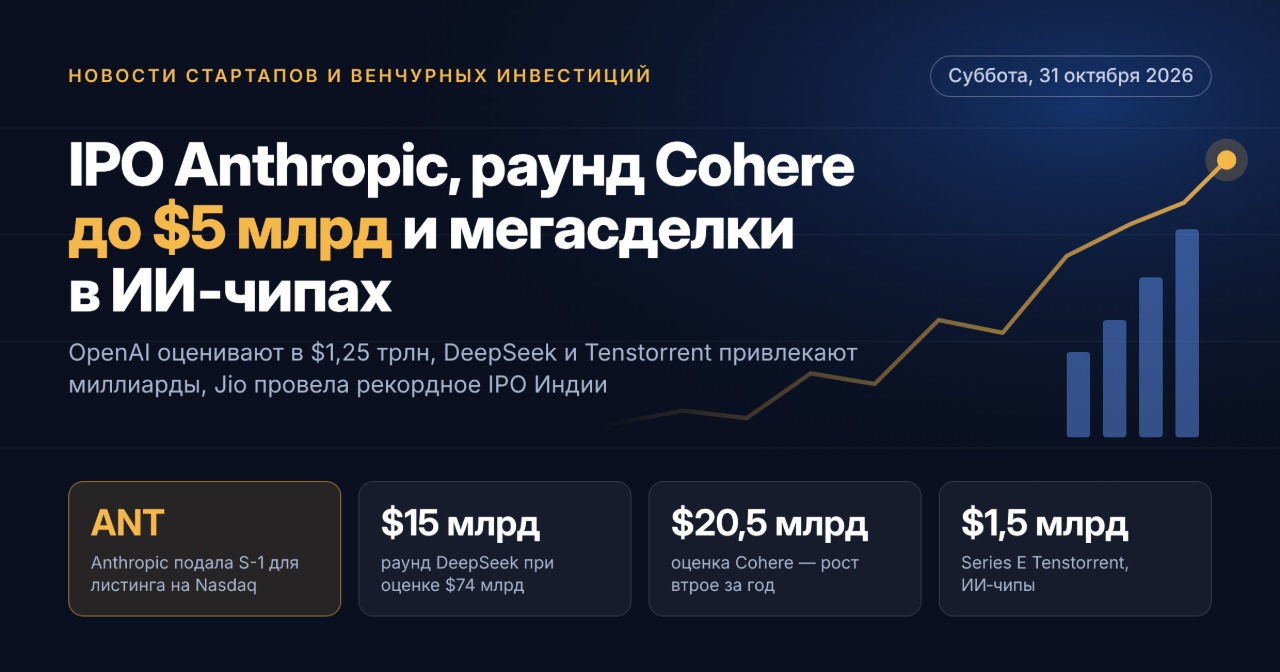
- Anthropic IPO: public S-1 filing, ticker ANT on Nasdaq, target valuation of $1.5–2 trillion.
- AI Mega-Rounds: Flapping Airplanes, Legora, Tenstorrent, and Modal Labs raising hundreds of millions to billions of dollars.
- Physical AI: Bedrock Robotics and Eka Robotics rapidly increasing their valuations.
- Defense and Government Technologies: ASI and 22one receiving support from leading funds.
- Europe and Emerging Markets: record nine months and closure of new venture funds.
Anthropic Publishes S-1: The Largest IPO in History on the Horizon
On October 26, Anthropic PBC converted its confidential application filed on June 1 into a public mode. The company plans to list on the Nasdaq Global Select Market under the ticker ANT. Goldman Sachs is the lead underwriter, followed by Morgan Stanley, with over twenty banks in the syndicate.
According to business media, the offering is aimed for the week of November 16. The amount raised could exceed $100 billion, with a valuation expected in the range of $1.5–2 trillion. For comparison, SpaceX went public in June with a valuation of $1.77 trillion and raised approximately $86 billion. The share price, number of shares, and final deal volume are not yet specified in the prospectus.
Key financial metrics from the S-1 include:
- Revenue for the first half of 2026: $16.29 billion, compared to $1.16 billion the previous year.
- Second-quarter revenue: $11.56 billion, operating profit: $974 million.
- Net loss for the half-year: $80.75 billion, primarily non-cash, associated with the revaluation of convertible notes amid the company's rising value.
- Last private round: Series H raised $65 billion with an evaluation of $965 billion (May 2026).
Multiples and Risks: How the Market Will Assess AI Businesses
Analysts describe the Anthropic offering as a referendum on the artificial intelligence business model. Annual revenue, calculated based on the second quarter, is approximately $46 billion. Thus, a $2 trillion valuation corresponds to about 43 times annual revenue. The private round in May was based on approximately 21 times revenue.
Key questions for institutional investors:
- Cost of Computing. Infrastructure expenses are rising along with revenue. Experts recommend monitoring the ratio of revenue to costs of computing power.
- Long-term Commitments. Multi-year data center and chip contracts put pressure on cash flow.
- Competitive Landscape. OpenAI is delaying its IPO until next year and reportedly raising another $30 billion privately at a valuation of $1.25 trillion.
Some observers caution that access to capital for AI companies may decrease. This is why the success of this offering is crucial for the entire venture ecosystem.
This Week’s AI Mega-Rounds: Betting on Efficiency and Vertical Solutions
While the market awaits ANT, private equity continues to concentrate in the artificial intelligence sector. Recent major deals include:
- Flapping Airplanes — $1 billion in Series A funding at a valuation of $6 billion, quadrupling from January. The round was led by Index Ventures and Lux Capital, with participation from GV, Sequoia, Kleiner Perkins, and Nvidia. The company is developing methods to train large models on significantly less data.
- Legora — $550 million in Series E funding at a valuation of $8.8 billion. The Swedish platform for lawyers received backing from Atreides Management, Fidelity, Baron Capital, and JPMorgan.
- Tenstorrent — $1.5 billion in Series E funding at a valuation of $6.2 billion to develop AI chips based on RISC-V architecture.
- Modal Labs — $750 million in Series D funding at a valuation of $15.75 billion, led by Accel. The company is building cloud infrastructure for AI workloads.
- Town — $108 million in Series B funding for an AI assistant for team collaboration. Participants in the deal include Forerunner, Menlo Ventures, and a16z.
The trend is clear: investors are willing to pay a premium for technologies that reduce AI costs (data, chips, computing) and for vertical applications with rapid monetization.
Physical AI and Robotics: Valuations Rising Faster Than the Market
Robotics is becoming the second most significant area of venture investment after language models. Bedrock Robotics, a developer of autonomous systems for construction equipment, reportedly raised $600 million in Series C funding at a valuation of $4.1 billion. In February, the company was valued at $1.75 billion. Demand is being fueled by the construction of data centers and a shortage of heavy equipment operators.
Other notable deals include:
- Eka Robotics — $150 million in Series A funding at a valuation of $1.45 billion. The round was led by a16z and F-Prime, making the company an immediate "unicorn."
- Enact — $30 million in pre-seed funding from Firstminute Capital and Redalpine for sensor technologies to enhance robot agility.
- Coherence Neuro — $45 million from Founders Fund and OpenAI Startup Fund for neurointerfaces.
Defense, Security, and Government Sector: Sustained Fund Interest
Defense technologies and critical infrastructure solutions remain a focus for venture funds. Boston-based ASI raised $325 million in Series C funding at a valuation of $3 billion. The round was led by Spark Capital, with participation from Craft Ventures, a16z, and Citadel Securities structuring. The platform helps military, airlines, and dispatchers manage assets.
London-based 22one, a developer of AI tools for police, is valued at nearly $400 million according to the Financial Times. Investors include Sequoia, General Catalyst, Lux Capital, and Creandum. Watchtower Labs secured $35 million in seed funding from Shield Capital, Conviction, and Founders Fund.
Fintech and Business Platforms: The Return of High Valuations
Fintech is once again demonstrating high multiples. Ramp raised $1.85 billion at a valuation of $60 billion, led by Dragoneer. This makes it one of the most valuable private fintech companies in the U.S. Whop, a platform for monetizing online business, received $200 million in Series D funding from Sequoia Capital at a valuation of $5.1 billion. London-based Nevis, which automates the work of asset managers, closed a Series B round at $70 million, led by EQT Ventures.
Europe: Record Nine Months and Focus on Late Stages
The European venture market is showing robust growth. Key figures include:
- In the third quarter, European tech companies raised €27.8 billion across 732 deals, a 32.4% increase year-over-year.
- For the first nine months, funding volume grew by 63% to $61.9 billion, despite a 19% decrease in the number of rounds.
- 53% of capital was allocated to late-stage investments, with about 35% directed toward London.
Among recent deals are Finland's Volare (€7.1 million for insect-based protein production) and Switzerland's Sonexos (CHF 5 million for noise suppression technology). Frankfurt-based QuoIntelligence in cybersecurity secured investments from former German Finance Minister Christian Lindner.
New Funds and Emerging Markets, Including Russia and CIS
Capital continues to flow into niche venture funds:
- Endeavor Catalyst Fund V closed with oversubscription at $320 million. Assets under management exceeded $850 million, focusing on emerging markets.
- Nauta reached the first close of its sixth fund at €60 million, targeting a total of €150–200 million for European software and deep tech.
- Indie GO Fund II in Russia targets 5 billion rubles for gaming studios with export potential. The first close is expected in Q4 2026.
In India, Live2.ai raised about $14 million in a pre-Series B round led by IvyCap Ventures, while Even Healthcare secured $50 million from Khosla Ventures and Alpha Wave. In Central Asia, the early segment is active: the Kazakh AI startup Riasm received $3 million in pre-seed funding. In the Russian market, the Moscow Venture Fund is allocating 250 million rubles to tech companies, and the "Creative Venture" fund invested in the data platform "Argument."
What This Means for Venture Investors: Key Takeaways
- The Anthropic IPO will serve as a price benchmark. A successful offering will solidify high multiples for late-stage AI companies. Conversely, weak demand could lead to valuations reassessing private portfolios.
- Exit opportunities are expanding. Following SpaceX and Anthropic, other "unicorns" are preparing to enter the public market.
- Diversification is shifting towards "real" AI. Robotics, defense, and infrastructure are capturing an increasing share of funding rounds.
- Discipline remains crucial. Concentration of capital in a few leaders raises risks for funds entering deals at peak valuations.
The global startup and venture investment market enters November with a rare combination of record liquidity and heightened uncertainty. The next three weeks, leading up to the anticipated debut of ANT, will be pivotal for investor sentiment worldwide.