Key themes of the day for venture investors and funds:
- IPO market — OPay on the NYSE, the debut of Jio Platforms, Anthropic's preparations for a Nasdaq listing.
- Mega-rounds in AI — deals worth hundreds of millions and billions of dollars at valuations above $5 billion.
- Physical AI and robotics — the sector with the fastest funding growth in 2026.
- New venture funds — from multi-billion-dollar pools to niche first-time funds.
- M&A and exits — strategic acquisitions of technology and teams.
Macro picture: the venture market after a record half-year
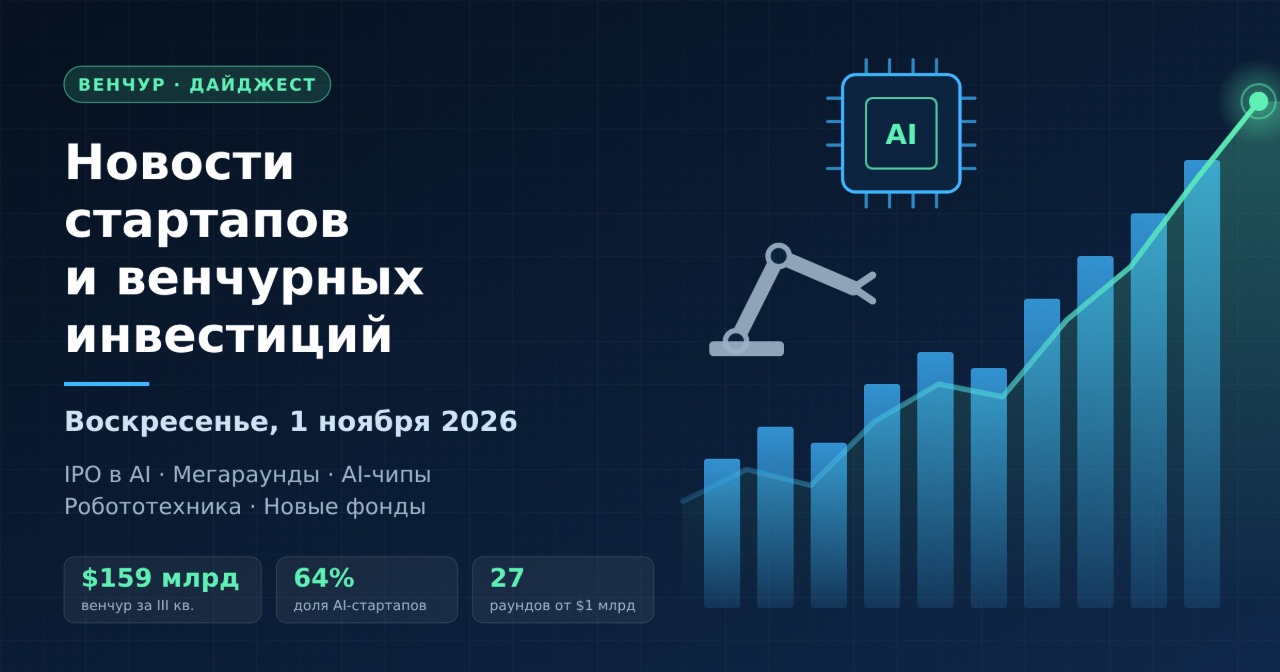
According to Crunchbase, global venture investment totalled about $159 billion in the third quarter of 2026. That is 25% below the record $212 billion of the second quarter, but 53% above the figure a year earlier. About two-thirds of the capital went to companies connected with artificial intelligence.
The quarterly decline should not be read as a reversal of the trend: the second quarter was inflated by a handful of exceptionally large deals. The structure of the market remains intact:
- Capital is concentrating in the segment leaders — a small number of rounds accounts for the bulk of the volume.
- Investors are shifting from "pure" AI models to companies that turn AI into operational outcomes.
- The role of later stages and secondary transactions is growing as the window for exits opens.
Anthropic: prospectus published, the market awaits the price range
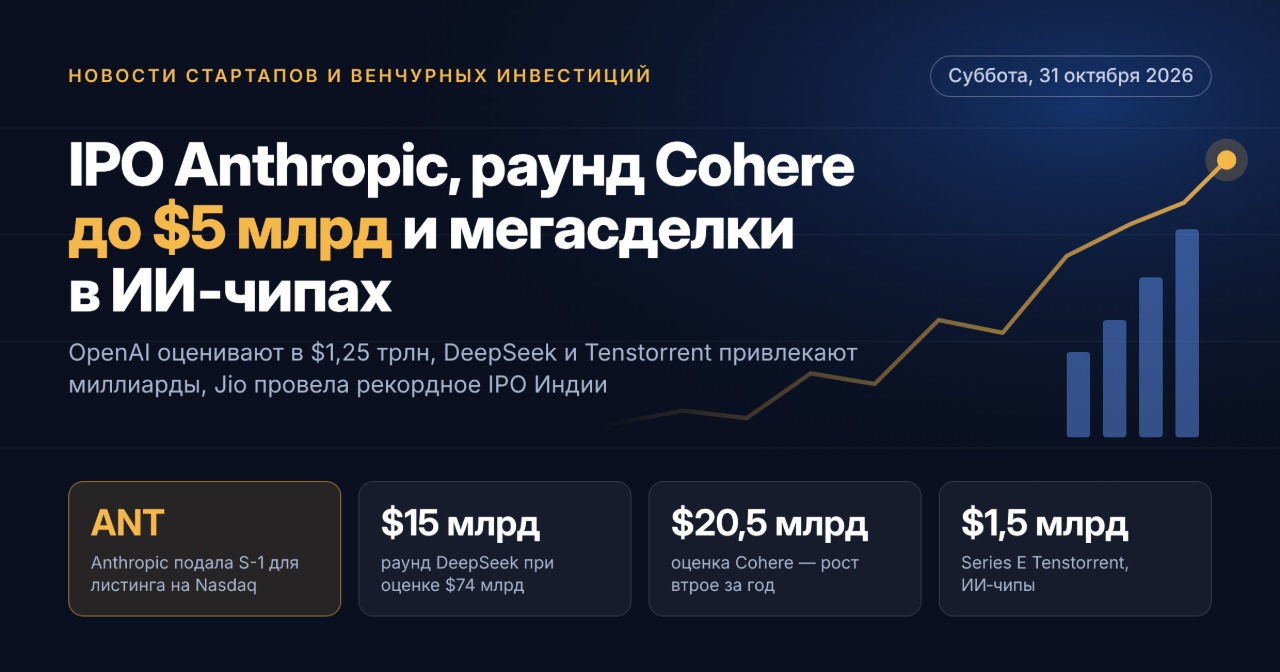
The main event of the week remains the public S-1 filing by Anthropic, submitted on 26 October. The developer of Claude plans to list Class A shares on the Nasdaq Global Select Market under the ticker ANT. Revenue for the first half of 2026 was about $16.3 billion against $1.2 billion a year earlier; in the second quarter the company reached operating profit.
What matters for investors:
- The price range and offering size have not yet been disclosed — they will be revealed in an amendment to the S-1.
- According to the US press, trading may begin in the week of 16 November.
- Market participants estimate the potential amount raised at roughly $75 billion — comparable to the SpaceX IPO.
- Commitments to purchase computing capacity exceed $400 billion over a horizon of up to 20 years.
- A non-standard lock-up schedule allows insiders to sell shares from the first day of trading.
For venture funds, the Anthropic listing will be the largest potential exit of the decade, and for the industry as a whole, a benchmark for valuing AI laboratories.
IPO market: OPay, Jio Platforms and biotech listings
On Wednesday, 28 October, Jio Platforms held the largest IPO in India's history: the company raised about ₹30,200 crore, and the shares opened at a premium of about 21% to the offer price. The book was oversubscribed more than 20 times, and qualified institutional investors submitted bids for an amount 70 times the offer.
On Thursday, 29 October, the debut of OPay on the NYSE is expected:
- Range — $19–21 per depositary share, around 16 million securities.
- Target valuation — up to $4.4 billion against $2 billion in the 2021 round led by SoftBank.
- Revenue for the first half of 2026 rose 137% to $467 million, with net profit up to $91 million.
- Standard Bank is investing up to $200 million through a parallel private placement.
The listing will be the first US IPO of a fintech serving predominantly Nigerian clients, and will set a valuation benchmark for the entire African venture sector. In the same week, biotech companies Aspen Neuroscience and Bambusa Therapeutics are preparing to list on Nasdaq with a range of $15–17 per share.
Mega-rounds in artificial intelligence
October has become one of the busiest months of the year by volume of large funding rounds. The most notable deals of the past two weeks:
- Ramp — $1.85 billion at a $60 billion valuation; the corporate spend management fintech is building its strategy around AI agents.
- Tenstorrent — $1.5 billion in a Series E round at a $6.2 billion valuation to develop an open AI chip architecture.
- Flapping Airplanes — $1 billion in a Series A at a $6 billion valuation led by Index Ventures and Lux Capital, with no commercial product or revenue.
- Legora — $550 million at an $8.8 billion valuation; the Swedish legal-tech company confirms its status as a European leader.
- Pigment — $250 million at a $2.3 billion valuation with planned participation from Nvidia.
- Whop — $200 million in a Series D at a $5.1 billion valuation.
The infrastructure layer stands out in particular: General Compute raised $100 million in a Series A, Hyperbolic raised $30 million to aggregate capacity from independent cloud providers, and Daytona joined the "unicorn" club with a $1 billion valuation.
Physical AI and robotics: the fastest-growing segment
According to Crunchbase, funding for robotics startups rose 185% year on year in the third quarter, with the US and China remaining the leaders. Recent deals confirm the trend:
- Bedrock Robotics — $600 million in a Series C for autonomous excavators; cumulative funding has approached $1 billion.
- Warhound — $200 million at a $1.2 billion valuation with participation from Sequoia, 8VC and In-Q-Tel.
- Machenta — $40 million in seed funding for training robots in simulation.
For funds this is a signal: the cost of entry into robotics at early stages is rising fast, and defence and industrial applications are becoming a distinct investment thesis.
Fintech, climate and vertical AI
Diversification of the venture portfolio continues. Among the notable deals of the week:
- Nevis — $70 million in a Series B led by EQT Ventures for an AI-powered wealth management platform.
- Peak Energy — $108 million in a Series B for sodium-ion energy storage systems.
- Town — $108 million in a Series B for an AI assistant for team collaboration.
- Emvolon — $22 million in a Series A for modular units converting methane into biomethanol.
Venture funds: large capital and specialisation
Fundraising by management companies remains active, with LPs favouring established brands and narrow specialisation:
- Disruptive is forming a fund of up to $10 billion with a concentrated bet on a limited circle of companies.
- Spectrum Equity closed the largest growth fund in its history at $2.5 billion.
- Seaya held the first close of its new Nova growth fund at €600 million.
- Inspired Capital raised $450 million for its fourth fund with a New York focus.
- Trust Ventures filed documents for a $400 million Fund V, while Benchmark registered partner funds with the participation of Jack Altman.
At the same time, the median new venture fund remains small — around $3.4 million, reflecting the polarisation between mega-funds and micro-funds.
M&A and strategic deals
Consolidation is concentrated in AI infrastructure and semiconductors:
- Anthropic disclosed the acquisition of Mithril Medicine — a one-employee biotech startup that used Claude to develop a drug candidate for a rare form of muscular dystrophy.
- Unconventional AI is acquiring Israeli processor developer NeuReality.
- SG Micro is buying a controlling stake in Shenxiling Microelectronics for about $114.5 million.
Central Asia, Russia and the CIS
Regional startup ecosystems are showing moderate but steady activity. Kazakh AI startup Riasm raised $3 million in a pre-seed round, Jooba raised $4 million in seed investment, and Astana Hub continues to act as a magnet for international capital. A Moscow venture fund will allocate RUB 250 million to technology companies with a target co-investment volume of around RUB 1 billion. Additional interest in the region is being generated by inDrive's plans to test robotaxis in Central Asia in 2027 together with Pony AI and Nvidia.
Takeaways for investors
The venture market at the end of October 2026 is defined by three factors: the opening IPO window, the concentration of capital in AI leaders and the rapid growth of physical AI. In the coming weeks, investors should monitor:
- the price range and book demand for Anthropic;
- the performance of OPay and Jio Platforms shares after their debuts as an indicator of appetite for emerging markets;
- the resilience of valuations in AI mega-rounds amid public market volatility;
- the pace of venture fund fundraising ahead of 2027.
Successful listings could trigger a cycle of LP capital returns and a new wave of venture investment in startups, but valuation discipline remains the key condition for quality growth in the market.