Oil Market: Brent Hits Five-Month High
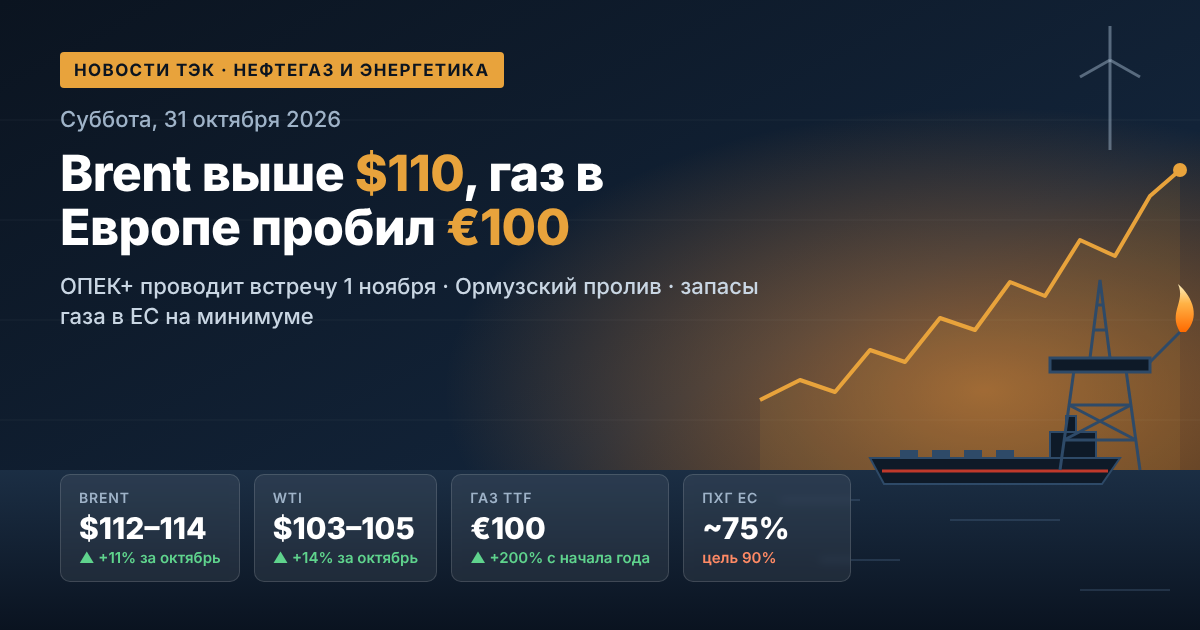
December futures for Brent traded between $109 and $111 per barrel on Tuesday, while the November WTI contract was around $99 to $100. Since the beginning of October, oil prices have increased by approximately 10%, with Brent at around $100 on the 1st. Oil price formation is influenced by three main factors:
- Geopolitical Premium. Traders are factoring in the risk of supply disruptions from the Persian Gulf and Red Sea.
- Declining Inventories. According to the EIA, commercial oil inventories in the U.S. dropped by 8.6 million barrels to 415.6 million for the week ending October 9. Distillate stocks fell to 102.6 million barrels, approximately 12% below the five-year average.
- Conflicting Flow Estimates. U.S. Energy Secretary Chris Wright indicated that oil shipments from the Persian Gulf have recovered to about 80% of pre-war levels. However, ship-tracking analysts noted a sharp decline in transit through the Strait of Hormuz last week.
Middle East: Attacks on Saudi Aramco and Threats to Shipping
The main topic of the day for the oil market is the conflict's expansion into Saudi Arabia. The Houthis reported attacks on Saudi Aramco facilities in Yanbu on the Red Sea coast, the Shaybah oil field, and airports in Riyadh and Abha, as well as military sites. Previously, the Aramco headquarters in Dhahran was targeted. Riyadh has postponed the FII investment forum to next year.
The situation in the maritime corridor is also deteriorating:
- In the past two weeks, at least 18 vessels have been attacked;
- In the southern part of the Strait of Hormuz, a tanker struck a naval mine;
- The average daily oil transit through the region last week fell to approximately 8.5 million barrels, down from over 20 million the previous week.
For the market, this implies high volatility: any confirmation of damage to Aramco's production or export facilities could quickly add several dollars to prices.
OPEC+ and IEA: Quotas on Pause, Shortage Until Year-End
Seven key OPEC+ members have kept their production targets unchanged for November. Saudi Arabia's quota stands at 10.5 million barrels per day, Russia at 9.9 million, and Iraq at 4.4 million. Increases agreed upon in 2026 largely remain on paper. In August, the group produced about 25 million barrels per day, approximately 5 million below pre-war levels. The next meeting of the alliance is scheduled for November 1.
Key takeaways from the IEA's October report:
- Global oil demand will decrease by 2.6 million barrels per day by 2026.
- Global supply will drop by 5.8 million barrels per day by 2026.
- The market balance will remain in deficit until the end of the year.
- Shortages of middle distillates will persist until 2027.
Oil Products and Refineries: Diesel Remains the Most Depleted Segment
The oil products segment is facing a dual shock: disruptions in the export of finished fuels from the Middle East coincided with damage to refineries in Russia. The IEA has approved the release of over 20 million barrels of diesel fuel from reserves. Overall, approximately 330 million barrels have already been directed to the market as part of the crisis management plan. Global diesel exports in September were about 700,000 barrels per day lower than last year's levels. American refineries are operating at about 93.5% capacity, supporting high refining margins and profits for independent refiners.
Russia: Urals Discount Widens, Infrastructure Under Pressure
Russian oil exports are facing pressure from multiple fronts:
- Market Competition. The Urals discount in Baltic ports widened to $20.85 per barrel compared to Dated Brent. This is due to weakening demand in India amid a resumption of Middle Eastern volumes and high freight costs. Urals shipments from the Baltic decreased by 21.9% over the week.
- High Tax Base. The Urals price for calculating MET in October is around $104.7 per barrel, compared to $92 in September. This is significantly above the budget target of $59.
- Logistics Attacks. On October 18, drones attacked the St. Petersburg oil terminal with a capacity of 12.5 million tons per year and the Ruchyi oil base.
- Domestic Market Regulation. An export ban on gasoline is in effect until January 31, 2027. Restrictions on diesel exports for producers have been extended until the end of October. Data on refinery capacity utilization is classified under a decree dated September 28.
Gas and LNG: Europe Enters Winter with Storage Shortages
The Dutch TTF hub is trading around €88 per MWh. Since the beginning of the year, the price has more than tripled. Gas storage in the EU is about 74% full, while the average norm for mid-October is around 86%. The market is additionally supported by three factors:
- Absence of Qatari LNG on the global market;
- Unscheduled downtime at Norway's Kårstø gas processing plant;
- The EU's impending ban on the import of Russian LNG starting in January.
The main suppliers filling the production gap have been American LNG exporters. However, Europe is forced to compete for every shipment with Asian buyers.
Coal: Renaissance Amid Gas Crisis
Thermal coal has once again become a safety fuel for Asia's energy systems. The Australian Newcastle benchmark is hovering around $150 per ton, approximately 40% higher than at the start of the year and 45% above last year’s levels. On October 6, the price reached $152.2, the highest since October 2024. A specific risk for the industry arises from a ruling by the High Court of Australia: when approving the expansion of coal mines, regulators are now required to consider emissions from coal combustion abroad. Mining companies warn that this could slow down investments.
Electricity and Renewables: Renewable Energy as Price Buffer
The energy crisis has accelerated the development of renewables. In June, solar generation for the first time became the largest source of electricity in the EU, accounting for around 25% of generation, or 52 TWh. In Germany, the share of renewables in the first half of the year was 61.8%. According to industry association SolarPower Europe, since the beginning of the Middle Eastern crisis, solar energy has saved the EU about €20 billion in gas imports. Onshore wind auctions are seeing significant oversubscription: in Germany, 2.5 GW have been allocated at an average price of around €50.6 per MWh. Nevertheless, during the winter, when solar generation is low, electricity prices in Europe are expected to be tied once again to expensive gas.
What to Monitor for Energy Market Participants on Wednesday, October 21
- Weekly EIA Report on U.S. Oil and Petroleum Product Inventories. Particular attention should be paid to distillates and refinery utilization rates.
- Updates from Saudi Aramco and the Saudi Ministry of Energy. It is important to confirm any damage in Yanbu and Shaybah.
- Data on tanker transit through the Strait of Hormuz and freight rates.
- TTF dynamics and the pace of gas injections into European storage facilities.
- Russia's government decision on diesel exports starting November.
- OPEC+ signals ahead of the November 1 meeting and the status of production capacity audits.
Overall, the global oil and gas market remains a seller's market: a fundamental shortage is intensified by geopolitical factors, and petroleum product inventories are dwindling. For investors, this signifies continued high volatility in the coming weeks. The most resilient positions appear to be those of refiners, LNG exporters, and coal mining companies.