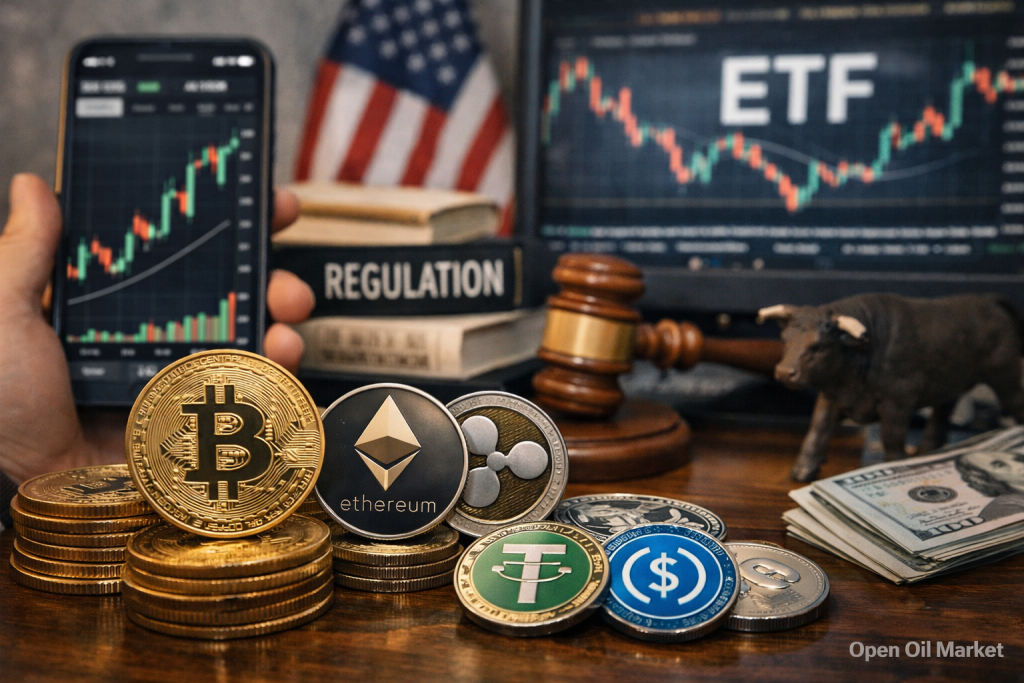
Current Cryptocurrency News as of April 7, 2026, Including Bitcoin, Ethereum ETF, Stablecoins, and Key Trends in the Global Crypto Market
As of Tuesday, April 7, 2026, the cryptocurrency market maintains a constructive yet cautious tone. Following a period of high volatility, digital assets once again become part of the global investment agenda, not only as a speculative segment but also as an infrastructural layer of the financial system. Bitcoin retains its dominant position, Ethereum seeks to regain its status as a key platform for on-chain economics, and stablecoins are definitively moving beyond the internal cryptocurrency market to become part of international transactions.
For investors, this signifies a transition to a new phase in the market. The movement of quotes increasingly depends not only on traders' sentiments but also on three systemic factors:
- Regulatory clarity in major jurisdictions;
- The influx of institutional capital through ETFs, funds, and corporate balances;
- Practical use of blockchain infrastructure in payments, settlements, and asset tokenization.
Bitcoin Once Again Sets the Tone for the Entire Crypto Market
Bitcoin remains the primary barometer of the cryptocurrency market. It is BTC that continues to dictate the risk appetite for digital assets, and the rise in its dominance indicates that capital is predominantly flowing into the most liquid and institutionally understood asset. For global investors, this is an important signal: the market still prefers quality, depth of liquidity, and a coherent investment thesis.
The current phase does not appear to be an absolute alt-season. On the contrary, the crypto market is currently developing under a model of selective demand, where Bitcoin benefits as the foundational reserve digital asset, while capital flows into altcoins are more cautious. This creates a more mature market structure in which investors increasingly look at fundamental drivers rather than just short-term impulses.
Ethereum, Solana, and XRP Compete for the Second Tier of Institutional Demand
While Bitcoin maintains its status as the first choice in the crypto market, the competition for the second tier is unfolding between Ethereum, Solana, and XRP. Each of these assets presents its own investment thesis.
Ethereum
Ethereum remains a key platform for DeFi, tokenization, and staking. However, investors continue to closely monitor user activity on the network, the pressure from Layer 2 solutions, and competition from faster blockchains. For ETH, it is especially important at this stage to demonstrate that the network can not only maintain its status as a technological standard but also convert infrastructural leadership into sustainable demand for the asset itself.
Solana
Solana is solidifying its position as a high-speed network for consumer applications, trading activity, and new ecosystem products. Institutional interest in SOL-based instruments is becoming increasingly prominent, and the coin is perceived as a bet on fast blockchain scenarios with high throughput.
XRP
XRP continues to maintain a strong position due to brand recognition, liquidity, and interest from the retail audience. The market is closely watching whether the asset can convert regulatory certainty and ETF interest into more sustainable growth rather than just short-term speculative movements.
Stablecoins Evolve into a Separate Investment and Infrastructure Class
One of the most critical topics of 2026 remains stablecoins. This is no longer merely a technical tool for trading on exchanges. Stablecoins are becoming the foundation for cross-border transactions, corporate payments, remittances, and new models of international liquidity.
This segment is particularly important for several reasons:
- It reduces the cost and time of international transfers;
- Creates a bridge between traditional finance and blockchain infrastructure;
- Generates demand for reliable, regulated digital dollar instruments;
- Enhances the role of the cryptocurrency market in the global financial system.
For investors, this means that the valuation of the cryptocurrency market is increasingly less about the dynamics of speculative tokens. The financial infrastructure on which the digital economy is built is gaining significance.
Regulation Becomes a Key Driver of Sector Reevaluation
In 2026, the cryptocurrency market is increasingly influenced by legislative initiatives. For professional participants, this is one of the most important shifts in recent years. Regulation is no longer just a threat but is starting to be viewed as a factor in legitimizing the market.
The most significant changes are currently associated with two areas:
- The formation of a clearer regulatory architecture for digital assets in the U.S.;
- The development of rules for payment stablecoins and settlement digital liquidity.
The clearer the boundaries between digital goods, securities, and payment tokens are, the higher the likelihood of expanded institutional participation. For cryptocurrencies, this signifies a potential reduction in the structural discount that has held the sector back for years.
ETFs and Institutional Capital Remain the Main Quality Filter
The crypto-ETF segment remains one of the main channels for capital redistribution within the industry. For global investors, this is the most straightforward and regulated way to enter digital assets without direct ownership of coins. This is why the market is increasingly focused not only on the price of Bitcoin or Ethereum but also on the stability of ETF flows, depth of demand, and the ability of issuers to expand their product line.
The key logic here is simple:
- Bitcoin benefits as an institutional standard;
- Ethereum is striving to retain its role as a second-tier technological asset;
- Solana and XRP become a test of the market's readiness to accept a broader array of crypto instruments;
- Multi-asset and index products may represent the next stage of sector maturity.
For long-term investors, this perspective is more critical than short-term noise. If institutional channels continue to expand, the crypto market builds a more robust base of demand.
Top 10 Most Popular Cryptocurrencies: What the Global Market is Watching
As of April 7, 2026, the focus of investors remains on the largest and most liquid digital assets. These form the foundation of the global cryptocurrency market and set the agenda for funds, traders, and corporate participants.
- Bitcoin (BTC) — the main reserve digital asset and primary market sentiment indicator.
- Ethereum (ETH) — the foundational infrastructure for DeFi, tokenization, and smart contracts.
- Tether (USDT) — the largest stablecoin and key liquidity instrument.
- BNB — systemic asset of the Binance ecosystem and related services.
- XRP — a liquid asset with strong market recognition and a payment thesis.
- USD Coin (USDC) — a regulated dollar stablecoin for transactions and corporate use.
- Solana (SOL) — a bet on high-speed blockchain infrastructure.
- TRON (TRX) — an important player in the transaction activity and stablecoin turnover segment.
- Dogecoin (DOGE) — an indicator of retail interest and speculative demand.
- Cardano (ADA) — a large ecosystem asset that remains on the radar of the global audience.
This list is significant not only for observing quotes. It illustrates where liquidity is concentrated, where institutional interest is being formed, and which assets the market considers most relevant in the current phase of the cycle.
What the Current Market Structure Means for Investors
Today's cryptocurrency market differs from previous cycles. Previously, growth was often driven by aggressive retail impulses, whereas in 2026, institutional logic is increasingly manifesting. This suggests slower but potentially more sustainable trends.
Investors should consider several conclusions:
- Bitcoin remains the central asset for managing crypto risk;
- Ethereum and Solana are essential as infrastructural bets but require more careful evaluation of user activity;
- Stablecoins are becoming an independent investment theme through payment infrastructure, issuers, and related services;
- Regulatory decisions in the U.S. and other major economies can drastically change the valuation of the entire sector.
Key Takeaway as of April 7, 2026
Cryptocurrencies are entering a new stage of development, where market emotions are no longer the only pressing factor, but institutional architecture also plays a crucial role. Bitcoin maintains its leadership, Ethereum and Solana compete for the role of technological pillars in the next phase, XRP retains high visibility, and stablecoins are becoming a real bridge between digital assets and the global payment system.
For the global investor, this means one thing: the cryptocurrency market remains highly risky, but its structure is becoming noticeably more mature. Liquidity, regulation, quality of infrastructure, and the ability of individual projects to integrate into the real financial economy are taking center stage. These factors will determine which cryptocurrencies will lead not only in the current week but throughout 2026.