Global Venture Market on May 30, 2026: Investors Discuss AI Startups, Fintech, Robotics, and Infrastructure Technologies
Saturday, May 30, 2026, marks a new wave of capital concentration in artificial intelligence for the venture market. The key topic of the week is the record financing of Anthropic, which has once again raised questions about how venture investors and funds should evaluate AI startups, infrastructure companies, and applied business models amid rapidly rising valuations.
News from startups and venture investments today indicates that the market is no longer in a classic recovery cycle following the downturn of 2022–2023. It is transitioning into a phase of stringent selection, where significant funding rounds are awarded to companies with access to computational power, corporate clients, industry data, and a clear trajectory towards a public market or strategic acquisition.
For venture funds, this signifies a shift in priorities. A mere bet on audience growth no longer seems adequate. Investors are seeking startups that can become part of the new AI infrastructure, reduce business costs, automate expensive workflows, or establish a foothold in strategically important sectors: fintech, insurance, healthcare, defense technologies, robotics, and enterprise software.
Anthropic Sets a New Benchmark for AI Startups
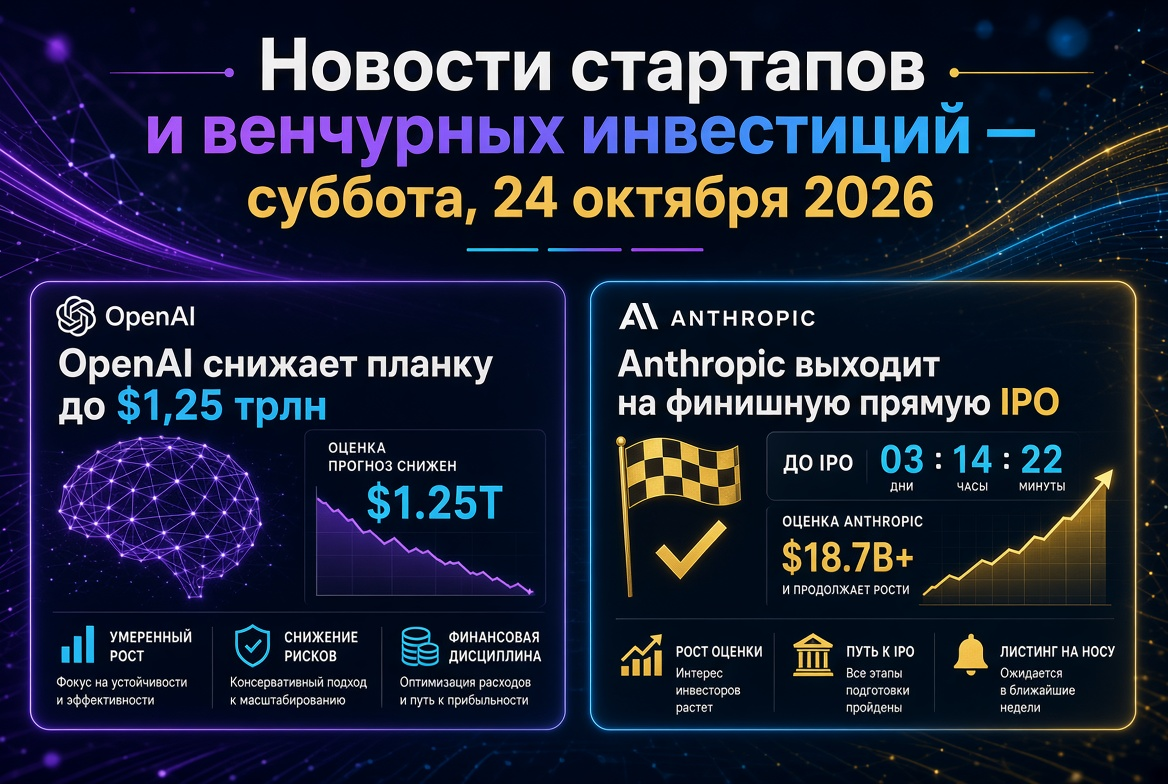
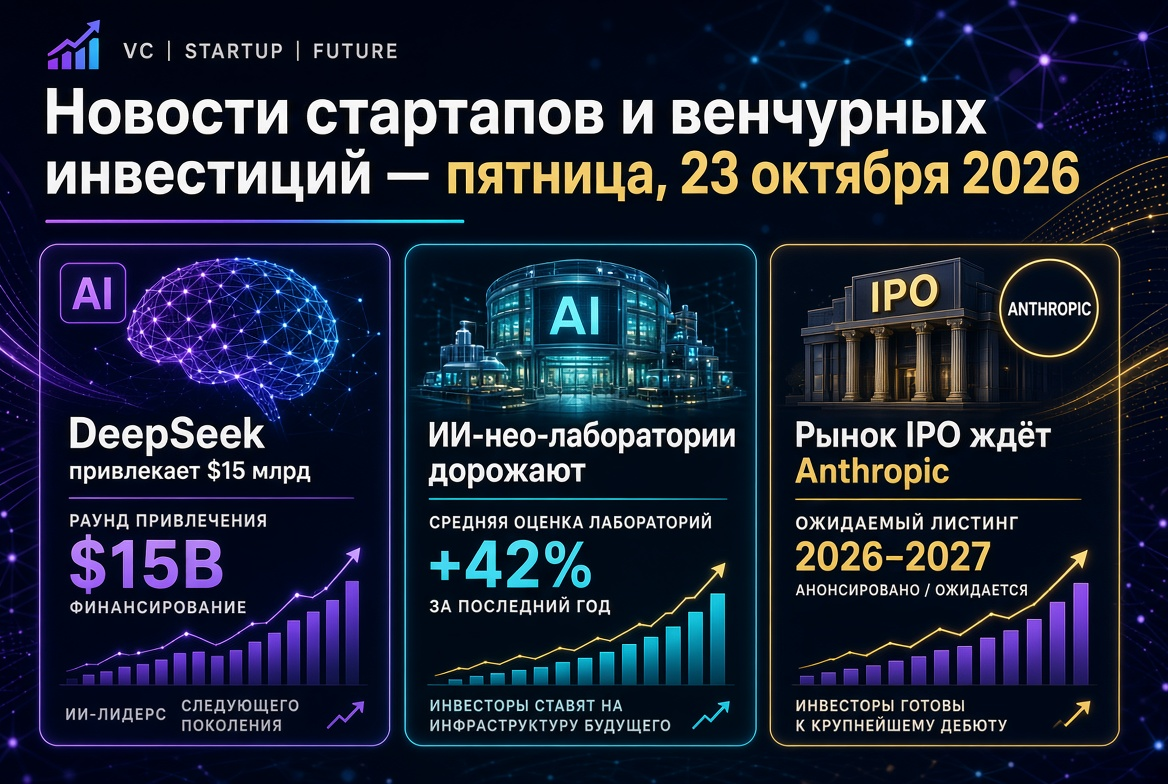
A key event was the recent valuation of Anthropic, which after raising $65 billion, reached $965 billion. For the venture market, this is not just another mega-round; it is a signal that the largest AI companies are now being valued not merely as ordinary tech startups, but as potential foundational platforms for the global economy.
Three conclusions are crucial for investors:
- AI models are becoming infrastructure assets. Capital is flowing not just into the product, but into computational power, cloud contracts, chips, and long-term corporate deployments.
- Market leaders obtain disproportionately larger capital shares. The higher the demand from large clients, the easier it is for these companies to attract new rounds at increasing valuations.
- The public market is becoming a strategic target once again. The largest AI startups are increasingly viewing IPOs as a means of financing further growth and infrastructure expenses.
This dynamic is generating a new logic for venture investments: funds must consider not only a startup's technological advantage but also its ability to endure the capital-intensive race for computations, distribution, and corporate contracts.
Record Quarter for Venture Financing: Growth Exists, but It Is Uneven
The first quarter of 2026 has become historic for the global venture market: investment volume in startups approached $300 billion. However, behind this strong performance lies an important structure: a significant portion of the capital has gone into a few major AI deals.
For venture investors, this creates a dual narrative. On one hand, the market again demonstrates scale, liquidity, and investors' willingness to fund technological growth. On the other hand, a large number of early-stage startups continue to face a high bar for selection.
The most sought-after projects are those that can prove:
- rapid revenue growth or a repeatable sales model;
- cost savings for corporate clients;
- access to unique data;
- technological advantage in AI infrastructure;
- potential strategic value for large buyers.
In other words, venture capital is returning, but not uniformly. It is concentrating in segments where artificial intelligence creates a direct economic impact.
AI Infrastructure Becomes a Central Focus for Funds
Venture investments in 2026 are increasingly shifting away from consumer applications towards infrastructure. Investors are actively looking at companies that support the functioning of the AI ecosystem: cloud computing, GPU access, server platforms, developer tools, search, corporate AI agents, and data management systems.
A prime example of this trend is the growing interest in companies like Modal Labs, Glean, and other platforms that help businesses launch AI models, lower computational costs, and implement intelligent tools in corporate processes. For funds, this represents a clearer investment logic: as companies' expenditures on AI increase, infrastructure providers gain sustainable demand.
In this category, the following criteria are especially important:
- scalability of the platform;
- integration with corporate systems;
- control over token and computation costs;
- data security;
- potential to become the standard within the enterprise segment.
For venture funds, AI infrastructure is becoming the equivalent of "rails" for the new digital economy. Not every consumer AI product will survive, but foundational platforms that facilitate data flow, computations, and corporate processes may create long-term value.
Fintech and Insurtech Back in Focus
Another notable signal of the week is the activity in fintech and insurtech. Corgi raised $106 million at a valuation of $2.6 billion, while Mercury previously reached a valuation of $5.2 billion. This indicates that venture investors are once again willing to finance financial infrastructure when a startup combines AI, operational efficiency, and a clear customer base.
Fintech in 2026 differs from the previous cycle. Investors are no longer inclined to pay solely for rapid user growth. Profitability, customer quality, risk management, compliance automation, and the ability to serve new categories of business, including AI startups, are now more critical.
Three promising directions remain for venture funds:
- banking infrastructure for startups and small businesses;
- AI tools for underwriting, insurance, and risk management;
- financial workflow platforms for companies that require speed, transparency, and automation.
Fintech is becoming attractive again, but now it's a market not just for growth, but for the quality of the business model.
Vertical AI: Investors Move from Abstract Models to Industry Solutions
One of the main themes for venture investments is the transition from horizontal AI tools to vertical AI. Funds are increasingly selecting startups that address specific challenges in healthcare, legal services, manufacturing, logistics, insurance, construction, and financial services.
The reason is simple: industry-specific startups have access to unique data, are embedded in actual business processes, and can demonstrate ROI for clients more swiftly. This is especially important as corporate buyers are already testing AI but are increasingly demanding concrete economic results.
A good vertical AI startup in 2026 should address several questions:
- what expensive operation it automates;
- what client budget it substitutes or optimizes;
- what data makes the product hard to replicate;
- which strategic buyer might be interested in a future acquisition.
For venture funds, this represents a significant shift: value is created not just by the model, but by the depth of integration into the industry process.
The European Market Grows Stronger: AI Shifts the Balance Between the US and Europe
European startups are garnering more attention from global investors in 2026. Venture financing in Europe has increased, with artificial intelligence accounting for over half of the regional investment volume. London, Paris, Stockholm, Zurich, and Berlin are particularly notable.
For global funds, this is an important signal. Europe is no longer viewed solely as a talent market for American tech companies. Increasingly, European founders are building globally scalable companies locally, leveraging strong academic institutions, mature local ecosystems, and growing interest from American investors.
The most promising European directions include:
- frontier AI and research laboratories;
- AI for legal and financial services;
- autonomous systems and robotics;
- industrial AI and new materials;
- sovereign cloud and computational infrastructure.
For venture investors, this expands the geography of deal sourcing. In 2026, strong AI companies may emerge not only from Silicon Valley but also from European tech hubs.
Robotics, Defense Tech, and New Materials Become Part of the AI Thesis
The venture market is increasingly shifting AI from the software layer to the physical world. Funding rounds in robotics, defense tech, aerospace technologies, and new materials demonstrate that investors are ready to fund startups where artificial intelligence influences manufacturing, security, logistics, and industrial efficiency.
Orbital Industries raised $50 million to develop an AI platform for discovering and commercializing new materials. Such deals indicate that AI is becoming a tool not only for generating text or code but also for developing physical products, optimizing data centers, creating industrial components, and enhancing manufacturing process efficiency.
Venture funds are increasingly viewing physical AI as the next big market. While capital costs are higher and implementation cycles longer, the potential market size is also significantly larger: industry, defense, energy, transportation, and healthcare all create demand for technologies that address real infrastructure challenges.
What This Means for Venture Investors and Funds
The main takeaway as of May 30, 2026: the startup market is growing again, but venture investments have become more selective. Capital is flowing to companies that can demonstrate not only technological novelty but also economic necessity.
For funds, the following strategy is relevant:
- Separate AI hype from AI economics. It is essential to assess not just the pitch, but the revenue, implementation, customer retention, and cost of computations.
- Look for infrastructure positions. Platforms for data, cloud computing, enterprise AI, and vertical AI may be more resilient than standalone applications.
- Consider M&A as a baseline exit scenario. Not every startup will reach an IPO, but strategic buyers will actively seek industry AI solutions.
- Diversify geography. Europe, Israel, India, and select Asian markets are becoming an essential part of the global venture search.
- Evaluate capital intensity. The closer a startup is to frontier AI or physical infrastructure, the more critical it is to understand its future financing needs.
Startup and venture investment news indicates that 2026 is shaping up to be the year of maturity for the AI market. Those companies that merely use artificial intelligence in marketing will not prevail; instead, those who turn AI into infrastructure, an industry standard, or a direct source of savings for clients will succeed.
Conclusion: The Venture Market Becomes Larger, Tougher, and More Rational
By May 30, 2026, the global venture market appears simultaneously overheated and rational. The valuations of AI leaders are reaching historical highs, yet investors are growing more attentive to the quality of revenue, scalability costs, and strategic business defenses.
For venture funds, this necessitates deeper expertise. The simple premise of "this is an AI startup" is no longer sufficient. Clear answers are required for why a specific company can secure a sustainable place in the new technological architecture.
In the coming months, the market will likely continue trending towards significant AI infrastructure deals, the growth of vertical AI, a resurgence in fintech and insurtech, as well as new rounds in robotics, defense tech, and industrial AI platforms. For investors, this creates a broad yet highly competitive landscape, wherein access to the best deals will hinge upon the speed of analysis, industry expertise, and the ability to distinguish temporary hype from long-term value.