Startup and Venture Capital News for Tuesday, June 23, 2026: Rising Interest in AI, Robotics, Defense Tech, Semiconductor Tools, New Funds, and Tech Company IPOs
The global venture market enters Tuesday, June 23, 2026, with a clear capital shift towards AI infrastructure, robotics, semiconductor tools, defense tech, and pre-IPO assets. For venture investors and funds, the key question is no longer whether there is demand for artificial intelligence, but rather which startups can convert technological hype into sustainable revenue, industrial implementation, and a clear exit pathway.
Startup and venture investment news indicate that capital is becoming more selective, yet substantial rounds continue to flow into companies controlling the critical infrastructure of the new tech economy. The focus remains on AI startups, physical artificial intelligence, robotics, defense technologies, semiconductor equipment, enterprise software, and companies preparing for IPOs.
Key Theme of the Day: Venture Capital Moves from Pure Software to Physical AI
The most noticeable trend of the week is the shift of investors from classic SaaS models to startups that operate at the intersection of AI, hardware, industrial automation, and the real sector. Venture funds are increasingly seeking companies that do not merely create software products but integrate into supply chains, logistics, energy, defense, and the semiconductor industry.
For funds, this signifies a change in investment logic. While the market was willing to pay high multiples for rapid subscription revenue growth in 2020-2021, in 2026, investors are more likely to evaluate:
- the presence of a technological barrier;
- control over data, computing, or equipment;
- long-term contracts with corporate and government clients;
- the startup's ability to scale without deteriorating unit economics;
- prospects for an IPO or strategic sale.
Nearfield Instruments: Semiconductor Tools Become a Distinct Venture Focus
One of the most illustrative deals has been the investment in Nearfield Instruments, a Dutch company specializing in equipment for quality control in modern chip manufacturing. The startup raised $380 million at an estimated valuation of around $1.6 billion. This is an important signal for the venture market: capital is increasingly flowing not only into AI models but also into the infrastructure necessary to scale artificial intelligence.
Nearfield Instruments develops high-precision equipment for measuring microscopic elements of semiconductors. Such solutions are critically important for AI chip manufacturers, as the quality and accuracy of production directly impact the performance of data centers, neural networks, and machine learning systems.
For venture funds, semiconductor tools are becoming an attractive area for three reasons:
- demand for AI chips remains high;
- the semiconductor market is tied to the technological sovereignty of nations;
- companies with unique equipment have a high entry barrier for competitors.
Robotics Funding: Robotics Sets New Records for Venture Financing
Robotics and physical AI are emerging as one of the fastest-growing categories of the global venture market. Startups in this segment have already attracted more capital than in the entire previous year. For investors, this confirms that labor automation, industrial robotization, and humanoid systems are no longer niche areas and are becoming a full-fledged investment theme.
Capital is flowing into several key segments:
- industrial robots for factories and warehouses;
- humanoid and versatile robots;
- data collection and annotation systems for training robots;
- world models and physical world simulators;
- robotics for logistics, medicine, and defense.
For venture investors, this sector remains more capital-intensive than classic software but possibly more secure. In robotics, it is harder to quickly replicate a product: engineering expertise, supply chains, data, security, production, and real pilots with large clients are necessary.
Seedcamp VII: Early Stage Again Receives Institutional Capital
European venture investor Seedcamp has raised $320 million for new funds, strengthening interest in early-stage investments. This is an important indicator for the market: despite the concentration of capital in AI mega-rounds, institutional investors continue to finance the seed stage, especially if the fund has a strong track record of returns and access to quality founders.
Seedcamp plans to write initial checks of around $1 million and invest in 100–120 startups. A dedicated growth fund will support companies at later stages, including Series B and subsequent rounds. This approach indicates that large venture funds are eager not only to invest in early-stage startups but also to maintain stakes in top companies as they scale.
For founders, this means increased competition for quality seed capital. Funds are willing to invest, but the requirements for the team, market, growth speed, and defensibility are becoming more stringent.
Defense Tech: Defense Startups Transform into an Institutional Asset Class
Defense tech remains one of the hottest topics of 2026. Geopolitical tension and demand for drone systems, autonomous platforms, satellite analytics, and battlefield AI are shaping a new market for venture investments. Unlike past cycles, defense technologies are now perceived not as a narrow governmental niche but as a significant technological segment with long-term contracts.
Investors are attracted by several factors:
- increased defense budgets;
- the transition of armies to autonomous and software-controlled systems;
- demand for satellite intelligence, cybersecurity, and drones;
- opportunities for strategic M&A deals from large defense companies;
- reduced stigma surrounding investments in defense tech among institutional funds.
However, risks are also rising. The segment is becoming overheated, particularly in drones and autonomous systems. Venture funds need to distinguish between companies with real contracts and technological advantages and startups that simply leverage the defense agenda to increase their valuation.
Lime IPO: The Exit Market Awakens, But Investors Focus on Quality Economics
The planned IPO of Lime serves as another sign of the revival of the public placement market. The company, which operates in the electric scooter and bike rental sector, estimates it can reach a valuation of up to $1.66 billion and plans to raise up to $181.9 million. For venture investors, this is a crucial test: can companies with heavy operational models, seasonality, and regulatory risks generate demand in the public market?
Lime is interesting not only as a mobility startup but also as an indicator of market sentiment toward late-stage companies. Public investors in 2026 demand greater discipline: clear revenue, controlled losses, transparent economics, and proven demand. Even a strong brand and global presence no longer guarantee a premium valuation.
For venture funds, the IPO of Lime could serve as a benchmark for late rounds in consumer tech, mobility, and asset-heavy businesses. If the placement goes well, the IPO window for tech companies may broaden. If demand proves weak, funds will become even more cautious towards startups with high capital intensity.
AI-IPO and Pre-IPO Market: OpenAI and Anthropic Reshape Expectation Structures
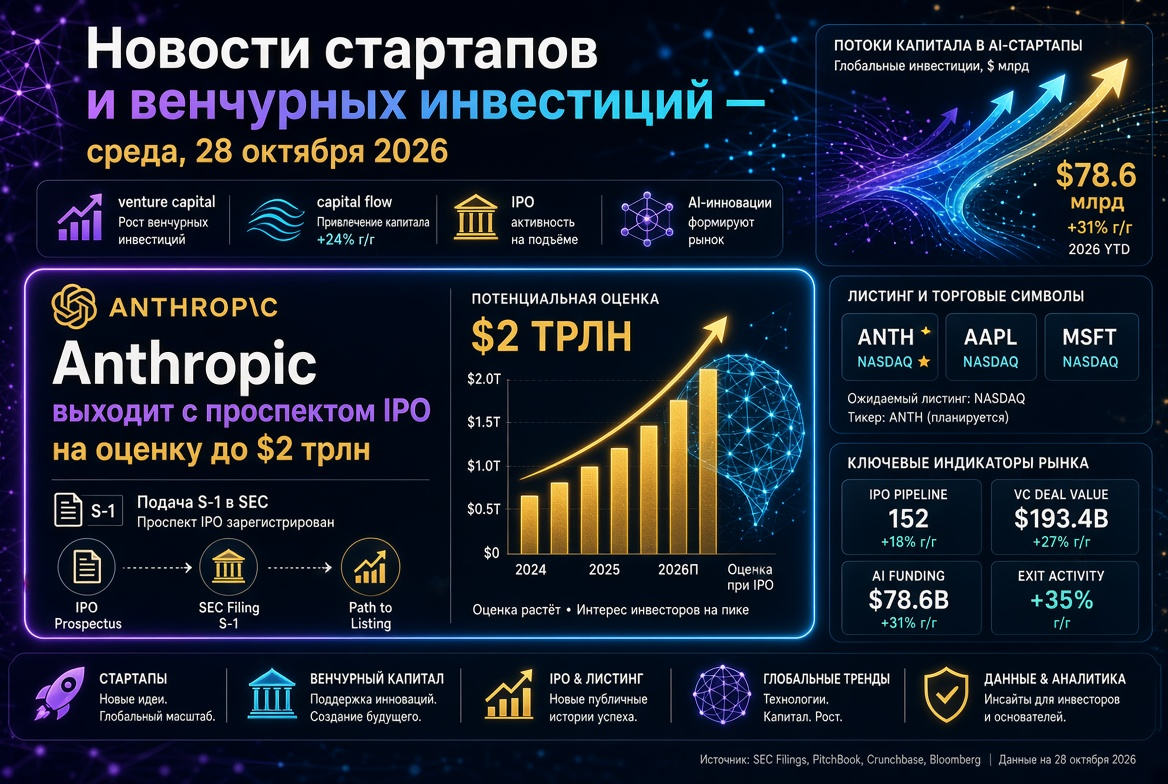
Major AI companies continue to shape investor expectations regarding the future IPO market. The potential listings of OpenAI and Anthropic are increasing interest in pre-IPO deals, secondary sales of shares, and funds that have access to late stages. For global venture investors, this could represent the largest cycle of AI asset exits to public markets.
However, the high valuation of AI companies simultaneously creates a risk of overvaluation. Investors must analyze not only revenue growth rates but also the cost of computations, margins, dependence on chip suppliers, regulatory risks, and the sustainability of demand from corporate clients.
What This Means for Venture Funds and Investors
Startup and venture investment news for June 23, 2026, indicates that the market is not in a phase of uniform recovery. It is becoming more concentrated. Money is flowing into a limited number of directions where there is scale, strategic significance, and a technological barrier.
Key takeaways for venture funds include:
- AI remains the main magnet for capital, but investors are increasingly selecting infrastructural and applied models.
- Robotics and physical AI are transitioning from an experimental phase to large-scale funding rounds.
- Defense tech is establishing itself as a full-fledged institutional segment of the venture market.
- The IPO window opens selectively: the public market is ready to accept companies but demands quality economics.
- The seed stage remains active, particularly in Europe, but competition for capital is intensifying.
Forecast: Which Startups Will Attract Capital in the Second Half of 2026
In the second half of 2026, venture investments are likely to concentrate on companies addressing infrastructure challenges for AI, industry, defense, and automation. The most promising areas appear to be AI infrastructure, chip equipment, robotics, cybersecurity, defense tech, energy tech, and enterprise AI with proven economics.
For startups, the main takeaway is simple: merely positioning within artificial intelligence is no longer sufficient. Funds will seek businesses with strong teams, a clear market, real revenue, defensible technology, and a clear exit trajectory. For investors, the primary risk lies in overpaying for a trendy category without adequate validation of demand and margins.
The global venture market in 2026 remains active but increasingly stringent. Capital is available, but it is becoming more discerning. The winners will be startups that combine technological ambition with industrial applicability, financial discipline, and strategic significance for large clients.