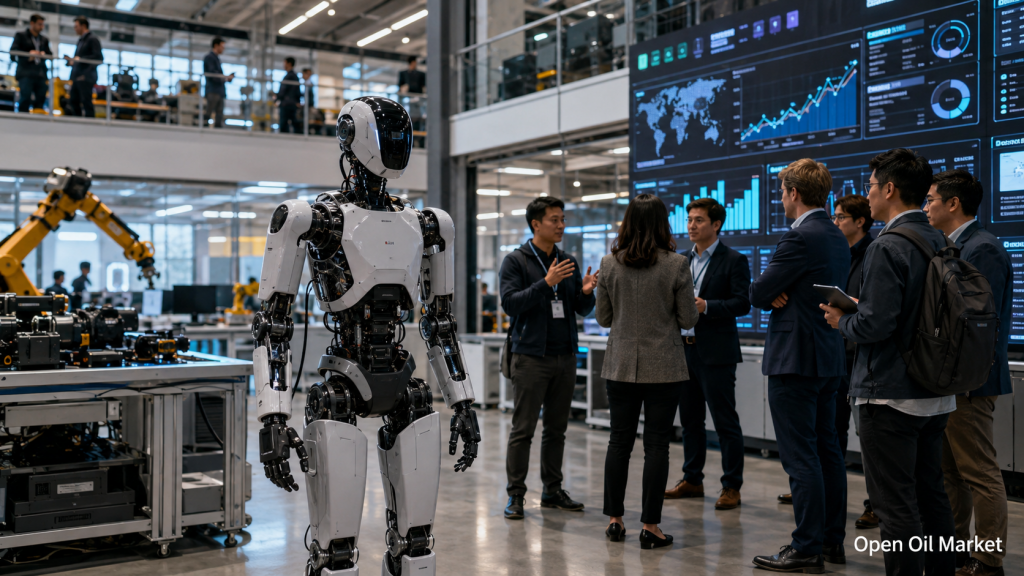
Startup and Venture Capital News for Monday, June 15, 2026: Major Rounds in Physical AI, Robotics, Defense Tech, Space Analytics, and Financial Market Infrastructure
The venture market enters a new week with a noticeable shift in investment focus: capital is increasingly moving away from traditional software toward Physical AI, robotics, space analytics, defense technologies, and infrastructure for regulated financial markets. For venture investors and funds, this is an important signal: in 2026, it is not merely AI startups that will win, but rather companies capable of transforming AI into physical productivity, industrial automation, safety, infrastructure data, and new operational standards.
The day's main theme is the sharp rise in mega-rounds within sectors where artificial intelligence is linked to the real economy. Startups are no longer evaluated solely by user numbers or revenue growth rates. The emphasis has shifted to control over the technology stack, access to data, production capabilities, defense contracts, hardware infrastructure, and the ability to scale globally.
Physical AI Becomes a Central Theme in the Venture Market
The largest news in recent days has been the substantial funding of Prometheus, a startup in the industrial artificial intelligence space. The company raised $12 billion at a valuation of approximately $41 billion and asserts its ambition to create an "artificial engineer" for designing complex physical systems, from aircraft engines to medical devices and industrial components.
For the venture capital market, this is not merely another significant AI round. It confirms a new investment thesis: the next wave of artificial intelligence will not be limited to chatbots, corporate assistants, and content generation, but will focus on engineering automation, manufacturing, and design. Funds are increasingly seeking startups that can reduce development cycles, lower R&D costs, and create defensible technological advantages in the physical economy.
Neura Robotics Enhances European Position in Humanoid Robotics Market
The European market has also received a strong signal: German-based Neura Robotics has raised up to $1.4 billion for the development of cognitive robots and a Physical AI platform. Among the investors are major technology and industrial players, including component manufacturers, semiconductor companies, and strategic partners from the industrial sector.
This round holds particular significance for Europe. The region is striving to close the technological gap with the U.S. and China in robotics, autonomous systems, and industrial AI. Neura is betting on robots that can see, hear, feel, learn, and work alongside humans. For venture funds, this indicates a growing interest in companies where software, sensors, mechatronics, manufacturing chains, and training data are integrated into a cohesive platform.
Defense Technologies and Counter-Drone Solutions Emerge as a Distinct Asset Class
The defense tech segment continues to strengthen as a distinct area of venture capital. French company Alta Ares, which is developing drone interception solutions using AI-based software, recently raised €50 million and subsequently announced a partnership with Airbus Defence and Space for the development and integration of European counter-drone systems.
This trend reflects structural demand from governments and defense contractors. Drones have become one of the key factors in modern security, and Europe is accelerating the establishment of its own technological base in air defense, airspace management, and critical infrastructure protection. For investors, this represents a market with long sales cycles, high regulatory complexity, but potentially steady demand and strategic barriers to entry.
Space Startups Transition from Observation to Sovereign Intelligence
Finnish company ICEYE has raised €450 million, or about $520 million, in a Series F round at a valuation exceeding €10 billion. The company is developing satellite analytics based on synthetic aperture radar, allowing for imaging regardless of cloud cover or time of day.
For the venture market, this is an important example of how space tech is evolving from a niche area into an infrastructure market for defense, insurance, logistics, climate, asset monitoring, and government planning. Space data is becoming part of sovereign intelligence: countries and corporations want not just to purchase images but to obtain their own layer of analytics, control, and situational awareness.
AI Infrastructure for Corporate IT Remains Attractive to Late-Stage Funds
American company NinjaOne has raised over $400 million at a valuation of approximately $12.3 billion. The company operates in the unified IT operations segment: managing end devices, automation, backups, remote access, and corporate IT support.
The NinjaOne round demonstrates that investors are not abandoning software-as-a-service, but are becoming more selective. Preference is being given to platforms that assist companies in managing increasingly complex IT infrastructure in the era of artificial intelligence. In light of rising cyber risks, distributed teams, and business process automation, demand is shifting toward systems that serve as operational centers for corporate infrastructure.
Digital Asset Confirms Renewed Interest in Blockchain Infrastructure for the Institutional Market
Digital Asset has raised $355 million for the development of the Canton Network—an infrastructure for regulated financial markets. The round was led by a16z crypto, with participation from major banks, exchange, and investment institutions.
For venture investors, this is an important signal: interest in blockchain is shifting from speculative consumer products to infrastructure for capital markets. Regulated financial organizations are seeking ways to tokenize assets, expedite settlements, enhance transaction transparency, and integrate on-chain solutions without sacrificing control, compliance, and privacy. In this segment, it will be the companies that can work with banks, regulators, and institutional standards that will prevail, rather than the noisiest crypto projects.
Spanish Theker Demonstrates Demand for Applied Robotics in Manufacturing
Barcelona-based Theker has raised $85 million for developing AI-native generalist robots for manufacturing environments. The involvement of investors connected with technology, industry, and consumer brands highlights the growing demand for robotics that can be implemented in real factories, warehouses, and logistics processes without years of customization.
This is especially significant for the market: investors are increasingly comparing robotics startups not just by the depth of their R&D but also by the speed of implementation, integration costs, ability to work with existing production lines, and the economics of a single robot. Companies that can demonstrate rapid ROI for clients will gain an advantage over more experimental projects.
India Strengthens Focus on Space AI and Local Earth Observation Models
Indian company SatSure Analytics has received a grant of approximately $2.57 million from the national space regulator to develop AI models for earth observation. The project focuses on analyzing satellite and drone data, including agriculture, monsoon cycles, urban development, infrastructure, and financial applications.
This case is important not for the size of the funding but for its direction. India is building its own AI and space tech competencies, reducing dependence on external platforms and global models that do not always accurately reflect local natural, climatic, and infrastructural conditions. For funds, this represents an example of the growth of regional tech ecosystems where government programs act as a catalyst for private capital.
What Matters to Venture Investors and Funds
A key feature of the current venture cycle is capital concentration. Global data for Q1 2026 shows a record volume of venture investments, a significant portion of which was directed to artificial intelligence and the largest late-stage deals. However, this does not mean a uniform recovery across the entire startup market.
- First takeaway: mega-rounds are becoming the norm for companies vying for control over the new technology stack.
- Second takeaway: Physical AI, robotics, defense tech, and space tech are receiving a premium for their strategic and infrastructural nature.
- Third takeaway: funds will be stricter in evaluating not just revenue growth but also client quality, availability of contracts, production capabilities, and data protection.
- Fourth takeaway: early-stage startups are finding it harder to compete for investor attention without proven practical value and clear unit economics.
For venture funds, Monday, June 15, 2026, opens a week in which the central question is no longer “Does the startup have AI?” but rather “What physical, financial, or infrastructural problem does this AI truly solve?” This is the direction in which the new map of global venture capital is being formed today.