Key Events in the Venture Market as of August 13, 2026
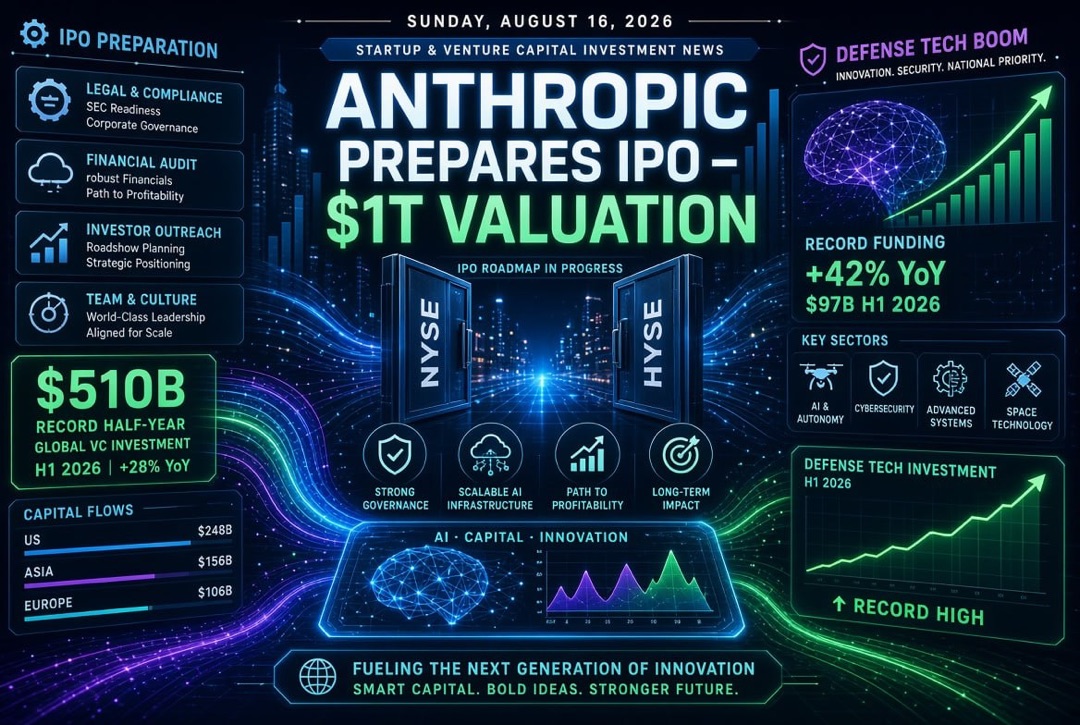
- Race to the Nasdaq. Anthropic is preparing for an IPO on Nasdaq aimed for fall 2026; OpenAI, which filed a week later, is shifting its listing closer to 2027.
- Record Capital Concentration. American venture funds have deployed over $412 billion since the beginning of the year—a historical high, with the lion's share going to a select few AI leaders.
- Energy for AI. Billion-dollar rounds for Base Power and Valar Atomics confirm that investors are financing not just models but the electricity powering them.
- Defense Tech Doubles Down. In the first half of the year, the sector attracted $12.3 billion—almost double the total for last year.
- Exit from China. American funds continue to scale back their venture operations in China following Sequoia and GGV.
Countdown to Anthropic’s IPO: Market Awaits Trillion-Dollar Debut
The central intrigue of the week is Anthropic's preparation for its IPO. The company, which closed its Series H round in spring at a valuation of $965 billion and confidentially filed Form S-1 on June 1, is reportedly holding meetings with institutional investors to bolster confidence ahead of its impending listing. The offering could occur in September or early October, with the largest Wall Street investment banks serving as underwriters. The company's annual revenue, as per disclosed data, exceeded $47 billion back in May, and independent trackers estimate the current figure to be significantly higher.
OpenAI, which submitted its own filing on June 8, is instead leaning towards postponing its listing to 2027: the management is targeting a valuation of no less than $1 trillion and is closely monitoring market volatility. A sobering precedent remains the June IPO of SpaceX—the largest in history, which was followed by a painful correction after its first public report. The outcome of this race is critical for the venture industry: successful offerings from AI giants would open a window for unprecedented exits and restore liquidity to limited partners in funds.
Record Volumes—and Record Capital Concentration
Venture investments in the U.S. are reaching an all-time high in 2026: funds have deployed over $412 billion since the start of the year. However, the structure of these investments is unprecedentedly skewed. The primary flow of capital is absorbed by AI giants—a notable example being OpenAI's $122 billion round, the largest private deal in venture market history. Investors are essentially beginning to treat frontier AI infrastructure as a sovereign-class asset rather than conventional venture investments.
For the rest of the market, this indicates tightening selection criteria. Money continues to flow, but funds are favoring startups with deep technological expertise, validated demand, and protected competitive advantages: proprietary data, specialized infrastructure, and distribution channels. The gap between a "funded company" and "just an interesting idea" continues to widen—ubiquitous AI products without technological moats are copied too quickly.
Energy for AI: Billion-Dollar Bets on Electrons
Another powerful trend in August is the flow of venture capital into the energy infrastructure catering to the data center boom. Key recent deals include:
- Base Power—an Austin-based home energy storage developer closed its Series D round at $1 billion with a valuation of $13 billion, featuring participation from Ribbit Capital, Valor Equity, and JPMorgan’s venture division; this is one of the largest climate deals of the year.
- Valar Atomics—a startup focused on small nuclear reactors raised $1 billion in a Series B round led by Sequoia Capital, complemented by a $200 million credit line from a banking syndicate.
- Joulent—a Houston-based energy company secured $1.75 billion in strategic financing earlier.
The rationale for investors is clear: record energy consumption in the U.S. and explosive demand from AI workloads are turning generation, storage, and distribution of electricity into a bottleneck for the entire tech economy—and a source of venture returns.
Defense Technologies: Sector Doubles Capital Raised
Venture funds invested $12.3 billion in defense startups in just the first half of 2026—almost double the total for all of last year. Capital is being directed towards autonomous systems, drones, and combat AI. Among recent deals, British Cambridge Aerospace raised $300 million in a Series C round for developing anti-drone systems, led by DFJ Growth, with participation from Lux Capital and Accel. Drone manufacturer Neros and air taxi developer Vertical Aerospace also joined the ranks of major funding recipients. For funds, defense tech has definitively ceased to be a niche topic and has transformed into a standalone investment strategy.
AI Infrastructure and Cybersecurity: The "Shovels and Picks" of the New Economy
Investments in the AI infrastructure layer are not slowing down. The inference platform Baseten closed its Series F round at $1.5 billion, with a valuation of $13 billion, showcasing a twentyfold annual growth spurred by multimodal strategies from enterprise clients. The open platform Ollama raised $65 million from Theory Ventures and Benchmark.
Simultaneously, a new wave of cybersecurity deals is forming in the AI era: Sequoia Capital led a $60 million seed round in Corma, which trains protective models against AI attacks, while Zenity, specializing in safeguarding AI agents, secured $125 million in a Series C round. Investors are banking on the premise that the proliferation of autonomous agents will create a multi-billion dollar market for their control and protection.
Fintech and Consumer Segment: Selective Return of Appetite
Beyond AI, capital is flowing selectively, but the volumes are impressive. The live-stream marketplace Whatnot closed its Series G round at $545 million, with a valuation of $20 billion—almost double last year's—signaling a resurgence of interest in consumer commerce. In fintech, the inKind platform secured funding of $414 million from Citi and Cross River Bank, while the tech bank Erebor is reportedly negotiating to raise around $1.5 billion—venture investors are clearly betting on a restructuring of banking infrastructure for the tech sector. European fintech saw a Series A round from Swedish Quartr at €15.6 million, while biotech made headlines with a $152 million deal from Swiss Vaderis Therapeutics.
China: American Funds Continue to Exit
The geopolitical fragmentation of the venture market is deepening. American financial group SIG is gradually closing its Chinese venture branch, which has operated for more than twenty years—following Sequoia Capital and GGV Capital, which have previously divided or scaled back their business in China. The head of the Chinese team is reportedly preparing to launch an independent fund with a volume of at least $100 million. For global investors, this means the final establishment of two parallel venture ecosystems with minimal capital overlap.
Russia and CIS: Market Matures Amid Expensive Money
The Russian venture market is undergoing a profound transformation. High key rates have made deposits a serious competitor to long-term risk investments, deal volume has significantly decreased, and investors have definitively stopped funding "promising ideas" without revenue and validated unit economics. At the same time, the market is consolidating and maturing: regional programs for developing the angel investing community are transitioning to a year-round format, and specialized funds are preparing to publish data for the first half of the year, which should reflect a shift in the model—from betting on ideas to financing mature tech companies with proven revenue.
What This Means for Investors: Fall Forecast
The venture market is entering a decisive period of the year. Key benchmarks for funds and institutional investors include:
- September–October—likely window for Anthropic’s IPO; the success of the offering will set a benchmark for valuations across the entire AI segment and determine the pace of subsequent listings.
- Concentration vs. Diversification—record volumes of capital amid extreme concentration require managers to take a clear position: either access to a narrow circle of leaders or disciplined selection in undervalued segments.
- Infrastructure Bets—energy, computing, and AI security remain the most capital-rich areas with a growing supply-demand gap.
- Risk Management—the experience of SpaceX's post-IPO correction serves as a reminder: the public market will demand real financial metrics from AI companies, not just growth rates.
The conclusion on Thursday, August 13, 2026: the venture industry is at a peak of capital and on the brink of the largest exits in its history. Fall will reveal whether public markets will validate the trillion-dollar valuations of private AI leaders—and this answer will define the trajectory of venture investments for years to come.