Key Topics of the Day: What Shapes the Energy Sector Agenda on August 12, 2026
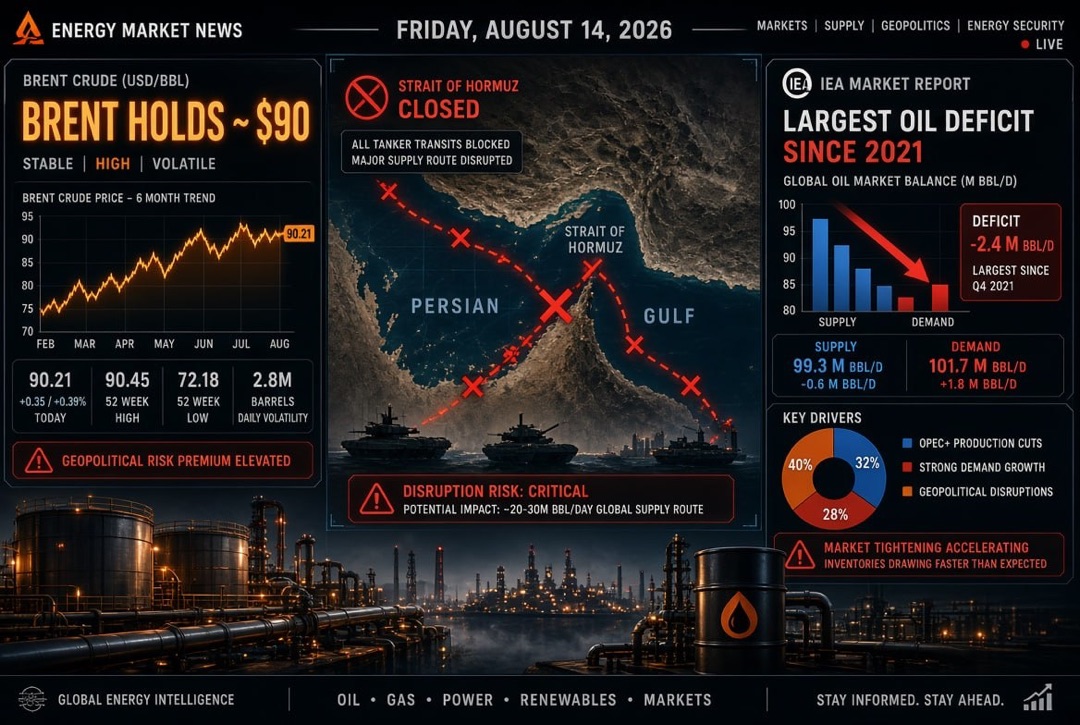
- Oil: Brent has risen above $90 per barrel for the first time since July 31; WTI traded around $84. The driver is the risk of a prolonged crisis in the Strait of Hormuz.
- Geopolitics: Washington has presented new demands to Tehran, including compensation for years of damage, complicating the normalization of shipping in the Persian Gulf.
- Gas: European storage facilities are nearly 17 percentage points below the five-year average; injection rates are among the worst since 2011.
- OPEC+: The alliance has raised quotas for August and September by 188,000 barrels per day and is preparing to pause production increases.
- Russia: The export embargo on gasoline has been extended until January 31, 2027, amid ongoing tensions in the domestic fuel market.
- Macro: Markets are awaiting the release of inflation data in the U.S. — the CPI report has the potential to set the direction for all raw material assets for the rest of the week.
Oil Market: Brent Above $90 — Risk Premium Returns
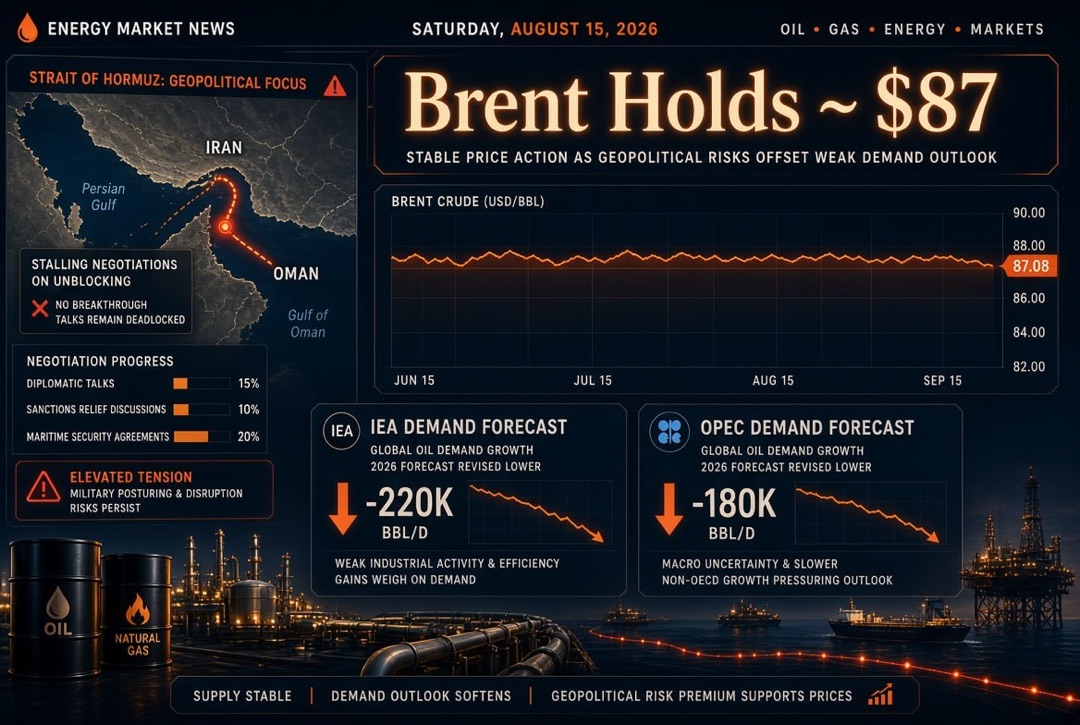
Oil prices closed Tuesday with a sharp increase of over 2.5%: October futures for Brent rose to $90 per barrel, while September WTI contracts reached $84.4. The formal trigger was the hard rhetoric from the White House: the U.S. president stated that Iran must compensate for damages incurred over decades of confrontation and emphasized that U.S. forces control the Strait of Hormuz and have carried out its demining. The market perceived these statements as signals that a swift agreement for restoring free shipping would not materialize.
Volatility remains extreme: just at the end of last week, Brent fell to $83 on hopes for progress in negotiations, only to increase by about $7 over two trading sessions. Traders are pricing in a significant geopolitical premium, as approximately 15% of the world's oil passes through the Strait of Hormuz. Adding to the market picture, Saudi oil imports to the U.S. dropped to zero for the first time since 1985, as the Middle Eastern crisis drastically reshuffles global commodity flows. Meanwhile, oil and gas majors are reporting tens of billions of dollars in additional profits for the first half of the year.
The Strait of Hormuz: Negotiations Around the World’s Key Oil Corridor
The key story for the commodity market in 2026 is the fate of the Strait of Hormuz. Following the effective blockade of the corridor, Tehran has shown a willingness to discuss the resumption of transit but on its own terms:
- Iran seeks a fee of 5-7% of the value of the cargoes from vessels using the strait;
- Oman, which is positioning itself as a mediator, is discussing a compromise rate of around 3%;
- A bill to ban the passage of American and Israeli vessels is under consideration in the Iranian parliament;
- The proposed agreement between Iran and Oman on joint control over the strait essentially gives Tehran leverage over all vessels entering the Persian Gulf.
Despite the blockade, Iran is ramping up its oil exports through a "shadow" fleet and complex payment schemes. Analysts warn that the longer the uncertainty persists, the higher the risk that fluctuations in oil prices will amplify the financial and macroeconomic vulnerability of the global economy.
OPEC+ Without the UAE: The Final Step of Quota Increases and a Pause Ahead
The oil alliance continues its strategy of cautious supply increases. Seven OPEC+ countries — Saudi Arabia, Russia, Iraq, Kuwait, Algeria, Kazakhstan, and Oman — have raised quotas for August by 188,000 barrels per day and agreed to a similar step for September, which will mark the final phase of lifting voluntary restrictions amounting to 1.65 million barrels per day. From February to August, the total quota has increased by approximately 940,000 barrels per day. Going forward, the alliance intends to take a pause: complex negotiations about quota distribution for 2027 lie ahead, while cuts of around 2 million barrels per day from 2022 remain in place.
Internal contradictions are growing: as of May 1, 2026, the United Arab Emirates left OPEC and OPEC+, and Iraq has publicly entertained a similar step, demanding an increase in its individual production limit. In the context of the August quota, Russia may increase production to 9.887 million barrels per day. For investors, a key question is whether the alliance can maintain discipline and unity in the face of high prices and centrifugal forces.
Gas Market: Europe Enters Winter with the Lowest Stocks in Years
The European gas market is the primary concern for energy professionals ahead of the autumn-winter season. EU gas storage is only about 59% full — nearly 17 percentage points below the five-year average. Injection rates in July were among the lowest since 2011, affected by lost competition with Asia for available LNG volumes during the Middle Eastern conflict, high fuel prices, and anomalous heat that increased electricity consumption for cooling. LNG imports are expected to be around 6.3 million tons in August — a 16% decrease from last year.
Prices at the TTF hub remain in the range of €41–44/MWh (over $500 per thousand cubic meters), and prices rose by about 55% in July. To meet the European Commission’s requirement of 90% storage fullness by the start of winter, the region needs to inject at least 68 billion cubic meters net, and achieving this goal is in question. A cold winter under the current balance could trigger a new round of price rallies in the global gas market.
Electric Power and Renewables: Record “Green” Share Does Not Shield from High Electricity Costs
The paradox of Europe's energy transition is vividly demonstrated by Germany: the share of renewable energy in generation has reached 71% compared to 65% in 2024, yet the average daily electricity price in August surged to €114/MWh — about 40% higher than last summer. The reasons include heatwaves, reduced output from French nuclear plants, and expensive gas that fills peak demand. An energy system that lacks sufficient storage is increasingly struggling to balance record capacities from solar and wind.
The global trend remains unchanged: according to the International Energy Agency, by 2026 renewables will surpass coal in global electricity generation. In the first half of the year, renewables accounted for 45.5% of generation in the EU, while China continues to install record capacities of solar and wind, developing energy storage systems and a market for “green” certificates.
Coal: Expensive Gas Extends the Life of Traditional Generation
High gas prices are once again enhancing the competitiveness of coal. The IEA expects that CO₂ emissions from electricity generation will increase by about 1% in 2026 due to increased coal generation, with emissions only stabilizing from 2027 onward as renewables and nuclear power expand. Demand for thermal coal remains robust in Asia: China and India rely on coal-fired power plants as a backup during peak consumption periods, while exporters such as Indonesia, Australia, Russia, and South Africa maintain stable supply volumes.
Russian Fuel Market: Export Embargo Until 2027
The domestic oil products market in Russia remains under manual control. The government has extended the total ban on gasoline exports until January 31, 2027, applying it to all producers; additional restrictions on diesel fuel exports were tightened in July. These measures are aimed at saturating the domestic market after months of fuel tension; however, wholesale and retail prices continue to rise. The baseline scenario anticipates stabilization and price growth within inflation, while the negative scenario suggests the persistence of a local deficit and an increase in A-95 prices to 65–67 rubles per liter. Non-standard solutions are being discussed, including the refining of Russian oil at Kazakh refineries with partial return of fuel to the Russian market. Experts do not expect significant price decreases before the fourth quarter — assuming uninterrupted operations at large refineries.
What This Means for Investors: Scenarios and Guidelines
The environment promises to be eventful: markets are awaiting consumer inflation data in the U.S., which will influence expectations for the Fed's rate and, consequently, the entire commodity complex. For energy sector participants, key benchmarks for the upcoming weeks appear as follows:
- Oil: the range of $83–95 for Brent per barrel remains intact, and any news regarding the Strait of Hormuz could shift prices by several dollars per session;
- Gas: Europe’s lag in storage makes winter TTF futures vulnerable to weather and geopolitical shocks;
- OPEC+: The pause in quota increases and negotiations regarding limits for 2027 will support prices in the second half of the year;
- Electricity: A shortage of flexible generation in Europe keeps spot prices high and maintains interest in investments in storage;
- Risks: Escalation in the Middle East, disruptions in U.S.-Iran negotiations, and a cold winter in Europe are the main catalysts for a new price rally.
The energy market in August 2026 is living in a new reality: geopolitics has once again become the main pricing factor, and the buffer of the global energy system has noticeably shrunk. In this context, the risk premium in the prices of oil, gas, and electricity is likely to persist for an extended period.