Venture Market in Mid-October 2026: Record Capital Volumes, High Concentration in AI, Largest Rounds of the Week, IPO Preparations, and Signals for Funds and Investors
Venture investments in 2026 are on track for a historic record, but the market is becoming increasingly uneven. Capital is concentrating in a small group of companies associated with artificial intelligence. The past week confirmed this trend: the largest rounds were secured by cloud AI infrastructure, fintech with AI products, and developers of AI agents. At the same time, the market is discussing the quality of revenues for AI startups and the sustainability of infrastructure built on debt financing. Below are the key events for venture investors and funds.
Macro Picture: Record Year Amid Declining Quarterly Dynamics
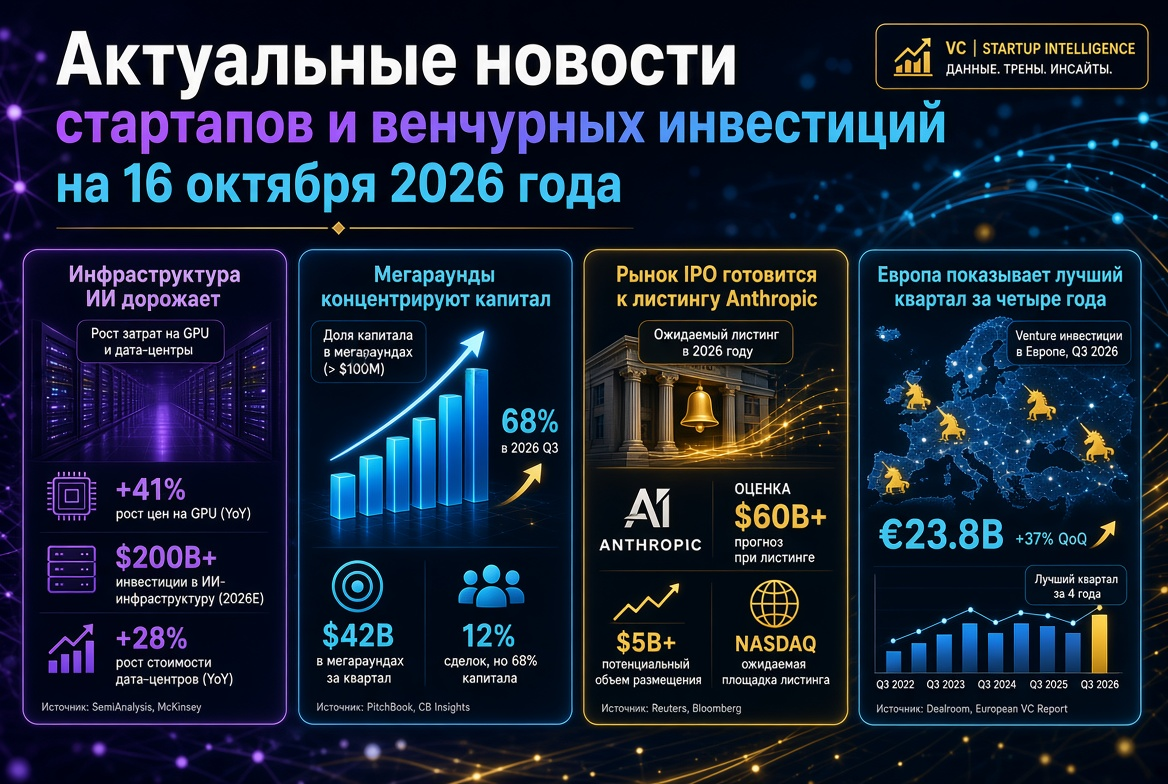
According to Crunchbase, global venture investments in Q3 2026 reached $159 billion. Approximately 6,000 startups received funding. Quarterly volume decreased by 25% compared to Q2 ($212 billion), but increased by 53% year-on-year. Over nine months, startups attracted $679 billion, the highest for the comparable period in history.
- AI Share: $102 billion, or 64% of global venture capital for the quarter.
- Mega Rounds: 27 companies secured rounds of $1 billion or more. This is an absolute record: there were 16 such companies in Q2 and 14 in Q1.
- Geography: US startups accounted for $91 billion (57%), while the San Francisco Bay Area accounted for 24% of the global volume.
- Stages: later rounds totaled $105 billion (+73% year-on-year), while early rounds reached $40.6 billion (+25%).
US statistics from PitchBook and NVCA show the same trend. From January to September, the volume of venture deals in the US reached $515.8 billion, of which 82.7% was allocated to AI companies. Approximately 90% of the funds went to rounds of $50 million or more. For startups outside AI, the market's record has hardly expanded access to financing.
Main Theme of the Week: AI Infrastructure Attracts Mega Rounds
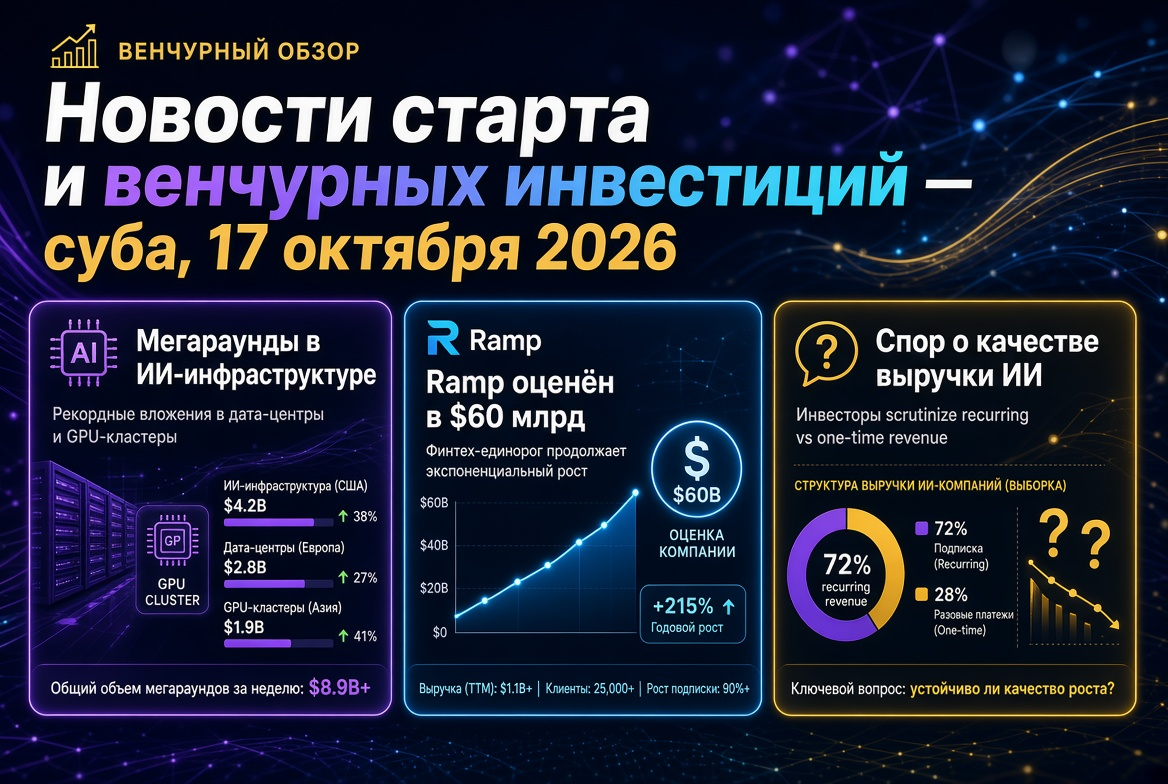
The most notable deal of the week was the $750 million Series D round for the California cloud platform Modal, with a post-money valuation of $15.75 billion. The round was led by Accel, with Kleiner Perkins participating, along with Menlo Ventures, General Catalyst, Redpoint, Lux Capital, and others. The company reported that its annual revenue growth rate exceeded $1 billion, and platform usage has tripled since May.
Investors are funding not only computing but also related segments of AI infrastructure:
- Salience Labs (Oxford) secured $125 million in a Series B round led by Bullhound Capital, with participation from AMD Ventures and Intel Capital. The company develops optical switches for GPU clusters.
- Skeleton Technologies (Estonia) received strategic investments led by Siemens, reportedly over $100 million. The company became a "unicorn" and is building a supercapacitor manufacturing facility in the US for data centers.
- Labelbox announced Series E funding of over $100 million, including a credit line. The funds will be used for reinforcement learning frameworks and corporate AI agents.
- Tamr raised $21 million in growth investments from Volition Capital for managing corporate data for AI systems.
The public market is sending a warning signal. On October 14, shares of AI cloud firm CoreWeave dropped sharply amid concerns about borrowing costs and the sustainability of infrastructure being expanded through debt. For venture funds, this serves as an argument to differentiate between companies with confirmed demand and projects whose returns depend on future capacity utilization.
Fintech: Ramp’s Valuation Increased by $16 Billion in Four Months
According to Bloomberg, the fintech platform Ramp raised approximately $1.85 billion at a pre-investment valuation of about $60 billion. The round was led by Dragoneer and Thrive Capital, with a significant check from Founders Fund. In June, the company secured $750 million at a valuation of $44 billion. Ramp serves over 70,000 businesses, and its annual revenue reportedly exceeded $1.5 billion last summer. The company did not comment on the round.
The deal underscores the consolidation within the corporate spend management segment. Ramp's closest competitor, Brex, was acquired by Capital One this year. Ramp is enhancing the AI component of its products, which directly supports its valuation.
AI Agents and Geopolitics: Manus Secures Over $500 Million
Butterfly Effect, the parent company of AI agent developer Manus, closed a round of over $500 million. Co-investors included Boyu Capital and IDG Capital, with participation from Tencent, HSG, and ZhenFund. This is the first funding round since Beijing forced Meta to abandon its $2 billion acquisition of Manus. The valuation has not been disclosed, although prior negotiations suggested a figure of around $4 billion.
The Manus case illustrates that regulatory risk in cross-border AI deals has become a distinct line item in due diligence. Investors need to consider not only the technology but also jurisdiction, capital structure, and the possibility of exit through strategic sale.
Deep Tech, Biotech, and Defense: Capital for Long Cycles
Besides AI, venture funds continue to finance capital-intensive technologies with long payback periods:
- OMass Therapeutics (Oxford) raised $310 million in an oversubscribed Series C round. The round was led by Bain Capital Life Sciences, Forbion, and Novo Holdings. The funds will be used for clinical research on endocrinology and immunology drugs.
- Oratomic closed a Series B round of $475 million for the development of fault-tolerant quantum computers.
- Sabi received $50 million in seed funding led by Khosla Ventures. The company is developing a wearable "brain-AI" interface.
- Fortastra raised $30 million in a Series A round for maneuverable spacecraft to protect orbital infrastructure.
- Tessolve Semiconductor (India) secured $75 million from Vector Line Capital for international expansion through acquisitions.
Funds and LPs: OrbiMed Raised $3 Billion
The funding side also remains active. Healthcare-focused investor OrbiMed announced the closing of $3 billion across two funds. OrbiMed Private Investments X raised over $1.9 billion for venture deals in life sciences in the US and Europe. OrbiMed Asia Partners VI raised over $1 billion for growth and venture investments in Asia. In the US, according to PitchBook–NVCA, emerging managers have closed 81 first funds totaling $4.9 billion since the beginning of the year. LP attraction continues to favor large and proven teams.
IPO Window: DayOne Files, Anthropic Clarifies Timelines
The public offering market remains a primary channel for capital return for venture funds. This week:
- Singapore's AI data center operator DayOne Data Centers filed for an IPO on Nasdaq under the ticker DODC. Underwriters include Morgan Stanley, J.P. Morgan, BofA Securities, and Citigroup.
- According to media reports, Anthropic may commence its roadshow in the week of November 9, approximately a month later than its original plans. The expected valuation is $1.8–2 trillion. The company has not officially confirmed the timelines.
- The case of SpaceX, the largest IPO in history (June 2026, valuation of $1.77 trillion), serves as a reminder of volatility post-listing. Reports indicate that by the end of July, the company's shares lost about half of their peak value.
Russia and CIS: Market Contracts, Focus on Strategics
The Russian venture market is moving against global trends. According to a report from the Moscow Venture Fund, investors injected 4.6 billion rubles in the first half of 2026, nearly 48% less year-on-year. The capital deficit is exacerbated by a tight monetary policy. Investors are concentrating on robotics, IT, and artificial intelligence. The primary exit scenario is the sale of stakes to strategic investors rather than an IPO. The Moscow Venture Fund announced it will direct 250 million rubles to tech companies and anticipates around 1 billion rubles in co-investments.
Risks and Takeaways for Venture Investors
Social Capital founder Chamath Palihapitiya pointed out the issue of "revenue quality" in AI. He suggests that a significant portion of AI companies' revenues comes from other AI startups that themselves rely on venture funding. From this, several practical takeaways emerge for funds:
- Distinguish between run-rate and ARR. The annual revenue trajectory in infrastructure with consumption-based billing does not equal contractually recurring revenue.
- Analyze deal structure. The headline figure of a round may include credit lines and secondary sales of shares.
- Consider client concentration. Dependency on venture-funded AI companies creates a chain of mutual risks.
- Account for regulatory risk. The Manus case illustrates that exit through sale can be blocked at the state level.
- Diversify beyond AI. Biotech, quantum technologies, defense, and industrial deep tech provide alternative sources of returns.
In summary, the global startup and venture investment market remains generous but increasingly selective. Capital is flowing to companies that control the infrastructure, data, and customer relationships necessary for AI commercialization. For funds, key selection criteria in Q4 2026 will be revenue quality, valuation discipline, and realistic exit pathways.