Startup and venture capital news — Friday, 30 October 2026: Anthropic prospectus sets the tone for the market, a US$10b Disruptive megafund and Jio's record debut
Top startup and venture capital news for 30 October 2026: Anthropic's IPO with a valuation of up to US$2t, late-stage megafunds, the week's largest rounds, AI infrastructure, Europe, India and the Russian market
The venture market enters the end of October 2026 in a state that would have seemed impossible just two years ago: private technology companies are valued in the hundreds of billions and trillions of dollars, and the largest investors are raising funds the size of small nations' budgets. The publication of Anthropic's prospectus became the week's main event and is setting the agenda for venture investors, funds and LPs around the world. At the same time, late-stage megafunds, record rounds in artificial intelligence and successful IPOs in Asia confirm that the exit window is open and capital continues to concentrate among the leaders.
Key themes in Friday's edition:
- Anthropic IPO — the public S-1 prospectus and a valuation benchmark of US$1.5–2t;
- megafunds — Disruptive closed a US$10b fund for around ten late-stage companies;
- largest rounds — Ramp, Upwind, Flapping Airplanes, Foundry Robotics;
- India and Asia — Jio Platforms' debut with a premium of about 21%;
- Europe — average late-stage cheque sizes doubling and tax incentives in the United Kingdom;
- Russia — a contracting market and a reliance on state and city funds.
Anthropic IPO: the key test of investor appetite for AI
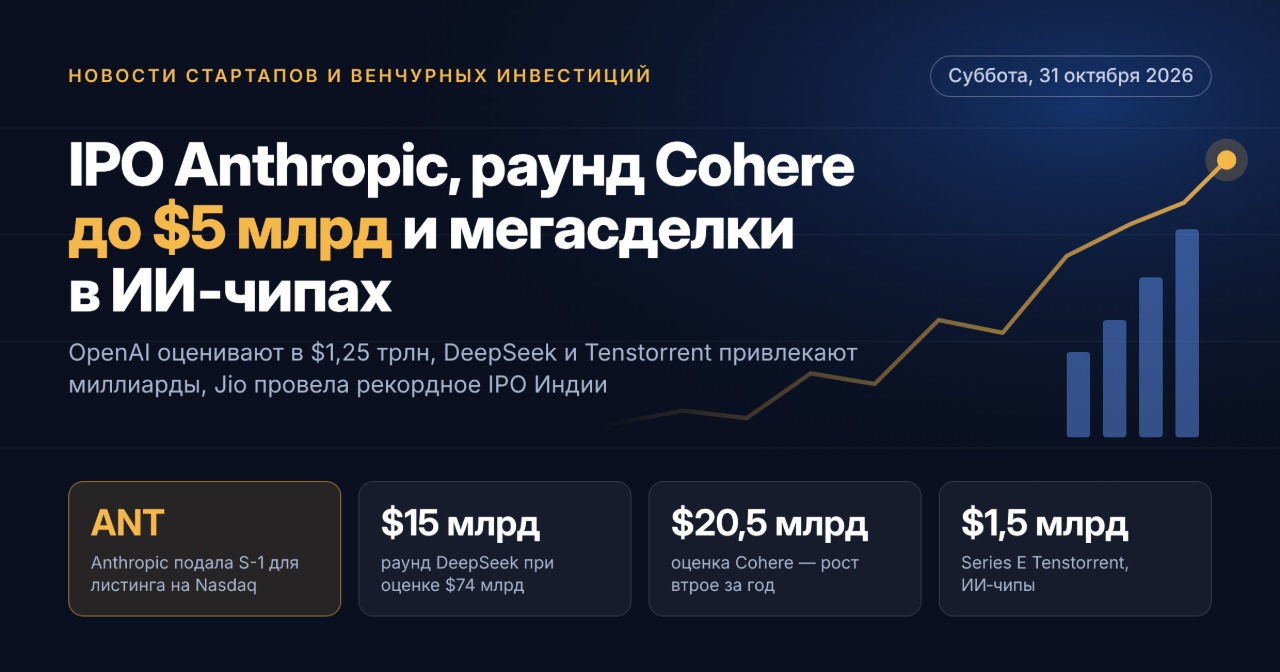
On 26 October, Anthropic, the developer of the Claude model family, published its registration statement on Form S-1. The company plans to list Class A shares on the Nasdaq Global Select Market under the ticker ANT. The price, offering size and first trading date are not yet specified in the document — they will appear in amendments to the prospectus during the roadshow.
Key figures from the prospectus
- Valuation: according to the business press, the range under discussion is US$1.5–2t, and the amount raised could exceed US$100b. The latest private valuation was US$965b post-money following a US$65b Series H round in May 2026.
- Revenue: approximately US$11.6b in the second quarter, which exceeds US$46b on an annualised basis. At a US$2t valuation, the multiple is around 43 times annual revenue.
- Loss: the net loss for the first half was US$80.7b, largely related to the accounting treatment of financing and infrastructure costs.
- Compute commitments: approximately US$498b, or 76% of capacity contracts, are non-cancellable.
- Underwriters: Goldman Sachs is the lead bookrunner, with JPMorgan, Citigroup, Barclays and Wells Fargo also in the syndicate.
Analyst views are sharply divided: optimists call the listing a catalyst for the entire technology sector, while sceptics see it as an unprecedented test of market discipline. For venture funds the takeaway is practical: a successful ANT listing will revalue the portfolios of all late-stage AI companies and set benchmarks for subsequent IPOs. It is also telling that, according to the Financial Times, exchange-traded products have already appeared on the market giving retail investors synthetic exposure to private Anthropic and OpenAI through perpetual futures.
Megafunds: Disruptive and the era of concentrated bets
Dallas-based investment firm Disruptive, known for bets on Groq, ElevenLabs and Reflection AI, announced the close of its Disruptive Flagship Fund at US$10b. It is the largest venture fund in Texas history and an event that reflects a structural shift in the industry.
- Strategy: around 10 late-stage companies with cheques of up to US$1b each.
- Focus: artificial intelligence, defence technology and enterprise software.
- Structure: the firm's first blind pool — previously Disruptive invested through SPVs for each deal.
- Scale: the fund roughly doubles the company's assets under management.
The logic is obvious: the best private technology companies are staying private longer and require ever more capital. Disruptive joins a narrow club of megafunds that already includes Andreessen Horowitz, which closed US$15b across six funds in January 2026. This week, Formation Bio (US$600m for clinical programmes), hardware investor Matter (US$450m in its second fund, oversubscribed) and European firm Begin Capital (US$100m in its second fund) also announced their funds.
October's largest rounds: AI, fintech and cybersecurity
October has become one of the year's most active months for startups: between 15 and 23 October alone, US companies raised more than US$6b across over 15 disclosed deals.
Deals shaping the agenda
- Ramp — US$1.85b at a US$60b valuation, with the round led by Dragoneer; the fintech company's annual revenue has exceeded US$2b.
- Tenstorrent — US$1.5b to develop open compute infrastructure for AI.
- Flapping Airplanes — US$1b in a Series A at a valuation of around US$6b, just nine months after its seed round; led by Index Ventures and Lux Capital.
- Upwind — US$400m in a Series C at a US$3.8b valuation led by Bessemer Venture Partners; the company's revenue grew fourfold in 2026.
- Foundry Robotics — US$100m in a Series A to build autonomous assembly plants.
- Fragment — US$56m from 8VC and General Catalyst for AI agents for procurement.
- Coherence Neuro — US$45m in seed funding from the OpenAI Startup Fund and Founders Fund for brain-computer interfaces.
AI infrastructure: picks and shovels remain the priority
Venture capital continues to actively fund the infrastructure layer for artificial intelligence — from chips and data centres to inference platforms. India's Simplismart raised US$14m in a Series B led by Dallas Venture Capital with participation from NVIDIA and Accel, while Mueon received US$65m for modular data-centre equipment with participation from Intel Capital. The scale of Anthropic's compute commitments clearly shows why investors regard this segment as defensively positioned for the long term: demand for compute is locked in by contracts decades ahead.
India and Asia: Jio Platforms' record debut
On 28 October, Jio Platforms, the digital arm of Reliance Industries, debuted on the NSE and BSE with a premium of about 21% to its offer price. The ₹30,213 crore IPO became the largest in India's history, and the order book was oversubscribed more than 22 times. For the region's startup ecosystem this is a strong signal: the domestic capital market is capable of absorbing world-scale listings. Venture activity in India remains high — Ace Blend raised US$9.9m with participation from 3one4 Capital, and Freshworks announced the acquisition of AI startup Robusta.
Europe: late stages grow, London incentivises founders
The European venture market is gaining depth. Over the first nine months of 2026, the average size of late-stage rounds more than doubled, and the number of unicorns in the region is growing. Key developments include:
- Lovable is offering employees a US$80m secondary share sale at a US$13.3b valuation — an example of how late-stage startups provide liquidity without an IPO;
- the UK Budget introduces a 10% capital gains tax rate for founders, expands employee option limits and simplifies the visa regime for talent.
Crypto startups: targeted but steady funding
Venture investment in the crypto industry remains moderate. Between 3 and 23 October, tracked companies announced 20 rounds with a disclosed total of US$307.8m. Capital is concentrating in infrastructure and stablecoin payments: Catalyst received US$30m in seed investment from Sequoia Capital, Navra raised US$19m in a Series A led by Ribbit Capital, and Tether has become an active strategic investor in payments projects.
Russia and the CIS: a contracting market and reliance on development institutions
The Russian venture market is moving against the global trend. According to the Moscow Venture Fund, investment volume fell 48% in the first half of 2026 to RUB 4.6b, while the number of deals dropped 45% to 54. The main constraining factor is the high key rate, which makes deposits a competitive alternative to risky investments. Development institutions are supporting the ecosystem:
- the Moscow Venture Fund will allocate RUB 250m to technology companies, attracting co-investment of up to RUB 1b;
- the Internet Initiatives Development Fund (FRII) has launched a RUB 300m fund for startups in information security;
- investment in Russian AI companies has grown to RUB 4.2b over the year.
What investors should watch on Friday and next week
- Amendments to Anthropic's S-1 — the appearance of a price range and offering size will determine sentiment in the AI asset market.
- Deployment of megafunds — Disruptive's first deals will show which companies investors regard as the future leaders.
- Jio Platforms' performance — the resilience of its share price after the debut will influence the IPO queue in Asia.
- The secondary market — tender offers for employees are becoming a standard liquidity tool.
The week's takeaway: the venture market is entering a phase where record valuations sit alongside rigorous selectivity. Capital is concentrating in a handful of leaders in artificial intelligence and infrastructure, and Anthropic's listing will test whether public investors are prepared to pay as much for growth as private ones. For venture funds this is a time for discipline: the exit window is open, but at current valuations the cost of a mistake has never been higher.