Oil market: Brent retreats from highs on expectations of talks
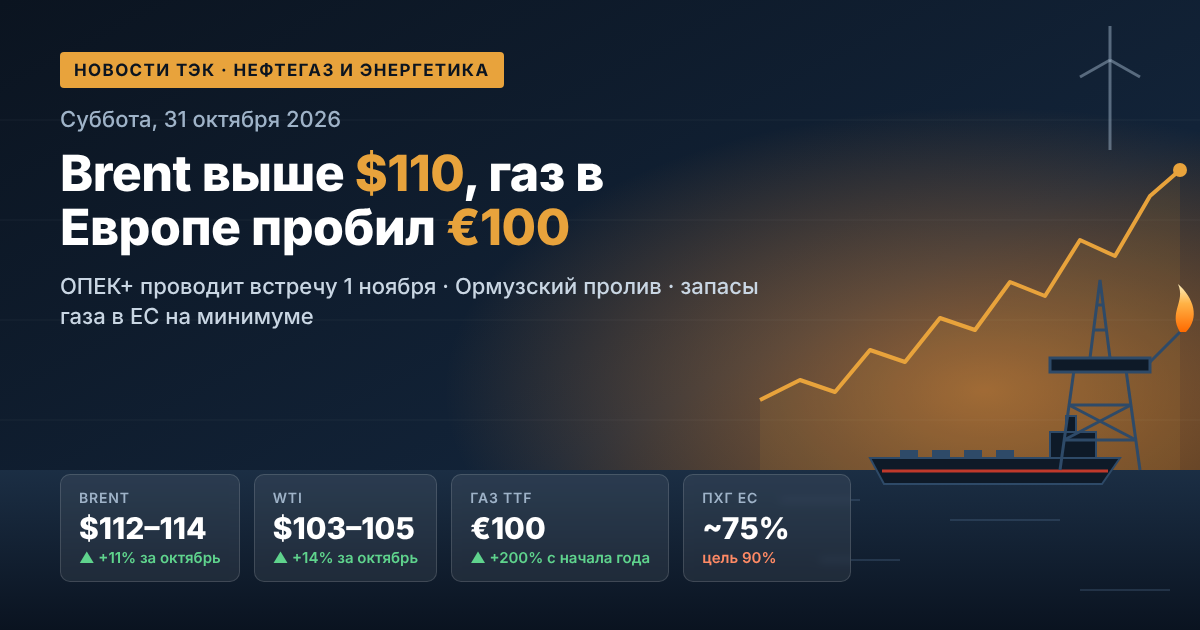
On Thursday oil prices fell by around 1%. North Sea Brent slipped to US$114 a barrel after closing Wednesday at around US$115.3. US WTI is trading around US$101. The trigger for the correction was reports that Washington is attempting to resume peace talks with Tehran. The Iranian side said it is open to diplomacy and ready to accelerate the seven-day peace plan under discussion.
Key oil market price benchmarks:
- Brent: around US$114/bbl, up almost 78% year on year;
- WTI: around US$101/bbl, the Brent–WTI spread has narrowed to approximately US$12.6;
- 52-week Brent range: from US$58.7 (December 2025) to US$120.9 (end-April 2026);
- Urals: around US$111–112/bbl after declining amid the broader correction.
The war premium nonetheless persists. The market is pricing in two threats: a possible US military operation against Iran after 3 November and intensified Houthi attacks on Saudi Arabia. That is why, even on positive diplomatic news, oil remains above US$110.
Middle East: attacks on refineries and the threat to supply
The security of infrastructure in the Persian Gulf remains the main source of volatility. On 27 October the Houthis claimed a missile strike on Ras Tanura — Saudi Arabia's largest refinery. Riyadh has not officially confirmed the attack, although a fire was contained in the vicinity of the terminal. On Thursday the Saudi-led coalition reported intercepting a ballistic missile launched towards the kingdom's eastern provinces.
For refined products market participants this means:
- continued risks to the export capacity of the largest supplier of crude;
- heightened volatility in refining margins in the Middle East and Asia;
- rising insurance and freight rates on tanker routes in the region.
OPEC+: quotas on paper and a de facto supply deficit
On Sunday, 1 November, seven key OPEC+ countries will hold their next online meeting. The participants are Saudi Arabia, Russia, Iraq, Kuwait, Kazakhstan, Algeria and Oman. For November the alliance has already kept production targets unchanged: 10.5 mln bbl/d for Saudi Arabia and 9.9 mln bbl/d for Russia.
The key problem is that the quotas exist largely on paper. In August these seven countries were producing around 25 mln bbl/d. That is roughly 5 mln bbl/d below the pre-war February level. Gulf exports are fluctuating within 60–80% of normal. Alliance sources indicate that serious changes to production policy are unlikely before 2027. The revision of production capacity, on which future quotas depend, has been postponed because of the war.
US inventories: strategic reserve at lowest since 1982
According to EIA data, US commercial crude inventories fell by 1.89 mln barrels in the week to 23 October, to 410.6 mln barrels. Even more telling is the situation with the Strategic Petroleum Reserve (SPR). Its inventories have dropped to approximately 283 mln barrels. That is the lowest since October 1982 and less than 40% of design capacity. The drawdown is linked to Washington's commitment to release 172 mln barrels to stabilise prices. The US's ability to cushion new shocks through reserves is becoming increasingly limited.
Gas and LNG: Europe enters winter with record-low inventories
The European gas market is experiencing its most strained period since 2022. On 28 October the front-month TTF futures contract rose intraday to €100.9/MWh. For comparison: in February, before the conflict began, gas cost around €30. EU underground storage facilities are approximately 75% full. That is the lowest reading for this time of year since 2009, whereas the five-year norm is around 89%. Brussels has already relaxed its UGS filling target from 90% to 80%.
Key gas market factors:
- Qatar: around 17% of Ras Laffan's export capacity has been out of action for years;
- Asia: spot LNG costs over US$30/MMBtu, and Europe is competing with Asian buyers for every cargo;
- US: Henry Hub remains around US$3/MMBtu — a gap with European prices of almost tenfold, which supports exports of US LNG.
Power generation and renewables: wind keeps prices in check
Despite expensive gas, wholesale electricity prices fell across most European markets in the week to 19 October. The main reason was high wind generation. In France and the Netherlands weekly prices dropped by 29%. On 23 October France set an all-time record for wind generation for an October day — 415 GWh. Renewable energy is proving its role as a price stabiliser. At the same time, analysts expect electricity prices to rise this week as wind weakens and heating demand grows. Gas-fired generation will again set the marginal price.
Coal: the gas shock brings demand back
Thermal coal is one of the main beneficiaries of the LNG market crisis. The Australian Newcastle benchmark is trading at around US$150 a tonne. That is roughly 40% above the level at the start of the year, and on 6 October the price reached US$152.2 — the highest since autumn 2024. Power companies in Asia and Europe are switching from expensive gas to coal, which supports exporters from Australia, Indonesia, South Africa and Russia.
Russian oil exports: expensive freight and competition in Asia
Seaborne exports of Russian oil averaged 3.55 mln bbl/d in the four weeks to 25 October — a five-week low. In the final week, by contrast, shipments rose to 3.85 mln bbl/d. Weekly export revenue is holding at around US$2.6–2.8 bln.
Main trends in the export structure:
- freight for Urals from western ports to India has reached a record ~US$30 a barrel;
- in September shipments to China rose to 1.68 mln bbl/d, while those to India fell to 1.8 mln bbl/d;
- Indian refineries are partly switching to crude from Iraq, Saudi Arabia and Brazil.
Refined products in Russia: export ban and market stabilisation
Russia's domestic fuel market is gradually emerging from crisis. A temporary ban on exports of petrol, diesel and marine fuel is in force from 1 August 2026 to 31 January 2027. For producers of diesel and marine fuel there is a separate deadline at the end of October. The market is awaiting a decision on the future export regime. After the attack on the Ryazan refinery on 15 October, no new confirmed strikes on Russian refineries have been recorded. The average retail fuel price by mid-October was around RUB 78.7 per litre. Imports of petrol from Belarus, India and Kazakhstan will continue at least until the end of the year.
Outlook and calendar: what investors should watch
In its updated forecast the World Bank expects energy prices to rise by around 32% in 2026 and fall by 12% in 2027. This is a scenario of gradual normalisation of supply. In the coming days the energy sector will be guided by the following events:
- 30 October — month-end close on commodity exchanges and US rig count data;
- 1 November — meeting of the seven OPEC+ countries on December production;
- 3 November — US midterm elections, after which the risk of military escalation around Iran increases;
- early November — gas withdrawal dynamics from European UGS facilities as the heating season begins.
The oil and gas markets remain in a mode of "headline" trading, where a single news item can move prices by several percent. For oil companies, refineries, traders and power generators this means high returns alongside significant risks. Hedging and liquidity management are becoming the main priorities until the end of the year.