Key Economic Events and Corporate Reports on Tuesday, March 3, 2026: Inflation in Turkey and the Eurozone, Brazil's GDP, API Oil Inventories, Central Bank Heads' Speeches, and Reports from Major Public Companies in the US and Europe
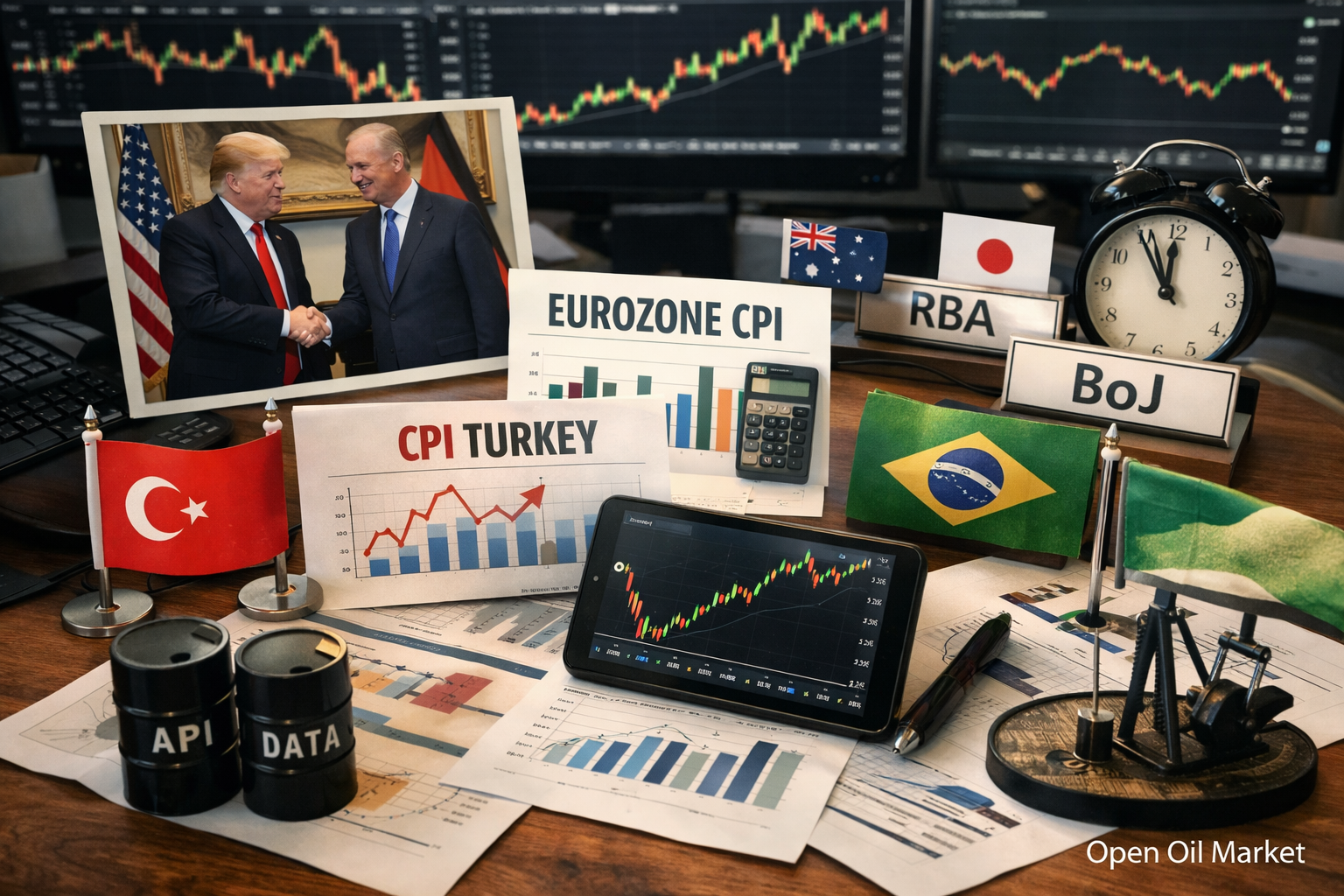
On Tuesday, global news will center on inflation (CPI) in Turkey and the preliminary CPI estimate for the Eurozone, as well as Brazil's GDP for the fourth quarter of 2025. Additional volatility may arise from the speeches of the heads of the central banks of Australia and Japan, while evening data on US oil inventories (API) will impact commodity markets. Simultaneously, investors will digest a stream of corporate earnings reports, focusing on major American retailers and technology companies, as well as selected European issuers.
Market Context for the Day: What Will Drive Prices
- Inflation Expectations: Turkey's CPI and the preliminary Eurozone CPI will set the tone for yield curves and EM/DM currencies.
- Risk Appetite: Comments from the central bank heads (Australia, Japan) could shift expectations regarding the trajectory of interest rates, influencing demand for risk.
- Geopolitics and Trade Rhetoric: Friedrich Merz's negotiations with Donald Trump in Washington may introduce uncertainty regarding the transatlantic agenda, sanctions, and trade conditions.
- Oil and Inflation: The API oil inventory data from the US will serve as an important indicator prior to the official statistics, affecting oil prices and inflation expectations.
Trading Environment and Liquidity: Key Exceptions
- India: Markets are closed (Holi holiday). This may reduce regional liquidity for Indian assets and certain EM instruments during the Asian session.
- Globally: Major US and European exchanges are operating as usual; attention in the Asian block will be on comments from the Bank of Japan.
Economic Calendar (Moscow Time)
- 00:10 — Australia: Speech by the Governor of the Reserve Bank of Australia (RBA).
- 00:30 — US: Oil, weekly inventories estimated by API.
- 07:00 — Japan: Speech by the Governor of the Bank of Japan (BoJ).
- 10:00 — Turkey: Consumer Inflation CPI (February).
- 13:00 — Eurozone: Consumer Inflation CPI (February, preliminary estimate).
- 15:00 — Brazil: GDP (Q4 2025).
Reading Key Macroeconomic Data: Practical Guidelines for Investors
Turkey (CPI) — A test of the resilience of the disinflation scenario. For markets, the following are important:
- The dynamics of core inflation and services (the inertial part),
- The response of the lira and local yields,
- Signals regarding potential tightness/looseness of monetary policy.
Eurozone (CPI, Preliminary) — A key for ECB rate expectations. Investors should monitor:
- The divergence between headline and core inflation,
- The services component (as an indicator of domestic demand),
- The response of the euro and interest rates, which directly affects Euro Stoxx 50 and corporate funding costs.
Brazil (GDP) — An indicator of the strength of the largest economy in Latin America. Strong/weak figures can significantly shift expectations for rates and risk appetite in EM.
Geopolitics and Politics: Merz and Trump's Negotiations
The meeting between Friedrich Merz and Donald Trump in Washington is an event that the market will interpret through the lens of trade conditions, sanctions rhetoric, and future contours of interaction between the US and Europe. For investors from the CIS, the practical significance lies in assessing the potential for sharp headlines that could affect:
- Safe-haven currencies and the US dollar,
- The price of oil and industrial metals,
- European cyclical sectors and the overall equity risk premium.
Commodity Markets: Oil, API Inventories, and Sensitivity to Inflation
On Tuesday, the oil market will balance expectations for demand and inventory statistics. API oil inventory data from the US (00:30 Moscow time) often sets the short-term momentum:
- Increase in inventories — Risk of downward pressure on oil prices, especially with weak risk appetite;
- Decrease in inventories — Support for oil, which may heighten inflation expectations and influence yields.
For investors, the key connection is: oil → inflation → rate expectations → reassessment of stock multipliers (including S&P 500 and Euro Stoxx 50).
Corporate Reports: US (S&P 500 and Major Public Companies)
The key reports of the day in the US are from the consumer sector and technology. Market focus is usually on revenue, margins, and guidance for 2026, particularly given the sensitivity to rates and inflation.
Pre-Market (before US opening):
- Target — An indicator of consumer demand and price pressure in retail; important are comparable sales, inventory dynamics, and comments on cost inflation.
- AutoZone — Margins and demand for auto components as a reflection of household behavior in the cycle.
- Best Buy — Demand for electronics and discipline in promotional activities; the market will look for recovery rates in the category and forecasts.
After US Market Close:
- CrowdStrike — Growth rates in subscriptions/ARR, profitability, quality of cybersecurity forecasts.
- Ross Stores — Consumer sensitivity to price; important are traffic, margins, and comments on the discount segment.
Corporate Reports: Europe, Asia, and Russia (Euro Stoxx 50, Nikkei 225, MOEX, and Major Issuers)
Europe: Among notable European issuers in this week's reporting block are companies from the industrial and consumer segments. For the European market as a whole (Euro Stoxx 50), signals regarding demand, exports, and the influence of interest rates on capital are key.
- Thales — A benchmark for the defense and high-tech segment in Europe; attention to orders and project margins.
- On Holding — Consumer demand in the premium segment and rates of international growth.
Asia: The focus is less on earnings reports and more on monetary signals from the Bank of Japan and liquidity due to closed markets in India. For the Nikkei 225, this could mean heightened sensitivity to rhetoric surrounding yields and currency (yen).
Russia: On the MOEX, investors will relate the external environment (inflation in Europe and EM, oil) to local factors: currency dynamics, funding costs, and corporate news. If certain Russian issuers release reports that day, the market usually reacts to:
- Free cash flow and dividend base,
- Debt load and refinancing schedule,
- Comments on demand and export restrictions.
Market Scenarios and Tactical Conclusions
- "Inflation Below Expectations" Scenario (Eurozone/Turkey): Support for risk assets, lower yields, and strengthening of rate-sensitive sectors; favorable for some growth stocks and technology segments.
- "Inflation Above Expectations" Scenario: Rising yields, pressure on multiples, increased volatility in S&P 500 and Euro Stoxx 50; defensive sectors and companies with strong pricing power could benefit.
- Oil and API Inventories: Unexpected inventory changes heighten short-term movements in oil and currencies of commodity-exporting countries; this is important for assessing inflation risks.
What CIS Investors Should Pay Attention To
- Two CPIs in One Day (Turkey and Eurozone) — The main driver for rates and currencies; watch market reactions, not just the numbers.
- Brazil's GDP — A test of demand resilience in EM; may influence overall sentiment towards emerging markets.
- Oil and API Inventories — A short-term impulse for oil, inflation expectations, and commodity-sensitive narratives.
- US Retail and Technology Reports (Target, Best Buy, AutoZone, CrowdStrike, Ross) — Comments on demand, cost inflation, and forecasts are critical as they often set the tone for the entire consumer and technology sectors within the S&P 500.
- Event Risk: Merz and Trump negotiations may trigger sharp headlines; manage risk through limits, diversification, and leverage control.
The ultimate focus of the day for the portfolio is a balance between inflation signals and corporate guidance. If the CPI figures turn out to be a surprise, the market will quickly reassess rate expectations, reflecting in currencies, yields, and stock valuations. In such an environment, the key is discipline in risk management and careful reading of company forecasts, not just the reported numbers.