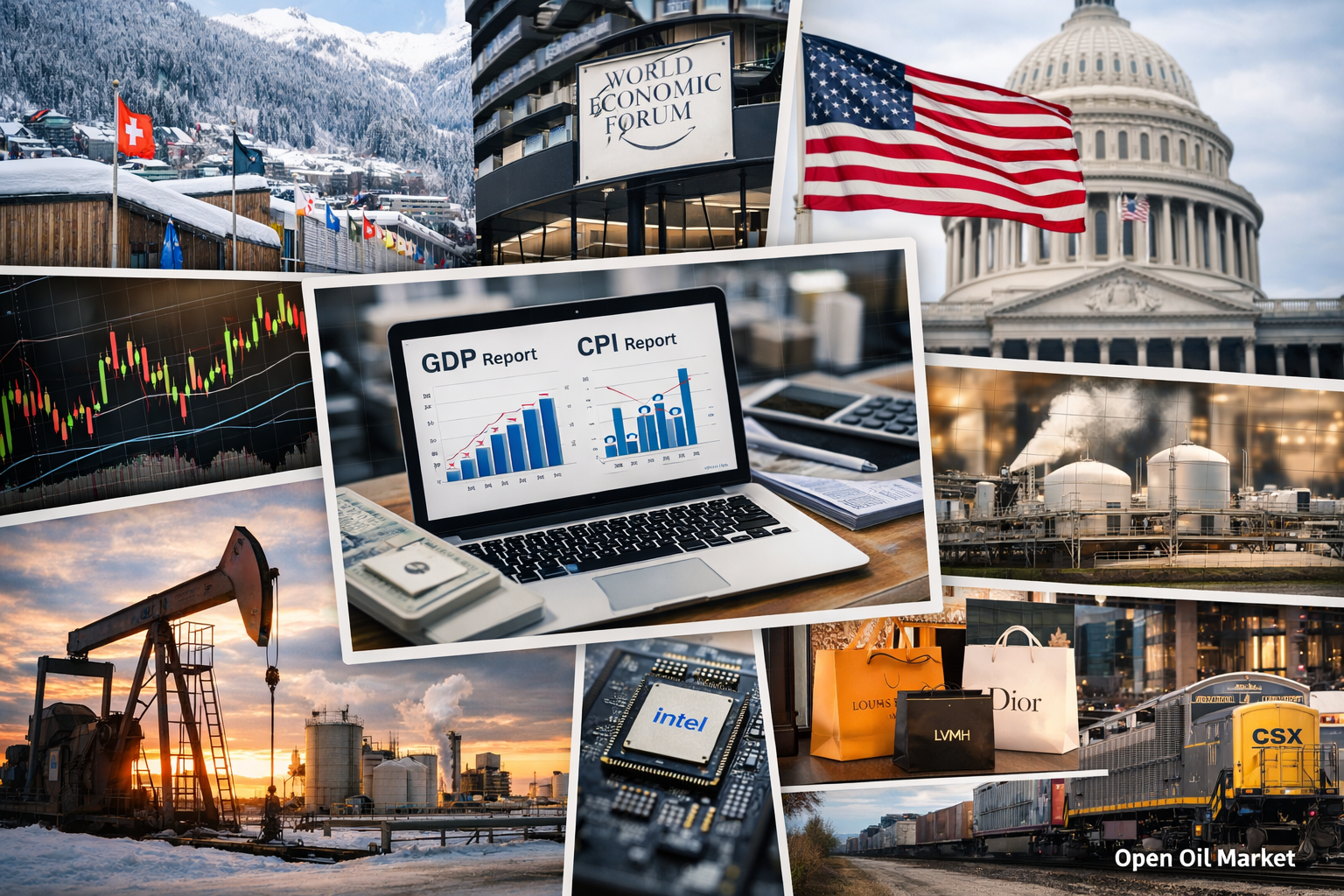
Detailed Review of Economic Events and Corporate Reports for January 22, 2026. World Economic Forum in Davos, Key Indicators of the US Economy (CPI Inflation, PCE Index, GDP for Q3, and Labor Market), EIA Oil and Gas Statistics, and Quarterly Reports from Major Companies in the US (Intel, Procter & Gamble, etc.), Europe (LVMH, etc.), Asia, and Russia.
Thursday shapes a rich agenda for global markets: in Europe, the focus is on the World Economic Forum in Davos (day 4), discussing global economic challenges. In Asia, investors are monitoring the start of the Bank of Japan's meeting (decision expected on January 23) and regional market sentiments ahead of important statistics from the US. In the US, several key macroeconomic indicators are set to be released in the second half of the day – December inflation (CPI) and PCE price index, the final GDP assessment for Q3 2025, as well as weekly labor market data. The energy sector is focused on the EIA reports on oil and natural gas inventories, which will provide signals regarding supply and demand balance in raw material markets. On the corporate side, there is a peak in the earnings season: before the opening of American trading, giants in the consumer and healthcare sectors will report, while after the closing, technology corporations and banks will follow; in Europe, the quarterly report from luxury segment leader LVMH is of particular interest. It is important for investors to assess incoming signals collectively: US inflation and economic growth ↔ expectations regarding the Fed's policy ↔ dynamics of the dollar and bond yields ↔ commodity prices ↔ overall risk appetite.
Macroeconomic Calendar (Moscow Time)
- 16:30 – US: Consumer Price Index (CPI) for December 2025.
- 16:30 – US: GDP for Q3 2025 (final estimate).
- 16:30 – US: Initial jobless claims (weekly).
- 18:00 – US: Personal Consumption Expenditures Price Index (PCE) for November 2025.
- 18:30 – US: Natural gas inventories (EIA), weekly report.
- 19:00 – US: Kansas City Fed Manufacturing Activity Index (January).
- 20:00 – US: Commercial crude oil inventories (EIA), weekly report.
Inflation in the US: CPI and PCE Index
- Core inflation (Core CPI, Core PCE) serves as the main benchmark for future Fed actions. A decline in Core CPI/PCE towards target levels would support the markets (growth stocks and bonds); conversely, faster inflation would heighten expectations of policy tightening, raising government bond yields and dampening interest in riskier assets. Price dynamics in housing and services are especially crucial: their slowdown indicates weakening inflationary pressure, while sustained growth suggests inflationary inertia.
- Market response: inflation data will dictate the dynamics of the US dollar and interest rates. A decline in CPI/PCE will weaken the dollar and reduce yields, positively impacting technology stocks and gold prices; a higher index, on the other hand, will strengthen the USD and negatively affect high-risk assets (including technology companies).
The US Economy: GDP and Labor Market
- GDP of the US (Q3 2025) – final growth rate assessment. Confirmation of strong economic expansion is expected. Robust GDP growth signals stable consumer demand and investment despite the impact of high rates, while a downward revision would indicate a more significant economic slowdown under their pressure.
- Labor market: number of initial jobless claims – a leading indicator of employment status. A low level of claims confirms ongoing tension in the labor market and upward pressure on wage growth; an increase in this figure could be an early sign of easing hiring and declining inflationary pressure. Investors will compare this data with recent unemployment and payrolls trends.
World Economic Forum in Davos
- Global leaders, heads of central banks, and major companies at the forum are discussing economic and socio-political issues. On the fourth day of Davos, announcements regarding the global economic outlook, inflation, and monetary policy are anticipated. Investors are closely monitoring signals from representatives of the Fed and the ECB, which may influence market expectations.
- Apart from macroeconomics, long-term development issues are also addressed at the forum – ranging from artificial intelligence and digital economy to climate initiatives and the "green" transition. The outcomes of these discussions shape perceptions of future investment trends: from technology regulation to new sustainable development projects.
Energy: EIA Oil and Gas Inventories
- Oil (EIA): the weekly report from the Energy Information Administration on US crude oil inventories will reflect the short-term market balance. A sharper-than-expected reduction in inventories will indicate robust demand or supply decline – a factor that could boost oil prices and support oil and gas company stocks. Conversely, an increase in inventories signals excess supply or weakening demand, which may pressure oil prices.
- Natural gas: the EIA data on gas storage shows inventory dynamics during the peak of winter. A rapid decline in inventories (for example, due to cold weather) will escalate gas prices and support revenues for gas production and utility companies. However, if inventories are decreasing slowly due to mild weather and remain high, this will limit price growth and affect profits in the sector.
Corporate Reports: Before the Markets Open (BMO, USA and Asia)
- Procter & Gamble (PG) – the global consumer sector leader will present results for October-December. Investors will evaluate organic sales growth and pricing strategy effects: whether P&G managed to maintain volumes amid rising prices and inflationary pressure. Focus will also be on margins across key product categories and management's forecast for 2026.
- Abbott Laboratories (ABT) – a large medical-pharmaceutical company will report revenue across its core segments (medical devices, diagnostics, pharmaceuticals). Special attention will be on sales of cardiology and diabetes equipment, as well as demand for diagnostic tests. Abbott's results will provide signals about the state of the global medical technology and services market.
- Bank Central Asia and First Abu Dhabi Bank will present reports, allowing assessment of the banking sector's health in Asia and the Middle East.
Corporate Reports: After Market Close (AMC, USA)
- Intel (INTC) and KLA Corp (KLAC) – the semiconductor sector will be in focus this evening. Intel will release results for Q4 2025: revenue in data center and PC segments, as well as chip demand forecasts (including for artificial intelligence) are critical. KLA, a chip industry equipment manufacturer, will complement the picture: order volumes for lithography and measurement equipment will indicate chipmakers' capital investment plans. Together, Intel and KLA’s reports will set the tone for the entire technology sector.
- Intuitive Surgical (ISRG) – a developer of robotic surgical systems will report quarterly results. Key metrics will include the number of newly installed Da Vinci systems and the growth in surgeries performed with their assistance. These metrics reflect the penetration of robotic surgery; a surge in demand will support revenue and service income, while a slowdown will indicate market saturation. Investors will also assess the company's profitability.
- Capital One (COF) – a significant credit card issuer will reveal insights into consumer credit. Trends in issued loan volumes and delinquency rates will show how households cope with debt burdens amid high rates. An increase in reserves for potential losses will be a worrying sign, while steady metrics will confirm robust demand.
- CSX Corp (CSX) – one of the largest rail operators in the US will provide insights into freight transport. Volumes of various freight categories and rate dynamics will reflect the level of business activity in industry and trade. An increase in volumes signals economic strengthening, whereas a decrease may serve as an early indicator of a slowdown.
European Reports: LVMH and Others
- LVMH Moët Hennessy Louis Vuitton – the leading global luxury group will present sales data for Q4 2025. Investors await information on demand dynamics for premium brand products in China, the US, and Europe during the holiday season. Key indicators will focus on the fashion and leather goods division, as well as the watches/jewelry and wine & spirits segments. A successful quarter for LVMH will support the entire luxury sector, while signs of slowdown will indicate weakening consumer demand in the premium niche. (It is noteworthy that the results of Christian Dior SE, LVMH's main shareholder, will largely reflect the same trends.)
- Bankinter (BKT) – a Spanish bank will publish a report shedding light on the state of the Eurozone banking sector. The market will assess growth in interest income from lending amid elevated ECB rates, dynamics in mortgage and corporate lending in Spain, as well as asset quality (levels of non-performing loans). Strong results will confirm the stability of the Spanish economy, while weak results will serve as a warning signal for the European banking sector.
Other Regions and Indices: Euro Stoxx 50, Nikkei 225, MOEX
- Euro Stoxx 50: on January 22, the European market will mainly depend on external factors. Reactions to US data, outcomes of discussions in Davos, as well as oil price dynamics and the euro exchange rate will set the tone for the index. A strong LVMH report may support the luxury segment in France, but overall, the Euro Stoxx 50 will follow the global investor risk appetite.
- MOEX / Russia: no major corporate events are scheduled for this date – the primary flow of annual reports is expected in February-March. Therefore, external factors (oil prices, ruble exchange rate, global risk appetite) will serve as the key driver for the Moscow Exchange. Geopolitical news or sanctions factors may cause specific fluctuations.
Day's Summary: What Investors Should Pay Attention To
- 1) Inflation in the US: the release of CPI and PCE data is the main factor of the day. Deviations from forecasts will immediately reflect on expectations regarding Fed rates and bond yield movements, triggering volatility in the stock market (especially in the technology sector) after 16:30 Moscow time.
- 2) Economic momentum: a combination of GDP and labor market indicators for the US will demonstrate the resilience of growth. Strong figures will boost confidence in the economy (but also the likelihood of tighter Fed policy), while weak figures will elevate expectations of a softer rhetoric from the regulator. This will impact risk appetite – from the dynamics of S&P 500 / Nasdaq indices to sentiments in emerging markets.
- 3) Commodity markets: EIA reports on oil and gas may provoke price movements in energy resources. Monitor how oil reacts to inventory data – rising prices will support energy company stocks and commodity currencies (ruble, Canadian dollar), while falling prices will weaken these market segments.
- 4) Corporate surprises: key reports of the day (Intel, P&G, LVMH, etc.) will locally influence their respective sectors and indices. Unexpected strong results in technology or consumer sectors will improve overall market sentiment, while disappointments will intensify sell-offs in affected industries. The balance between macro and micro factors will determine market direction.
- 5) Risk management: on a day filled with events, investors need to exercise caution. It is advisable to pre-determine acceptable ranges for key portfolio assets and set trigger levels for orders. Using limit orders and hedging tools will help mitigate potential losses during sharp market movements.