Key Highlights of the Day: Energy Sector Events
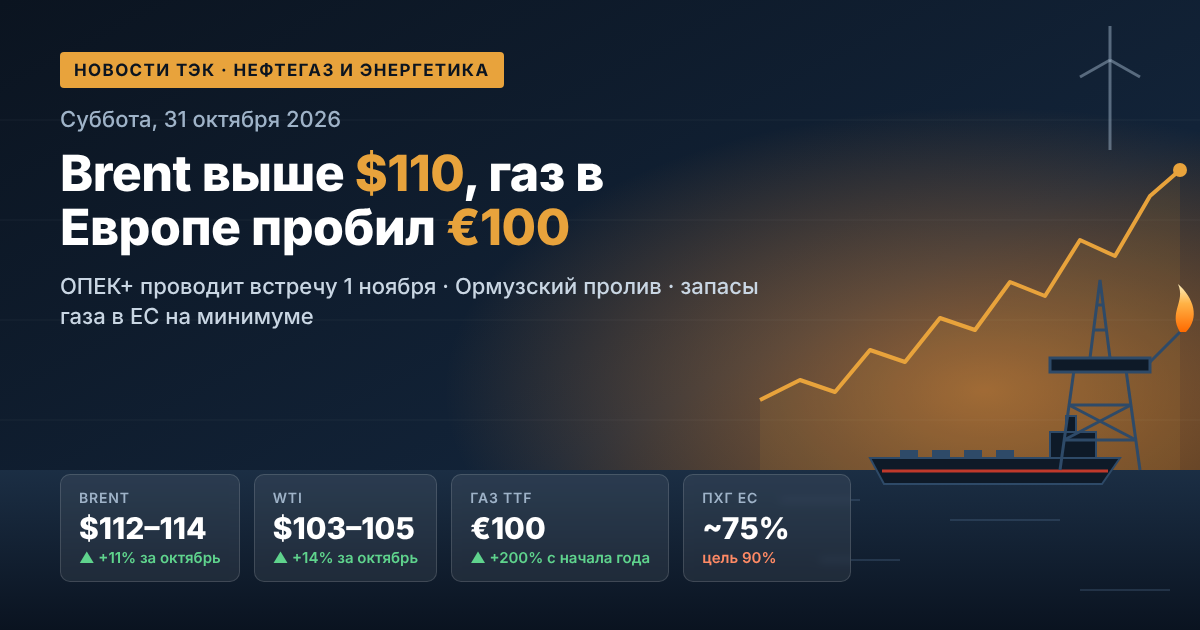
- Brent Oil rose approximately 3% on Thursday, peaking at $112.68 per barrel; WTI briefly surpassed $100.
- The USA and Israel, according to American media reports, have prepared a plan for a “short but intense” operation against Iran following the midterm elections in November.
- The Houthis attacked Saudi facilities, including the Shaybah oil field of Saudi Aramco; the US State Department ordered the departure of some diplomats from Saudi Arabia.
- Gas in Europe: TTF around €87/MWh, storage capacity is approximately 75% full against a seasonal norm of about 90%.
- Diesel Crisis: The diesel refining margin in Europe and the US remains above $100 per barrel.
Oil Market: Brent at Highest Since May
The main driver of the oil market is the anticipation of a new phase of confrontation surrounding Iran. Traders are assessing the likelihood of renewed strikes following the upcoming US midterm elections scheduled for early November. Concurrently, the market is reacting to the attacks by Yemeni Houthis on Saudi Arabia's infrastructure: a drone strike on the Shaybah field resulted in two fatalities, with another death reported at Dammam Airport.
Fundamental data also supports prices. Commercial oil inventories in the US decreased by 3.06 million barrels last week against a forecasted decline of 0.8 million, although stocks at the Cushing hub increased by nearly 1 million barrels. Over the month, Brent rose by more than 8%, and on a yearly basis, it has increased by approximately 70%.
An important signal for market professionals is the divergence between paper and physical markets. Over the past two weeks, Brent futures have increased by about $10, while the prices for physical oil batches have, in contrast, declined. This indicates that a significant portion of the rally is speculative and reflects the geopolitical premium rather than an acute shortage of crude.
Strait of Hormuz: Seven Conditions Set by Tehran
The situation in the Strait of Hormuz remains a crucial factor for global oil and LNG supplies. Iranian leadership has linked the full opening of the shipping route to the fulfillment of seven conditions set forth by Washington, as outlined in the so-called Islamabad Memorandum. Iranian Foreign Minister Abbas Araghchi stated that if the demands are met, the strait could be opened on the sixth day, and negotiations with the USA could resume on the seventh.
Physical flows have partially recovered:
- The transit of crude oil through the strait is estimated at around 10.3 million barrels per day — approximately 76% of pre-war levels.
- The share of petroleum products in the cargo flow has dropped to 11%, down from more than 20% before the conflict.
- Tehran and the IRGC threaten to extend restrictions to Bab-el-Mandeb and the Suez Canal, creating risks for tanker logistics between Asia and Europe.
OPEC+: Quotas On Paper, Production Below Targets
The OPEC+ alliance has maintained target production levels for November unchanged. Saudi Arabia’s quota is set at 10.5 million barrels per day, Russia's at 9.9 million, and Iraq's at 4.4 million. However, actual production from seven key participants in August was around 25 million barrels per day — approximately 5 million below the pre-war level of February. Increases in quotas for 2026 have largely remained symbolic.
The next meeting of the alliance is scheduled for November 1. An audit of production capacity, necessary for the allocation of quotas for 2027, has been postponed due to the war, so significant changes in oil policy are not expected until next year. Russian Deputy Prime Minister Alexander Novak expressed confidence that OPEC+ will play a leading role in overcoming the crisis, noting the stability of Russian oil exports.
Refined Products and Refineries: Diesel Shortage
The most strained segment currently is not crude oil, but refined products. The diesel refining margin in Europe has exceeded $100 per barrel, compared to a historical norm of about $20, while in the US, records above $117 were reported in September. The reasons are structural:
- Downtime of some refining capacities in Gulf countries;
- Regular drone attacks on Russian refineries;
- Ban on diesel exports for Russian producers until October 31;
- Export restrictions on fuel from several other countries, including China.
For investors, this means maintaining high profitability for independent refiners with operational capacities, particularly in the US. American energy regulators expect that diesel spreads will remain above historical averages until at least 2027.
Gas and LNG: Europe Enters Winter with Storage Deficits
The European gas market remains one of the main risks of the season. TTF futures are trading around €87/MWh — levels not seen since the beginning of 2023. European underground storage is about 74–75% full, roughly 17 percentage points below the seasonal norm. The EU has already softened the mandatory injection target from 90% to 80%.
The key issue is the LNG shortage. Attacks on the Qatari Ras Laffan complex have disabled two processing lines with a total capacity of 12.8 million tons per year, as well as the Pearl GTL plant, and QatarEnergy has ruled out the construction of pipelines as an alternative to marine exports through Hormuz. Europe and Asia are competing for spot shipments of liquefied gas, and a cold winter could trigger a new price spike.
Russian Fuel Market: Export Restrictions
In Russia, the ban on gasoline exports remains in effect until the end of 2026, while diesel fuel restrictions for producers last until the end of October. Mid-month signals indicated a potential partial easing of the export regime for refined products, contingent upon fully meeting domestic market needs. Refineries are transitioning to produce winter diesel, and authorities are monitoring reserve creation during scheduled maintenance periods. A decision on extending or lifting export restrictions after November 1 will be one of the key events for participants in the fuel market.
Electric Power, Renewables, and Coal
The energy crisis is accelerating the transition to renewables. According to the IEA, in 2026, renewables are expected to surpass coal for the first time, becoming the largest source of global electricity generation. Renewable generation is projected to grow by more than 8%, with solar generation adding approximately 600 TWh, surpassing wind output. Global electricity demand is expected to increase by 3.6% in 2026, with growth of 5.5% in China and 7% in India.
At the same time, expensive gas is supporting coal generation in Asia and partially in Europe: energy systems are using coal as a hedge against LNG shortages. The thermal coal market remains at elevated levels, with coal exporters maintaining strong positions in the Asia-Pacific region.
Forecast and What to Watch for on Friday
In conclusion to the week, news in oil, gas, and energy will be primarily influenced by geopolitics. Energy market participants should pay attention to the following factors:
- Signals from Washington and Tehran regarding Iran and the Strait of Hormuz ahead of the US elections.
- New attacks by Houthis on Saudi oil infrastructure and shipping.
- The dynamics of the spread between futures and physical grades of oil as an indicator of the rally’s resilience.
- Decisions on Russian refined product exports following October 31.
- Weather forecasts for Europe and the rate of gas extraction from underground storage.
The baseline scenario anticipates Brent remaining in the range of $105–115 per barrel until early November. Analysts agree that de-escalation prior to the US elections is unlikely, meaning the geopolitical premium in oil, gas, and diesel prices will likely remain. A sharp correction is only possible with real progress in negotiations over Hormuz.