Venture Capital Market 8 June 2026: artificial intelligence, Anthropic IPO preparations, OpenAI and SpaceX, spacetech growth, corporate software and deeptech deals
Monday, 8 June 2026, opens one of the most eventful weeks of the year for venture investors and funds. The startup market is once again in the global capital spotlight: the largest deals are concentrating around artificial intelligence, AI infrastructure, fintech, space technologies, robotics and corporate software. The week’s dominant theme is not merely new funding rounds, but a shift in the venture market from private mega-deals to potentially the largest public listings in recent years.
For investors, this signals a change in cycle phase. While in 2023–2024 the market assessed the resilience of business models after the period of expensive money, by 2026 the focus has moved to scale, access to computing power, the ability to monetise AI products, and companies’ readiness to go public. Startup and venture capital news today reveals: capital is again willing to pay high multiples, but only for companies that can demonstrate technological leadership, revenue growth and a strategic role in the new digital infrastructure.
Anthropic sets the tone for AI IPOs and reshapes expectations for tech company valuations
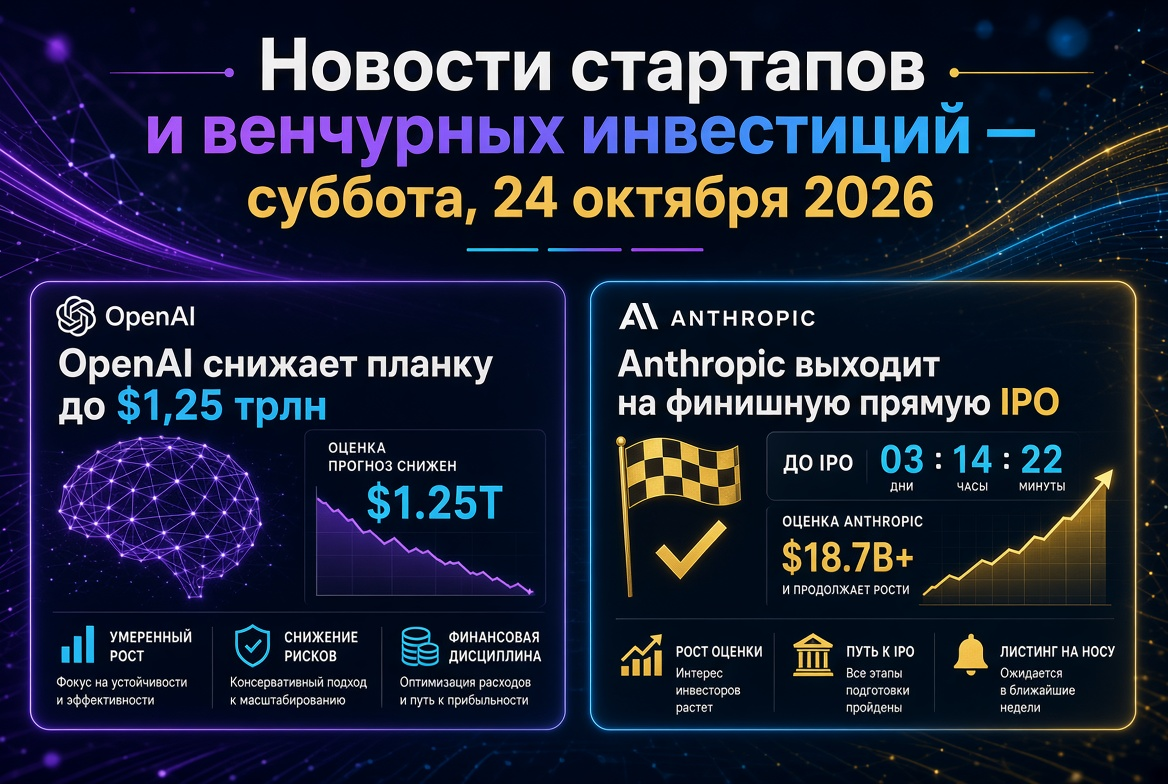
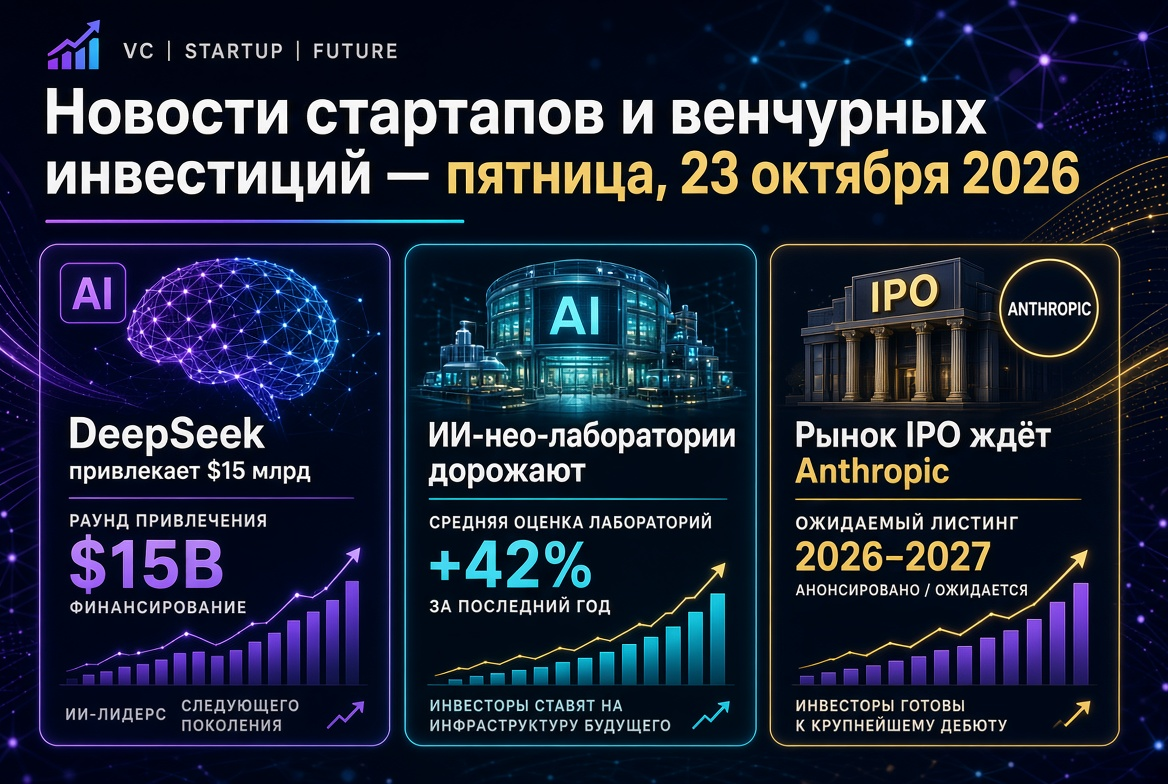
The key event for the venture market remains Anthropic’s preparation for a stock exchange listing. The company, which develops AI models and enterprise products based on Claude, has confidentially filed for an IPO in the United States. This is an important signal for the market: the largest private AI companies are now stress-testing their valuations not only in closed rounds but also before public investors.
Anthropic has already become one of the symbols of the new wave of venture capital investment. After a large capital raise, its valuation has approached the level of the largest public technology corporations. This creates several immediate consequences for venture funds:
- a benchmark for valuing frontier AI companies emerges;
- competition intensifies between Anthropic, OpenAI, xAI and other players;
- the likelihood of increased secondary market activity in late-stage shares rises;
- investors begin to scrutinise more closely the unit economics of AI models, inference costs and the margin profile of enterprise products.
For funds working with late-stage startups, a potential Anthropic IPO could trigger a revaluation of the entire artificial intelligence segment. If the public market accepts high multiples, it will support new rounds for AI startups. If demand proves weaker than expected, the market could quickly pivot to a stricter assessment of revenue, computing expenditure and client base quality.
OpenAI bets on a superapp and enterprise monetisation
OpenAI also remains at the centre of the global venture narrative. According to market reports, the company is preparing a major update to ChatGPT, focused on transforming the product into a multifunctional platform with tools for programming, AI agents, image generation and integration with external services. For the venture market, this is an important signal: the largest AI companies are gradually moving from a single-product model to an ecosystem model.
OpenAI’s primary focus is enterprise clients and paid users. This changes the investment logic of the entire sector. Venture funds are increasingly evaluating AI startups not by user numbers, but by their ability to embed into business workflows: development, finance, legal operations, marketing, analytics, customer support and data management.
As a result, the startup market is seeing growing interest in companies that are building not just AI tools, but full-scale infrastructure for automating corporate functions. That is why venture capital investment is increasingly flowing into AI-native SaaS, developer tools, data platforms and vertical applications for specific industries.
SpaceX and the largest IPO fuel interest in space technologies
SpaceX’s preparations for a potentially record-breaking IPO are intensifying investor attention on the spacetech sector. Although SpaceX has long since outgrown the classic startup stage, its public listing could be a landmark event for the entire venture ecosystem. An expected valuation in the trillions of dollars and a potential capital raise of tens of billions create a new benchmark for companies in satellite communications, space logistics, defence technologies and low-earth-orbit infrastructure.
Against this backdrop, Impulse Space stands out, having raised US$500 million in a Series D round. The company is developing technologies for moving satellites and payloads in orbit. For venture funds, this is an example of how the market is beginning to finance not only rocket launches but also the subsequent infrastructure of the space economy.
The spacetech sector is becoming increasingly institutional. Investors view it not as an experimental niche but as a long-term infrastructure bet tied to defence, telecommunications, navigation, Earth monitoring and future commercial services in space.
Ramp, Supabase and AlphaSense demonstrate the strength of corporate software
Among the week’s largest deals, enterprise platforms stand out. Ramp raised US$750 million at a valuation of around US$44 billion. For the fintech market, this is an important marker: investors are again willing to pay a premium for companies that combine financial automation, corporate expense management, analytics and AI tools.
Supabase closed a round of US$500 million at a valuation of approximately US$10.5 billion. The company is developing an open-source platform for developers and AI applications, placing it in the fast-growing market for agentic software infrastructure. As more companies build their own AI products, demand for databases, backend tools, APIs and development platforms continues to rise.
AlphaSense also attracted significant capital, confirming investor interest in AI analytics for financial and corporate clients. Platforms that help quickly process reports, research, documents and market data are increasingly in demand among banks, funds, corporations and consulting firms.
AI startups expand beyond classic software
The new wave of venture investment shows that artificial intelligence is no longer a standalone category. AI is becoming a foundational technology layer across different industries: music, robotics, medicine, law, manufacturing, finance and energy.
Suno raised more than US$400 million at a valuation of around US$5.4 billion, reinforcing interest in generative AI within the music and content industry. At the same time, the company faces legal risks related to copyright. For investors, this is an important reminder: in the AI sector, technological growth must be accompanied by legal resilience and a clear data licensing model.
Generalist AI, operating at the intersection of artificial intelligence and robotics, attracted a large round and reached a valuation of about US$2 billion. This segment is particularly interesting to venture funds, as moving AI from the digital realm into the physical world could become the next major investment cycle.
European venture market bets on AI, quantum and scale-up capital
Europe is also strengthening its position in the global venture narrative. Noteworthy deals are emerging in legaltech, HR tech, quantum computing, industrial AI and fintech. Wordsmith raised US$70 million in a Series B round to develop legal AI tools. Factorial secured US$150 million in Series D, confirming demand for HR process automation. Quantum startups Quobly and Oxford Quantum Circuits attracted significant capital, highlighting growing interest in European deeptech companies.
Of particular significance is the formation of large European capital pools for scaling technology companies. For venture funds, this is an important structural shift: Europe is attempting to close the gap with the United States not only in early stages but also in late-stage financing. If the region can retain promising companies until the global growth stage, the European startup market will gain a stronger position in the competition for AI, quantum, defence tech and industrial automation.
What venture investors and funds should consider
The current state of the startup and venture capital market yields several practical conclusions for funds:
- AI remains the primary magnet for capital, but investors increasingly demand proof of monetisation, computational efficiency and real business demand.
- The IPO window is gradually opening, though large listings from Anthropic, OpenAI and SpaceX could absorb a significant portion of liquidity available to other technology companies.
- Corporate software is back in focus, especially if the product is tied to automation of finance, development, analytics or legal processes.
- Deeptech and spacetech are attracting more capital, as investors seek long-term infrastructure bets beyond classic SaaS.
- Regulatory and legal risks are becoming a key valuation factor, particularly in generative AI, data, music, media and defence technologies.
The venture market enters a phase of major tests
Startup and venture capital news for Monday, 8 June 2026, reveals a market with high capital concentration and, simultaneously, growing demands on asset quality. AI mega-rounds, preparations for the largest IPOs, spacetech growth, the development of corporate software and European deeptech deals are shaping a new investment map for global venture funds.
The key question in the weeks ahead is whether the public market can validate the valuations that private investors have already baked into the largest AI and technology companies. For venture investors, this is a moment of heightened attention: successful IPOs could open a new cycle of liquidity, while weak demand could rapidly cool late-stage activity and force the market back towards more conservative multiples.
For funds, selectivity remains the priority. The most attractive are startups that combine technological advantage, strong economics, clear corporate demand and the ability to scale globally. It is those companies that will define the venture market agenda in the second half of 2026.