The Global Startup Market as of June 10, 2026 Enters a New Phase: Venture Investments Focusing on Artificial Intelligence, Defense Technologies, Space Infrastructure, Enterprise SaaS, and Biotechnology
As of June 10, 2026, the global venture market remains highly active but has become noticeably more selective. Investors are increasingly betting not on broad technological trends but on startups with a clear infrastructural role: artificial intelligence, AI infrastructure, defense technologies, space systems, IT operations automation, biotechnology, and enterprise SaaS. For venture funds and institutional investors, this signifies a shift from speculative growth to a more stringent assessment of revenue, margins, technological defensibility, and potential exits through IPOs or M&A.
The main theme of the day is the preparation of major AI companies and space tech players for the public market. Against the backdrop of filings from OpenAI and Anthropic, as well as the anticipated listing of SpaceX, the venture investment market is effectively gaining a new benchmark for late-stage valuations. If public investors confirm a high demand for such assets, this could open a liquidity window for funds that have been waiting for substantial exits for several years.
AI IPOs Become the Main Signal for the Venture Market
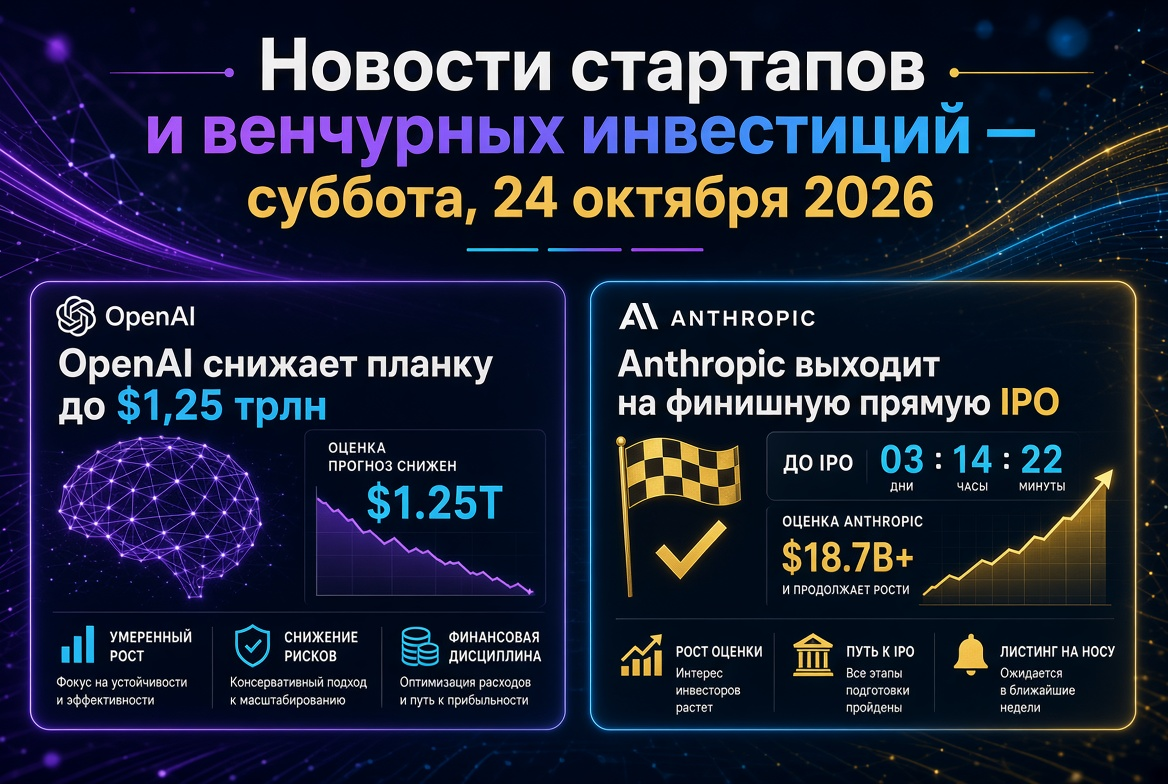
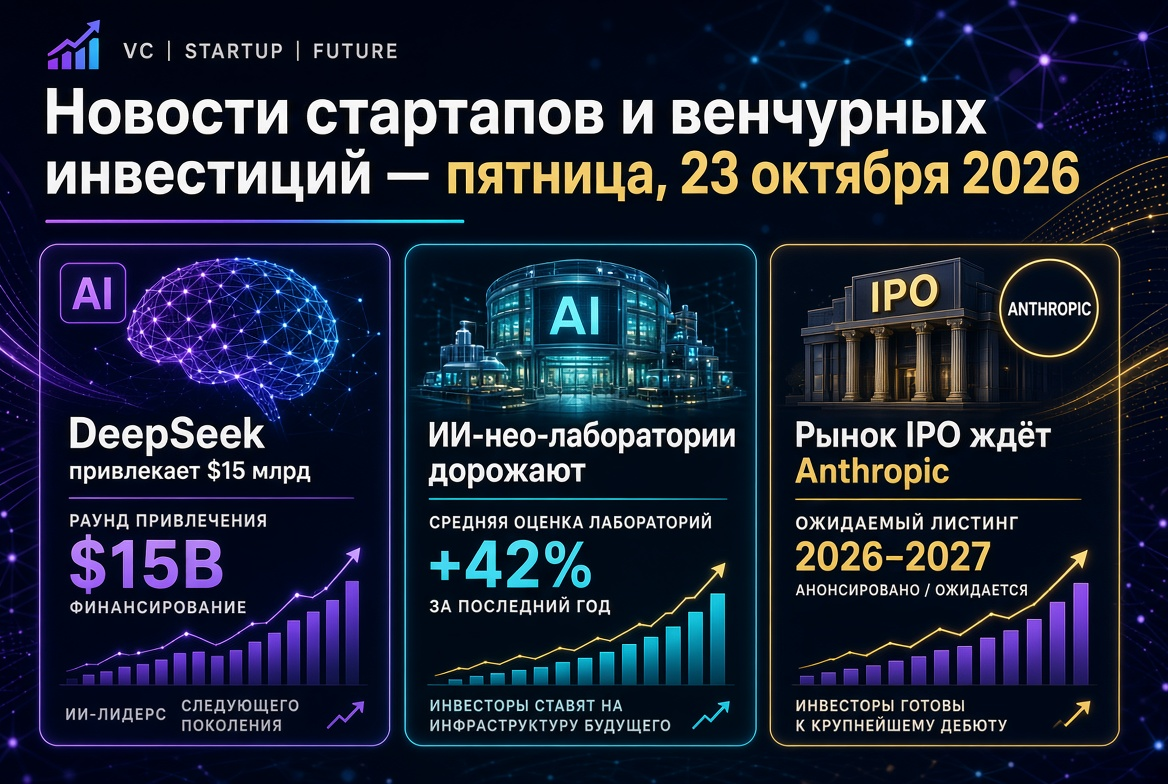
The most significant event for the startup ecosystem is the acceleration of the public offering race among major AI companies. OpenAI has confidentially filed for an IPO, joining Anthropic, which has also begun its journey to the public market. For venture investors, this is not merely news about an individual company but a test of the entire model for financing generative artificial intelligence.
Venture funds will closely monitor three questions:
- Is the public market willing to pay a premium for AI companies with a massive user base?
- How will investors evaluate losses, capital expenditures, and the cost of computing infrastructure?
- Will funds finally have the long-awaited exit mechanism from the largest private AI assets?
If the IPOs of OpenAI, Anthropic, and SpaceX are successful, it could enhance capital inflow into AI startups, data infrastructure startups, developers of enterprise AI applications, and companies operating at the intersection of artificial intelligence, cloud computing, and business automation.
SpaceX Sets the Benchmark for Late-Stage Financing and the Tech IPO Market
The anticipated IPO of SpaceX remains one of the key events of the week for venture capital. The company is viewed not just as a space startup, but as an infrastructural platform for satellite internet, communication, launches, defense contracts, and potential AI workloads. For the startup market, this is an important precedent: a private tech company can go public with a valuation comparable to that of the largest publicly traded corporations in the world.
For venture funds, the significance of SpaceX transcends a single deal. A successful offering could:
- Elevate the valuations of mature private tech companies;
- Accelerate the readiness of other “unicorns” for IPOs;
- Reignite institutional investors' interest in late-stage venture financing;
- Create a new benchmark for space tech, satellite communication, and infrastructural startups.
At the same time, risks remain high: investors will assess debt load, capital intensity, reliance on key founders, and the sustainability of demand for satellite services.
Defense Deep Tech in Europe Moves to Mega-Rounds
The European defense technology market continues to grow rapidly. A significant event was Iceye's €1 billion funding round, which valued the Finnish-Polish satellite company at approximately €10 billion. Iceye operates in the field of radar satellite observation, making it a strategic asset for defense, intelligence, infrastructure monitoring, and national security.
Concurrently, the Franco-Ukrainian company Alta Ares secured €50 million to scale its AI systems for air defense and drone interception. This demonstrates that venture capital in Europe is increasingly channeling into dual-use technologies: products that may have both civilian and defense applications.
For funds, this represents a distinct investment thesis for 2026: defense deep tech is no longer a niche and is becoming a standalone class of venture assets. Investors are turning to satellites, autonomous systems, drones, cybersecurity, edge AI, and industrial robotics as a long-term market with government demand.
Space Startups Attract Capital Amid Demand for Technological Sovereignty
Another important signal is the new €270 million funding round for Isar Aerospace. The German company is developing the Spectrum rocket and aims to enhance Europe's capabilities to independently launch satellites into orbit. For venture investors, this confirms that space tech is no longer exclusively a U.S. market and is becoming part of the global agenda for technological sovereignty.
Interest in space startups is supported by several factors:
- Growing demand for satellite communication and Earth observation;
- Military and government programs in Europe;
- Need for independent satellite launch channels;
- Connection between space tech and AI infrastructure, telecom, and defense.
For early and late-stage funds, this implies an expanding market beyond software: capital is increasingly directed towards hardware, engineering, and capital-intensive startups, where barriers to entry are higher, but the strategic value of the business can be significantly greater.
Enterprise SaaS and AI Infrastructure Remain at the Center of Venture Investments
The American market has seen major deals in enterprise SaaS and IT automation. NinjaOne raised over $400 million in a Series C expansion at a valuation of $12.3 billion. The company develops a platform for managing IT operations, automating endpoint management, and supporting corporate infrastructure.
Another noteworthy round involved Beacon Software, which raised $225 million to enhance its AI-enabled roll-up strategy. The company's model is based on acquiring niche software businesses and improving their efficiency through a unified AI operating system. This is an important trend: venture capital is starting to compete with private equity not only for technology startups but also for mature, profitable vertical software companies.
Special attention should be given to PointFive, which secured $60 million for developing a cloud expense management and AI infrastructure platform. Rising costs for tokens, computing, data storage, and AI models are forming a new market: optimizing AI expenses is becoming a standalone category of enterprise software.
Biotechnology Returns to the Forefront of Funds' Attention
The biotechnology sector is also showing signs of recovery. City Therapeutics raised $99.5 million in Series B funding for the development of RNAi therapeutics. This is an significant signal for the venture market: following a period of revaluation of biotech assets, capital is once again flowing into platform scientific companies with a strong technological foundation.
Biotechnology remains a challenging area for investors due to long development cycles, regulatory risks, and high costs of clinical trials. However, this is precisely why successful biotech startups can deliver considerable premiums upon going public or being acquired by strategic players. In 2026, funds are increasingly opting for platform approaches rather than individual product hypotheses: RNAi, computational biology, AI-drug discovery, and cell technologies.
European and Asian Early Stages: Capital Flows into AI-native Models
At early stages, activity around AI-native startups continues. The Austrian company fonio.ai raised $17 million in seed financing at a $140 million valuation. The company automates customer calls for small and medium-sized businesses, reflecting the growing demand for applied artificial intelligence in operational processes.
In Europe, there is also a new fund, Pitchdrive, with a volume of €60 million, focused on early-stage AI-native companies. This indicates that investors are not limiting themselves to late rounds and continue to seek new leaders at the pre-seed and seed stages.
In India, Integra Robotics secured $1.12 million in pre-Series A funding. The deal is small by global standards but significant regarding the trend: capital is flowing into robotics, human-in-the-loop models, and deep tech products capable of expanding beyond local markets.
What Matters to Venture Investors and Funds
The main takeaway as of June 10, 2026, is that the venture market is growing but becoming more disciplined. Investors are willing to pay high valuations if they see a technological moat, scalable revenue, strategic demand, and a clear path to liquidity.
Key areas for venture investors to pay attention to include:
- AI infrastructure: computing, expense optimization, corporate AI platforms, data management;
- Defense deep tech: satellites, drones, air defense systems, cybersecurity, edge AI;
- Space tech: satellite launches, communication, Earth observation, autonomous infrastructure;
- Enterprise SaaS: IT operations automation, vertical software, AI-enabled roll-up models;
- Biotech: RNAi, computational biology, platform therapeutic technologies;
- AI-native early stage: startups where artificial intelligence is embedded in the product economy from day one.
At the same time, the primary risks remain unchanged: overheating valuations, competition for the best deals, capital intensity of AI and space tech, dependence on the public market, and potential disappointment for investors if major IPOs do not meet expectations.
Conclusion: The Venture Market Enters a Phase of Infrastructure Selection
Startup and venture investment news for Wednesday, June 10, 2026, indicate that the market no longer finances growth for the sake of growth. Capital is concentrating in companies that are creating the foundational infrastructure of the new technological economy: artificial intelligence, satellites, defense systems, enterprise software, biotechnology, and automation.
For venture funds, this is a period of great opportunities but also heightened demands for the quality of due diligence. The winners will not be the loudest startups but those companies capable of proving commercial sustainability, technological advantage, and potential to become public leaders in their respective categories. In the coming weeks, the main indicator will remain the IPO market: if SpaceX, OpenAI, and Anthropic confirm high demand from investors, the global venture market may see a new cycle of liquidity and revaluation of technological assets.