Current Startup and Venture Capital News for Sunday, May 17, 2026: Mega Rounds in AI, Rising Interest in AI Infrastructure, Robotics, Biotech, and New Tech Company IPOs
As of Sunday, May 17, 2026, the startup and venture capital news presents one clear takeaway for venture funds: the market remains active but is becoming increasingly selective. Money has not vanished from the technology sector; however, it is flowing into a limited number of areas—artificial intelligence, AI infrastructure, robotics, biotechnology, semiconductors, and scalable platform models.
For venture investors and funds, this signals a shift from broad market growth to a strategy of selective picking. Startups without strong technological differentiation and clear economics are facing tougher conditions, while AI startups, companies in computational infrastructure, and projects with rapid revenue growth continue to attract capital at record valuations.
AI Remains the Central Focus of Venture Capital Investment
Artificial intelligence maintains its status as a key theme in the global venture market. Large funds are financing not only applied AI services but also foundational laboratories, infrastructure platforms, and companies that operate at the intersection of AI, science, and industry.
A primary indicator for the market is that capital is increasingly directed not towards classic SaaS startups, but towards companies capable of becoming the foundational layer of the new technological economy. This shifts the competitive structure: investors are evaluating not just the product and revenue, but also access to computational resources, research teams, data, corporate clients, and strategic partners.
Anthropic Boosts the Mega Round Race
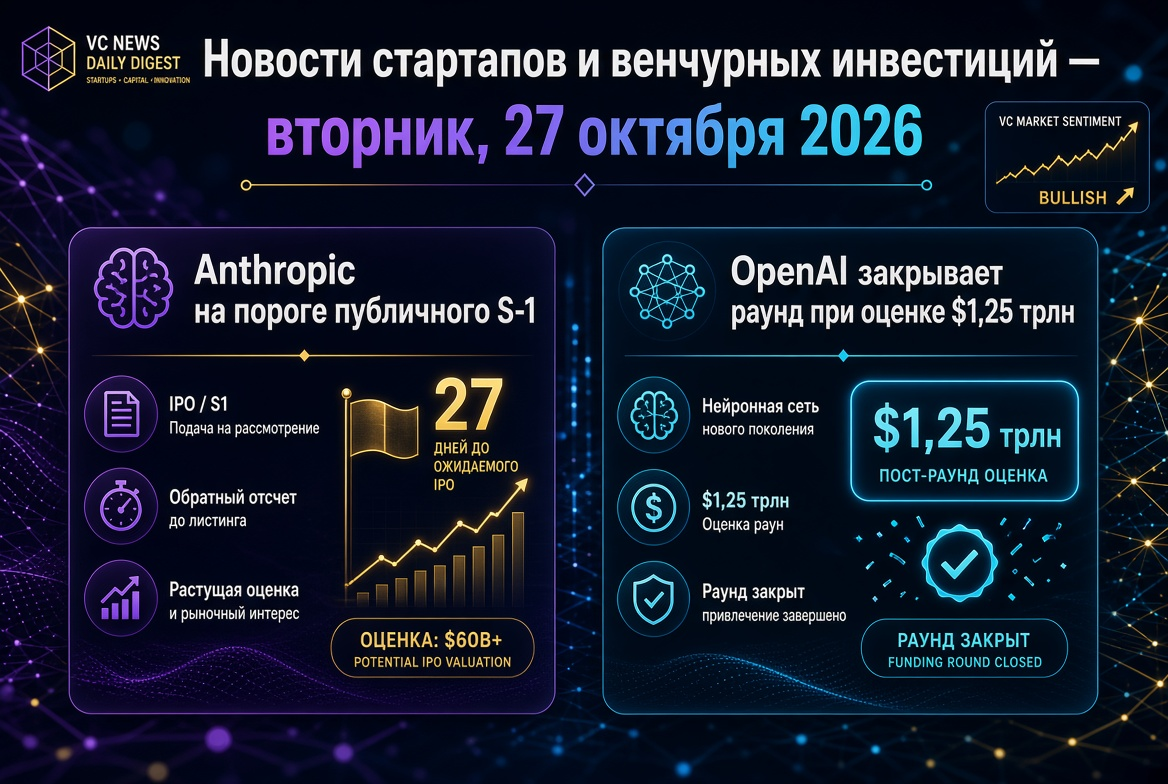
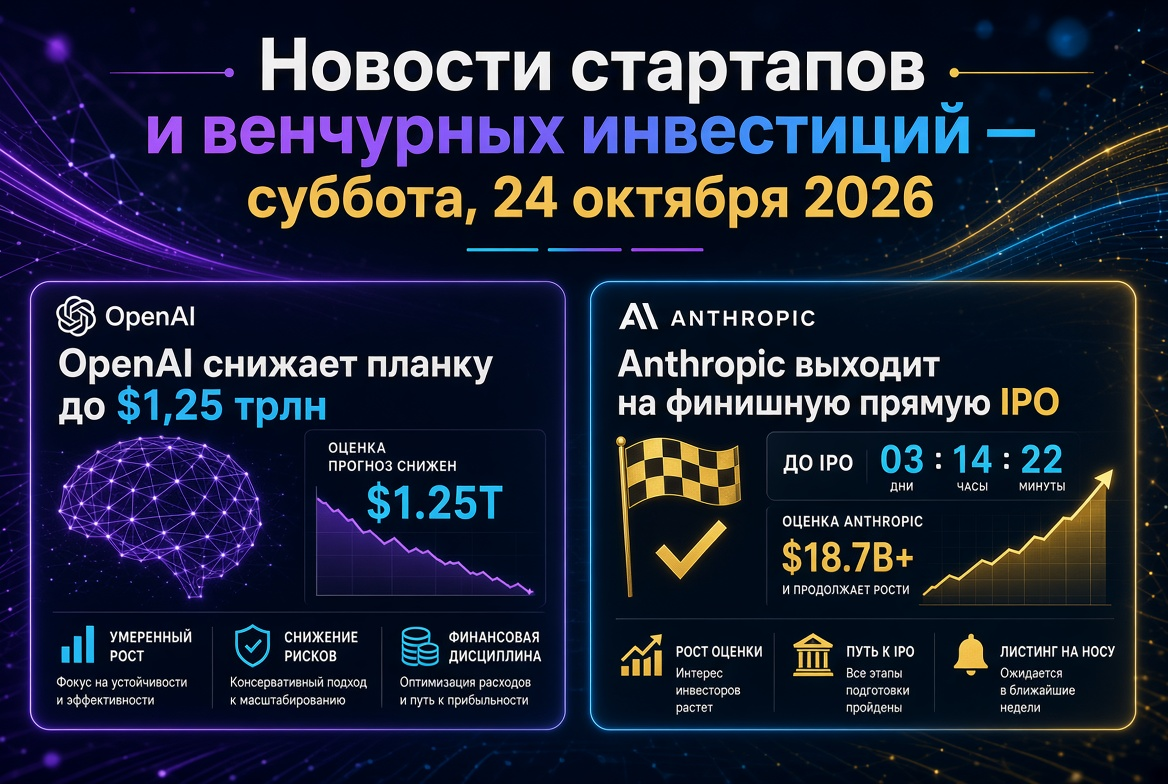
One of the most discussed topics remains the new major round for Anthropic. According to market data, the company is negotiating to raise around $30 billion at a valuation that may approach $900 billion. Even if the final terms of the deal change, the scale of the negotiations itself underscores how strongly venture capital is concentrating around the leaders in generative artificial intelligence.
For venture funds, this serves as an important indicator. The largest AI companies are effectively becoming a distinct asset class within the private market. They require enormous capital, but simultaneously generate expectations regarding future IPOs, corporate deals, and strategic partnerships with cloud, semiconductor, and corporate players.
Isomorphic Labs: AI Biotech Emerges as a New Mega Round Direction
Isomorphic Labs, affiliated with the Google DeepMind ecosystem, has secured $2.1 billion to scale its AI platform in drug development. This indicates that venture investments in artificial intelligence extend far beyond chatbots, office automation, and content generation.
Three factors are particularly important for funds:
- AI is beginning to impact capital-intensive industries with long research cycles;
- biotechnology is receiving new investment logic due to accelerated R&D;
- strong scientific teams are again becoming a competitive object among funds.
AI biotech could emerge as one of the major themes in the venture market of 2026, as it combines a high potential market, patent protection, strategic interest from pharmaceutical corporations, and the possibility of substantial exits via M&A.
Recursive Superintelligence and a New Wave of Research AI Startups
Recursive Superintelligence has exited its closed mode with a round of approximately $650 million. The company is working on the concept of self-improving AI systems, and its emergence confirms the trend of financing so-called next-generation research AI laboratories.
For venture investors, this is not a classic startup model with a quick go-to-market strategy. Such companies are evaluated based on team quality, scientific ambition, access to computing, and the likelihood of achieving a technological breakthrough. The risk here is higher, but the potential payoffs could be comparable to the largest platform stories of the previous decade.
AI Infrastructure: Semiconductors and Computing Return to the IPO Market
The IPO of Cerebras has become one of the week's major events for the tech market. The company raised around $5.5 billion and demonstrated strong demand from investors. For the venture market, this is not just a public offering of a single AI chip manufacturer, but a liquidity test for the entire AI infrastructure sector.
If demand for such offerings persists, funds will have a clearer route for exiting investments in semiconductors, data centers, specialized computing, and infrastructure for large models. This is especially important following a period when the IPO window for tech companies remained constrained.
Fractile and Mind Robotics: Capital Flows into Physical AI
The $220 million round for Fractile in the AI inference segment and the $400 million raised by Mind Robotics indicate that investors are increasingly funding projects where artificial intelligence intersects with the physical world: factories, robots, production lines, and industrial automation.
This direction appears particularly appealing to funds for several reasons:
- demand is rising for reducing computation costs;
- industry is seeking solutions to workforce shortages;
- corporate clients are willing to pay for measurable economic effects;
- AI infrastructure is becoming a strategic asset rather than just a software product.
Venture investments in physical AI could become one of the most resilient market segments, provided that companies can demonstrate not only technological novelty but also industrial reliability.
Rapido: Emerging Markets Again Attract Large Funds
The Indian platform Rapido raised $240 million in fresh capital as part of a larger deal that includes both primary and secondary components. The company's valuation has reached about $3 billion. For the global startup market, this is an important signal: emerging markets remain attractive if a company demonstrates scale, frequency of use, and potential for margin improvements.
Rapido is not only interesting as a transport startup. It shows that venture funds are once again willing to consider consumer platforms if the business has a tight operational model, a large addressable audience, and the potential to enhance technological efficiency.
Early Stages Remain Stable, but Quality Demands Are Increasing
Despite the dominance of mega rounds, the early-stage market is not disappearing. Data on pre-seed funding shows a steady volume of deals in the U.S., but competition for fund attention has intensified. Founders can no longer rely solely on a polished presentation and a large market. Venture investors are increasingly demanding early revenue, strong teams, technological advantages, and a realistic customer acquisition strategy.
For funds, this creates a dual challenge: not to miss a future leader in the early stages while also avoiding overpaying for a company that exists solely on the AI hype wave.
What Venture Funds Should Consider on May 17, 2026
The key takeaway for venture investors is that the market remains strong, but uneven. Capital is flowing to startups that can demonstrate technological leadership, rapid growth, or strategic significance for major industries.
Key Indicators for Investors
- AI startups remain the primary magnet for venture capital.
- Infrastructure companies are rewarded for their strategic role in the AI chain.
- The IPO of Cerebras reinforces expectations of new public offerings in the AI sector.
- Biotech, robotics, and semiconductors are becoming focal points for large funds.
- Early stages are stable, but investors are becoming more demanding regarding team quality and metrics.
Thus, the startup and venture investment news for Sunday, May 17, 2026, illustrates a market where capital is not merely returning to technology but is concentrating around companies that can become the infrastructure of the next growth cycle. For venture funds, this is a time of intense competition, large checks, and the necessity for deep technological expertise.