Startup and Venture Investment News Update for Saturday, June 27, 2026: AI Infrastructure, Fintech Mega Rounds, Robotics, New Funds, and Key Trends for Venture Investors
As of June 27, 2026, the global startup and venture investment market is entering a new phase: capital is flowing back into tech companies, but it is being distributed far more selectively than during the previous venture boom. The primary focus of the day is the concentration of investments around AI infrastructure, fintech platforms, robotics, autonomous systems, and applied artificial intelligence for the corporate sector.
For venture investors and funds, the current agenda is particularly significant: the market is showing signs of liquidity recovery, yet simultaneously widening the gap between leaders and the rest of the startup ecosystem. Mega rounds are being secured by companies with demonstrable technological depth, access to data, an infrastructural role, or connections to large payment and corporate markets. Conversely, startups without proven economics are facing stricter revenue, margin, and sustainable business model requirements.
Global Venture Market: Capital Has Returned, But Became More Concentrated
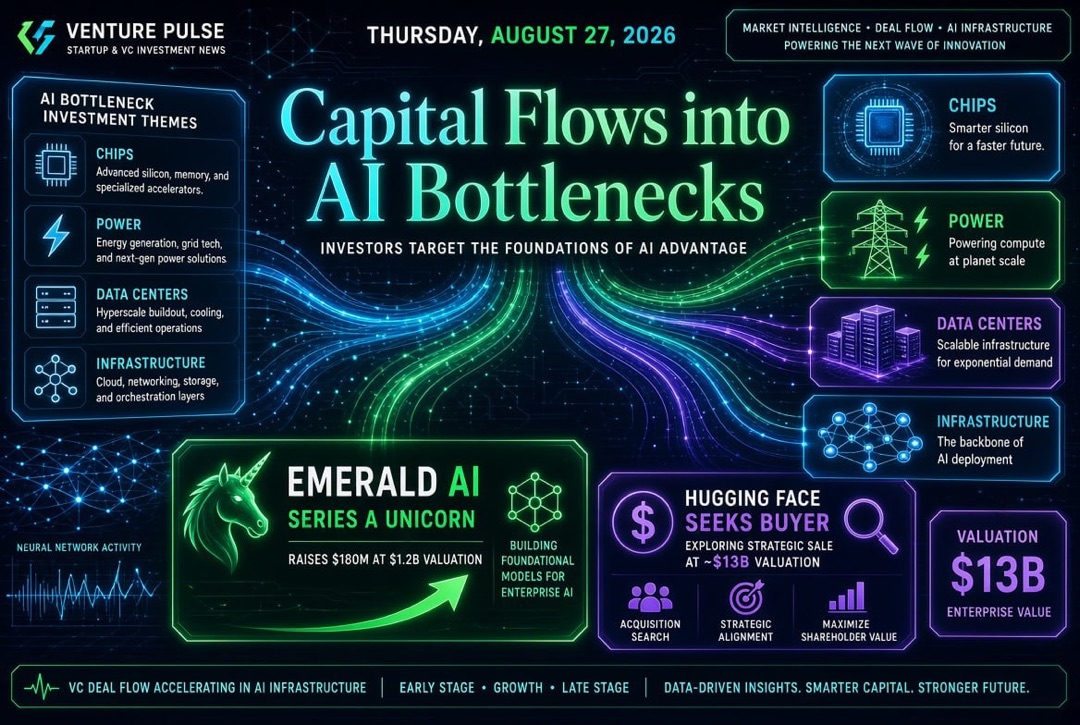
The defining characteristic of 2026 is not merely the growth of venture capital but its sharp concentration in a few major areas. Investors worldwide are once again ready to finance tech startups; however, an advantage is being granted to companies that operate not at the level of "AI wrappers," but at the core infrastructure level: computing, models, agent systems, robotics, fintech ecosystems, and corporate automation.
Several resilient investment theses are emerging from the market:
- AI infrastructure is becoming the new baseline for the venture cycle;
- Fintech is regaining the spotlight due to payments, lending, and embedded finance;
- Robotics and physical AI are transitioning from the experimental phase to industrial applications;
- Venture funds are raising larger mandates again but focusing on narrower strategies;
- IPO and M&A remain key indicators of market maturity.
AI Infrastructure: General Intuition and Runpod Show Where the Big Capital Is Going
The most notable signal for the venture market is the new substantial rounds in AI infrastructure. General Intuition, an artificial intelligence lab utilizing gaming data and scenarios to train models, raised $320 million in a Series A round at a valuation of approximately $2.3 billion. This is a significant example of how venture investments are shifting from classic chatbots to systems capable of understanding actions, environments, and complex behavioral scenarios.
Simultaneously, the market is actively financing computing infrastructure. Runpod raised $100 million at a valuation of around $1 billion, reinforcing the thesis that the demand for GPUs, cloud services for AI developers, and flexible computing infrastructure remains one of the most stable areas for venture capital. For funds, this indicates that the best deals are increasingly found not in the user interface but in the “rails” upon which the new AI economy will operate.
AI Agents and Model Validation: Patronus AI and Sail Research are Shaping a New Market
The next important layer is the infrastructure for AI agents. As artificial intelligence transitions from generating text to autonomously executing complex tasks, investors are beginning to seek companies that address reliability, cost, and scalability issues.
Patronus AI attracted $50 million to develop "digital worlds" for stress-testing AI agents. The essence of the approach is to create simulated environments where models can be tested before they interact with real corporate systems, financial operations, or user data. This direction is particularly vital for banks, insurance companies, consulting firms, software development, and large B2B platforms.
In the same vein, Sail Research raised $80 million for infrastructure catering to long-term AI agents. For investors, this signals that the market is gradually shifting from a race for "the smartest model" to a competition based on the economics of model utilization. Winning companies will be those that can reduce output costs, enhance the stability of agent systems, and make AI applicable in real business processes.
Fintech Mega Rounds: Airwallex and CRED Rekindle Interest in Payment Platforms
Fintech is once again becoming one of the central themes of the venture market. Airwallex raised $320 million at a valuation of approximately $11 billion, affirming strong investor interest in global payment infrastructures, international settlements, corporate wallets, and financial operations automation. For venture funds, this indicates that mature fintech companies with scalable revenue and licenses across various jurisdictions can again command premium valuations.
An even larger signal came from India: CRED received Meta's investment of $900 million at a valuation of around $4.5 billion. This deal is noteworthy not only for its size but also for its strategic context. India remains one of the largest markets for payments, credit products, consumer fintech, and embedded finance. For global investors, this confirms that emerging markets with significant digital audiences can offer opportunities as compelling as those found in the USA and Europe.
Robotics and Physical AI: A New Center of Venture Demand
By 2026, robotics is definitively shedding its niche status. Venture investments in robotics and physical AI have surged, with investors increasingly viewing such companies as the infrastructure of future industries, logistics, construction, defense, resource extraction, and warehouse automation.
Previously, robotics was perceived as a capital-intensive sector with long adoption cycles. The situation is changing for three primary reasons:
- AI models have improved in understanding physical environments;
- The costs of sensors, computing, and prototyping are gradually declining;
- Labor shortages in industry and logistics are driving demand for automation.
For venture funds, robotics is emerging as a sector with high technological barriers to entry. Unlike many software startups, products in this space are more challenging to replicate quickly, while access to real-world operational data creates a long-term competitive advantage.
Venture Funds: Large Platforms and Niche Managers Intensify AI Strategies
There is also notable revival among the investors themselves. Menlo Ventures announced raising $3 billion—the largest fund in its history. This amplifies the overall signal: successful bets on AI companies are allowing large venture platforms to return to LPs with a compelling performance history and to scale new funds for the next cycle.
Concurrently, niche funds are becoming more active. Daybreak raised $100 million for early investments in AI startups, including pre-seed and seed-stage companies. This is significant for the entire ecosystem: despite the concentration of mega rounds among leaders, early-stage investing remains vibrant, particularly if a fund has a clear specialization, access to quality deal flow, and the capability to assist founders at the product, hiring, and early sales levels.
IPO and M&A: The Exit Market is Recovering Unevenly
For venture investors, the central question for the second half of 2026 is not only where to allocate capital but also where to realize returns. The IPO market is currently recovering unevenly: public market investors are willing to purchase technology stories but demand transparent economics, clear revenue, and realistic valuations.
In this environment, M&A can remain a faster exit channel, particularly in AI infrastructure, cybersecurity, fintech, robotics, and enterprise software. Major tech companies are eager to acquire teams, models, data, licenses, and product platforms that accelerate their own strategies in artificial intelligence.
What Matters for Venture Investors and Funds as of June 27, 2026
The current agenda indicates that the venture market is growing again, but this is no longer a market for cheap capital available to all. Investors are becoming more disciplined and are demanding evidence from startups of technological advantages, commercial applicability, and the ability to scale without uncontrolled cash burn.
Key focal points for funds in the coming months include:
- Seek AI startups not only in applications but also within the infrastructure;
- Evaluate fintech companies based on licenses, transaction volume, and customer retention;
- Monitor robotics and physical AI as a new industrial venture cycle;
- Avoid overvalued companies without revenue and proven unit economics;
- Maintain a focus on potential exits through M&A and selective IPOs.
The main takeaway for the startup and venture investment market as of Saturday, June 27, 2026: capital has returned, but it has become much smarter. Companies that are building the infrastructure for the new technological economy—AI computing, agent systems, fintech platforms, robotics, and corporate solutions with real revenue—are winning. This is a period of great opportunity for venture funds, but only under conditions of rigorous selection, discipline in valuations, and a deep understanding of industry trends.