Startup and Venture Investment News for Sunday, May 3, 2026: Record AI Rounds, Rise of Mega Funds, Robotics Deals, and New Benchmarks for Venture Investors
On Sunday, May 3, 2026, venture investors and funds are navigating a market where startups in artificial intelligence, robotics, autonomous systems, computing infrastructure, and enterprise software remain the key drivers. Following a record first quarter of 2026, the global venture capital market is increasingly dividing into two segments: a small number of AI companies attracting tens of billions of dollars, while the majority of startups compete for more cautious, selective, and disciplined capital.
The main theme of the week is not just the increase in venture funding volume, but a shift in the logic of the market itself. Investors are increasingly acquiring not current revenue, but strategic access to technologies that may become the infrastructure of the next decade: AI models, agent systems, robotic intelligence, data centers, semiconductors, defense technologies, and autonomous transport.
AI Remains the Main Magnet for Venture Capital
Artificial intelligence continues to dominate startup and venture investment news. Market data estimates that in the first quarter of 2026, global investments in startups reached approximately $300 billion, with AI companies receiving around 80% of venture capital. This indicates that the market has ceased to be even: capital is concentrating around a small number of companies capable of building fundamental models, computing infrastructure, or applied AI platforms for businesses.
Key Considerations for Funds
- AI startups have become a separate asset class, comparable in scale to public technology giants.
- Rounds reaching tens of billions of dollars are changing the valuation standards for late-stage companies.
- Funds are finding it increasingly difficult to gain allocations in the best deals without significant checks and strategic value for the founders.
This creates a challenging dilemma for venture funds. On one hand, ignoring artificial intelligence is no longer an option. On the other hand, entering the best AI startups is becoming increasingly expensive, with the risk of asset overvaluation growing alongside the size of the rounds.
Founders Fund Accelerates the Mega Fund Race
One of the main events for the market has been the Founders Fund attracting a new fund of approximately $6 billion. This is a signal for the venture industry: the largest players are preparing to continue the race for late-stage investments, AI infrastructure, defense technologies, fintech, and startups with potential monopolistic positions.
The previous Founders Fund was quickly directed toward a limited number of large deals, including investments in Anthropic, Anduril, OpenAI, Stripe, Ramp, and Cognition AI. This strategy illustrates that the largest funds are shifting from traditional diversification to concentrated bets on companies that can become systemic platforms.
The venture market is increasingly resembling a strategic capital market. The winners are not those funds that merely identify promising startups, but those that can rapidly close large rounds, assist with infrastructure, clients, regulation, and global expansion.
Anthropic and the New Ceiling for AI Company Valuations
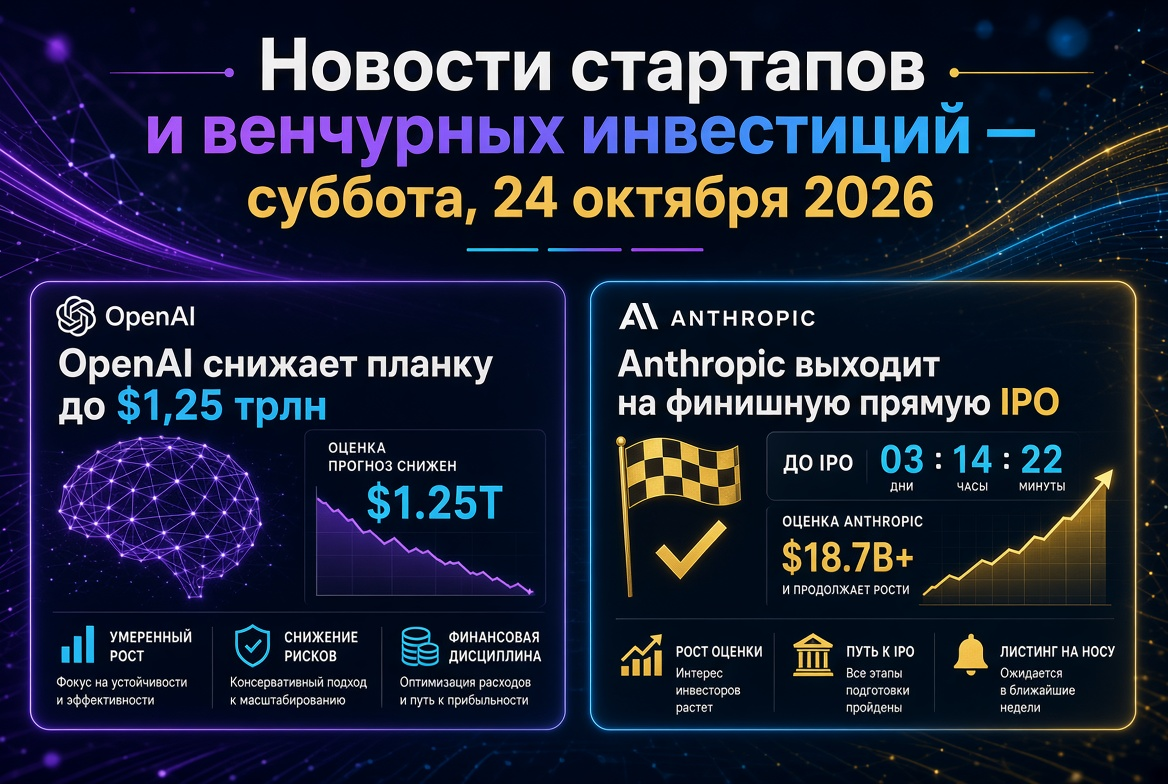
Investor attention remains strong around Anthropic. The market is discussing the possibility of a new major round that could elevate the company’s valuation to about $900 billion. Even if the deal closes on different terms, the very range of negotiations indicates how aggressively the market is revaluing leaders in fundamental AI models.
For venture investors, this is an important benchmark. AI company valuations are no longer built solely on revenue multiples. They now take into account access to computing power, model quality, enterprise customer bases, developer ecosystems, partnerships with Big Tech, and the company's potential role in the global AI infrastructure.
- Fundamental models receive a premium for scale and technological leadership.
- AI infrastructure is becoming a priority for late-stage funds.
- Applied AI solutions must demonstrate real cost savings or revenue growth for clients.
London Strengthens its Position in the Global AI Ecosystem
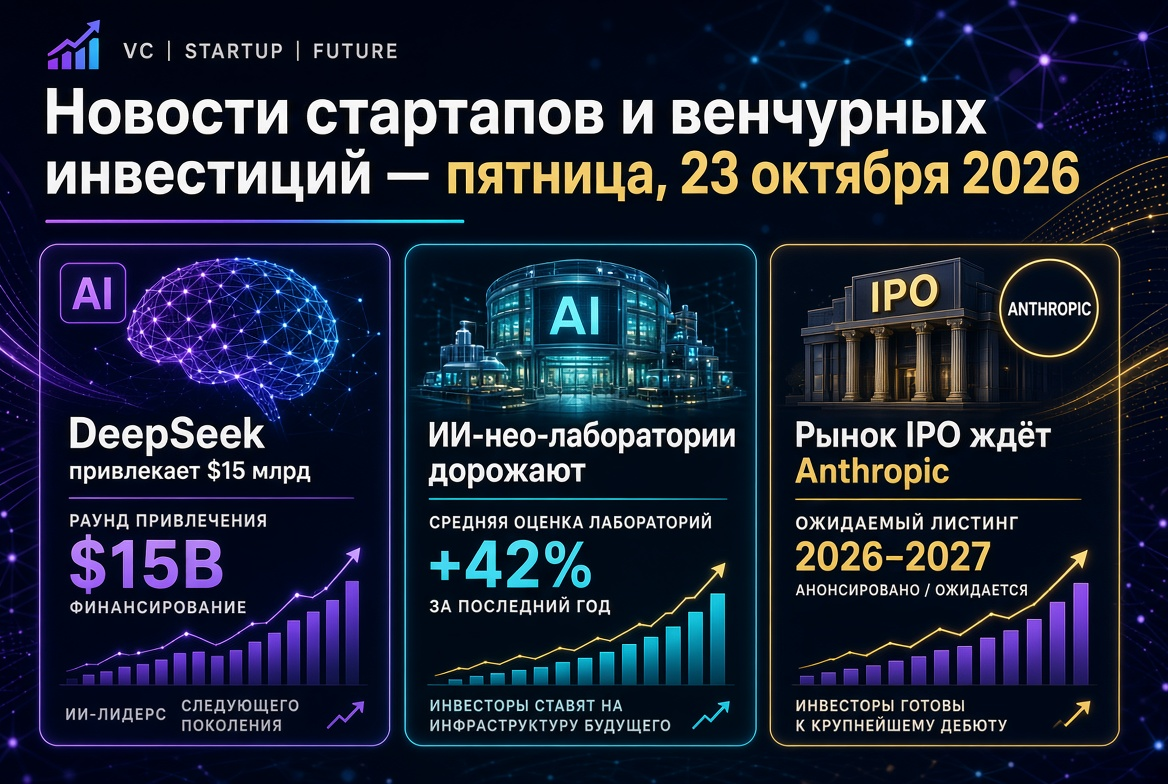
The European startup market has also received a strong boost. The British AI company Ineffable Intelligence, founded by former Google DeepMind researcher David Silver, raised approximately $1.1 billion in seed funding at a valuation of around $5.1 billion. For Europe, this is a highly significant event: the region is proving it can compete for capital in the frontier AI segment, not just in fintech, SaaS, and climate technologies.
Particularly importantly, a new investment logic is forming around such companies. Funds are willing to finance not only product startups but also research laboratories that may not yet have a classic business model but possess strong scientific teams and potentially groundbreaking technologies.
Robotics Becomes the Next Focus After Generative AI
Another important signal for the venture market is the growing interest of major tech companies in robotic intelligence. Meta has acquired Assured Robot Intelligence, a startup developing AI models for humanoid robots. This deal underscores the rising interest in the "brain" of robots—the software level that enables machines to understand human behavior, adapt to environments, and perform physical tasks.
For venture funds in 2026, robotics is no longer just a hardware story. The most attractive companies seem to be those working at the intersection of AI, sensing, simulation, industrial data, and autonomous control.
Promising Directions in Robotics AI
- Intelligent control systems for humanoid robots;
- Software for object manipulation;
- Autonomous systems for warehouses, factories, and logistics;
- Robotic training models in simulated environments;
- Industrial AI platforms for automating physical labor.
India Shows Mixed Dynamics: Startup Growth and Pressure on Late-Stage
India’s venture ecosystem remains one of the key regions for global investors, but the dynamics have become less straightforward. Indian startups raised about $660 million in April 2026, slightly above last year's levels, but significantly decreased compared to March. Late-stage investments remain under pressure due to IPO delays, public market caution, and reevaluations of tech company valuations.
The largest deals of the month indicate that capital is still available for companies with clear economics, strong regulatory positioning, and public market exit potential. However, funds are increasingly demanding not only growth but also proven operational efficiency.
What is Changing in Venture Fund Strategies
Venture investments in May 2026 are becoming more polarized. On one end are mega funds fighting for shares in the largest AI companies. On the other are early-stage funds looking for undervalued teams in applied niches. The average market area appears most challenging: startups are already demanding large checks but do not always prove scalability, profitability, and sustained demand.
Rational Strategies for Funds
- Maintain exposure to AI, but avoid automatic participation in overvalued rounds.
- Seek applied verticals: finance, healthcare, industry, logistics, legal services, cybersecurity.
- Evaluate not only technology but also access to data, sales channels, and computing costs.
- Distinguish between fundamental AI labs and ordinary AI-wrapper startups.
- Look at M&A as a genuine exit path, particularly in robotics and enterprise software.
Main Risks for the Venture Market
Despite record funding volumes, the startup and venture investment market remains vulnerable. The primary risk is an excessive concentration of capital in a limited number of companies. If monetization expectations for AI prove to be exaggerated, revaluation could impact not only market leaders but also adjacent segments: data centers, chips, cloud infrastructure, and enterprise software.
The second risk relates to the IPO market. Large private valuations demand liquidity, but public investors may be more disciplined than private funds. This is particularly important for late-stage startups that hope to go public in 2026-2027.
What Investors Should Pay Attention To
For venture investors and funds, the main task in the coming weeks is to separate strategic trends from overheated valuations. Startup and venture investment news for Sunday, May 3, 2026, indicates that the market remains strong, but is becoming more complex, expensive, and competitive.
The focus should remain on four areas: AI infrastructure, robotic intelligence, enterprise AI, and startups with real economics. Funds should closely monitor new mega funds, negotiations around Anthropic, deals in Europe, and the dynamics in India as one of the largest emerging venture markets.
A key takeaway for the market: 2026 might not only be a year of record venture capital but also a year of definitive division in the startup ecosystem between global technology leaders and companies that must demonstrate effectiveness faster than in the previous cycle.