Current News on Startups and Venture Investments for Sunday, July 5, 2026: AI Infrastructure, Semiconductors, Defense Tech, Climate Tech, IPOs, and New Opportunities for Venture Funds
As of Sunday, July 5, 2026, the global startup market has entered the second half of the year in a significantly more aggressive investment phase. After several years of caution, venture funds are ramping up deal volumes once again, but the structure of demand has shifted: capital is increasingly focused not on consumer applications, but on AI infrastructure, AI chips, autonomous systems, defense technologies, climate tech, and companies with clear paths to IPOs or strategic exits.
The main theme of the day for venture investors and funds is the shift from the "AI narrative" to funding real production capabilities: computational platforms, specialized processors, energy infrastructure, autonomous control systems, and corporate AI services. By 2026, the startup market is resembling less of a classic growth cycle and more of a race for control over the foundational layers of the new technological economy.
Global Venture Market: Record Capital and High Deal Concentration
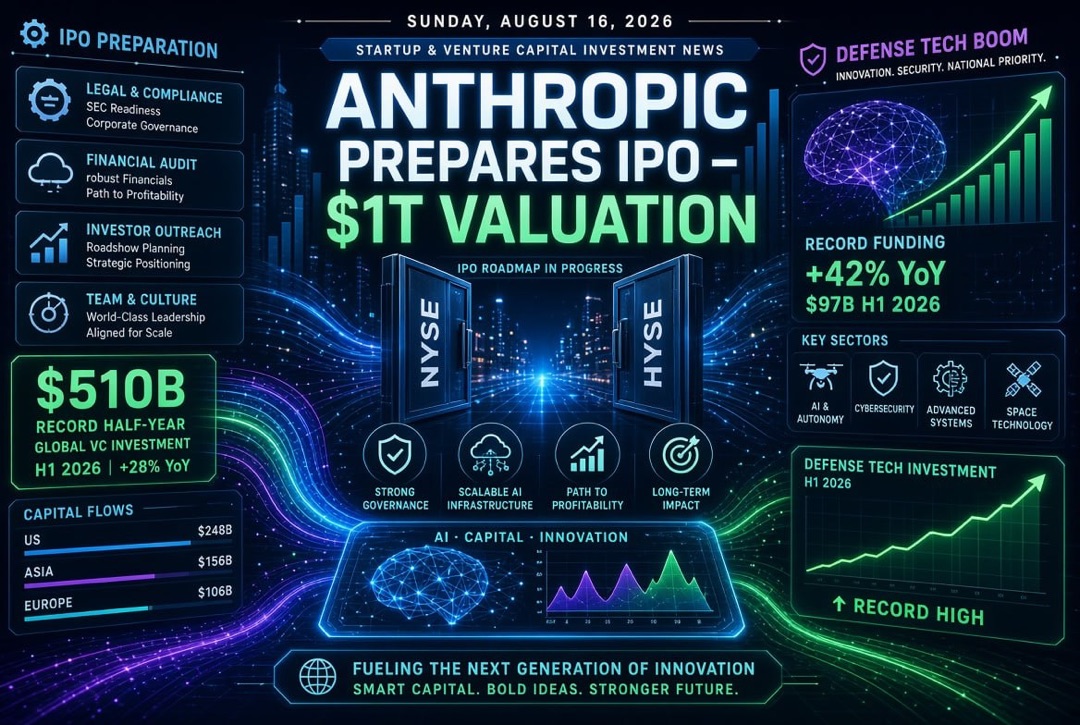
Startup and venture investment news at the beginning of July indicates that global venture capital is once again eager to fund growth but is choosing companies with much stricter criteria than during the 2020-2021 boom. Market estimates suggest that the first half of 2026 has been one of the strongest periods in the history of venture investments. Notably, growth has been significant in segments such as AI infrastructure, defense technologies, autonomous transportation, semiconductors, and energy solutions for data centers.
For venture funds, this signifies an important shift: the market no longer pays a premium simply for the word "AI" in a pitch. Premiums are awarded to startups that control scarce resources:
- Computing power and cloud infrastructure for artificial intelligence;
- Chips and architectures for inference workloads;
- Dual-use autonomous systems;
- Corporate AI tools with measurable cost savings;
- Technologies related to energy efficiency, cooling, and sustainability of data centers.
Venture investors are increasingly looking not just at revenue growth but also at access to supply chains, margins, technology security, depth of corporate demand, and the likelihood of an exit through IPO or M&A.
AI Infrastructure: Together AI Confirms Demand for Open Model Ecosystem
One of the key events of the week was the significant round raised by Together AI. The company, which develops infrastructure for training and deploying open-source models, secured approximately $800 million at a valuation of about $8.3 billion. For the venture investment market, this is a signal: investors continue to bet not only on closed models but also on platforms that allow companies to deploy alternative AI infrastructure.
Demand for such solutions is growing for several reasons:
- Large corporations want to reduce dependence on a single model provider;
- The cost of inference is becoming a critical factor for scaling AI products;
- Open-source models are increasingly being adopted in enterprise environments;
- Regulators and governments demand greater transparency and data control.
For funds, this confirms the investment hypothesis: the next layer of value in AI will be created not only by model developers but also by companies that enable affordable, reliable, and scalable use of artificial intelligence in real businesses.
AI Chips and Inference: Etched, Oxmiq, and Nearfield Accelerate Hardware Race
The segment of AI chips remains one of the most capital-intensive areas of the venture market. Startup Etched raised about $800 million and announced major client contracts for AI inference systems. The company's bet is on specialized architecture geared towards running modern models, rather than general-purpose computing. This reflects a broader trend: the market is seeking alternatives to dominant GPU platforms, especially in scenarios where cost, energy consumption, and latency are critical.
Meanwhile, Oxmiq secured $35 million to develop a unified architecture for AI computations. Interest in the company is bolstered by the reputation of its founding team: the market closely watches projects with deep expertise in semiconductors, IP blocks, and system architecture.
Another important example is Nearfield Instruments, a Dutch company in advanced chip production control equipment. The round of $380 million at a valuation of about $1.6 billion indicates that venture capital is delving deeper into the semiconductor supply chain: not only chips but also tools essential for the mass production of AI processors.
For venture investors, this means an expansion of opportunity maps: not only "Nvidia competitors" but also suppliers of measurement systems, cooling technologies, memory, chip packaging, and manufacturing software are becoming attractive.
Defense Tech and Autonomous Systems: Quantum Systems as a Symbol of European Turnaround
Defense technologies are continuing to emerge from niche status and are transforming into one of the major venture sectors of 2026. German drone manufacturer Quantum Systems raised approximately $1.2 billion at a valuation of about $8 billion. This is one of the most notable rounds in European defense tech and an important indicator of how quickly institutional investors' attitudes towards dual-use companies are changing.
The market sees several drivers of growth:
- Increased defense budgets in Europe and NATO countries;
- Demand for autonomous surveillance and reconnaissance systems;
- A shift from heavy defense platforms to software-defined modular solutions;
- Acceleration of technology procurements that have been tested in real-world conditions.
For venture funds, defense tech is becoming a distinct investment class. Unlike classic software-as-a-service, this segment carries higher regulatory barriers and longer sales cycles, but successful scaling can lead to substantial government contracts, strategic partnerships, and premium valuations.
IPOs and Exits: The Liquidity Market is Reopening
The venture ecosystem cannot sustain growth without exits, and July 2026 indicates that the liquidity window is gradually expanding. Lime went public, raising about $167 million in its IPO. Although the company has gone through several challenging cycles—from a micromobility boom to pandemic-related valuation declines—the mere fact of the offering confirms that investors are once again willing to consider venture-backed companies with recognizable brands and a global presence.
Another significant signal is the strong debut of Bending Spoons on Nasdaq. The Italian tech group, which owns several digital assets, experienced a sharp rise on its first trading day. This is particularly meaningful for European startups and funds: the public capital market is ready to evaluate not only American AI companies but also European tech platforms with proven operating models.
Special attention should be paid to Wayve. The British autonomous driving company is preparing to leverage the private market infrastructure of the London Stock Exchange for a transaction involving existing shares. This could set an important precedent for late-stage startups: liquidity for employees and early investors will increasingly be provided not only through IPOs but also through regulated private venues.
Climate Tech: Capital Returns to Energy, Grids, and Data Centers
Climate tech remains a critical area for global venture investments, but the focus is shifting from broad ESG narratives to concrete infrastructure economics. European climate startups secured over $7 billion in the first half of 2026, with June being particularly strong due to several major rounds.
The most interesting areas for funds are:
- Energy infrastructure for AI data centers;
- Cooling systems and energy consumption management;
- Grid tech and software for energy networks;
- Materials for industrial decarbonization;
- Climate fintech and tools for managing carbon risks.
For venture investors, this is no longer just a "green" agenda. Climate tech is increasingly becoming part of AI infrastructure, energy security, and industrial policy. Companies addressing energy cost and capacity accessibility issues are gaining strategic importance for the entire technological economy.
Corporate AI and Vertical Startups: The Market Matures
At early and mid-stages, venture funds continue to finance AI startups, but selection criteria are becoming stricter. Investors are interested not in demo products but in solutions that can be integrated into corporate processes: software development, customer support, compliance, analytics, sales, security, and knowledge management.
The $135 million round for 8090 Labs demonstrates interest in AI coding platforms for corporate teams. The market is now evaluating not only the speed of code generation but also quality control, auditing, security, token costs, and integration with existing IT infrastructure.
Another example is Coval, which raised capital for testing and monitoring AI agents. This is an important signal: as autonomous voice and chat agents grow, there is increasing demand for reliability infrastructure. For venture funds, this opens a separate market—the "control layer" for AI—where startups responsible for simulations, quality assessment, observability, security, and regulatory compliance will be in demand.
Geography of Venture Investments: US Leads, Europe Strengthens its Position
The geographical landscape of the venture market remains uneven. The US continues to lead in AI, cloud infrastructure, enterprise software, and semiconductors. The American market accumulates the largest checks, particularly in late stages and mega-rounds.
Europe, however, is noticeably strengthening its position in three areas: defense tech, climate tech, and industrial AI. The rounds of Quantum Systems, Nearfield Instruments, and the strong public debut of Bending Spoons indicate that the European tech ecosystem is maturing and capable of attracting global capital.
The Middle East is also becoming an increasingly important player in the venture market. Strategic investors from the region's participation in AI infrastructure reflects a long-term bet on computational power, sovereign AI platforms, and diversification of economies beyond the resource sector.
Key Takeaways for Venture Investors and Funds
As of July 5, 2026, the startup and venture investment market is shaping several practical insights for funds, family offices, and strategic investors.
- AI infrastructure remains the primary magnet for capital. The strongest demand persists for compute, inference, chips, cloud platforms, and cost optimization tools.
- Defense tech is moving into the mainstream. European and North American funds are increasingly considering autonomous systems, drones, robotics, and software-defined defense.
- The IPO window is selectively opening. The public market is ready to accept companies with clear revenue, operational discipline, and strong branding, but weak narratives will still face pressure.
- Climate tech is becoming an infrastructure bet. Energy, cooling, networks, and industrial materials are gaining new importance due to the rise of AI data centers.
- The early AI market requires proof points. Simple user growth is not enough: funds want to see retention, gross margins, customer cost reductions, and product security.
The overall landscape for the venture market remains positive, though not without risks. Significant capital has returned to startups; however, it is being allocated very selectively. Companies that focus not on trendy applications but on critical technological infrastructure—computation, chips, autonomy, security, energy, and corporate AI—will define the news of startups and venture investments in the second half of 2026.