Current Startup and Venture Capital News for Wednesday, June 24, 2026: Baseten Mega Round, Growth in AI Infrastructure, Fund Interest in Defense Tech, Cybersecurity, and AI Chips
Wednesday, June 24, 2026, marks a significant day for the global startup market, highlighted by major deals in artificial intelligence, cybersecurity, defense technologies, and AI infrastructure. Venture investors and funds continue to concentrate capital in companies that are not just creating applications but foundational technological platforms: computational power, inference models, AI chips, autonomous systems, critical infrastructure protection, and enterprise AI services.
The main highlight of the day is Baseten's new mega round of $1.5 billion at a valuation of $13 billion. This deal reinforces the thesis that the venture capital market in 2026 is increasingly dividing into two segments: extremely large AI startups with access to capital and other tech companies that must prove efficiency, revenue, and sustainable business models much more rigorously.
Baseten: AI Infrastructure Remains the Main Magnet for Venture Capital
California-based AI startup Baseten has raised $1.5 billion, bringing its valuation to $13 billion. For the venture market, this is not just another large round; it signifies a shift in investor focus from generative AI applications to the infrastructure upon which the commercial use of artificial intelligence is built.
Baseten develops software and computational infrastructure for configuring and deploying AI models. For corporate clients, both the quality of models and the cost of inference—the stage where the trained model delivers results in real business processes—are of paramount importance. This is why AI infrastructure has become one of the most attractive segments for venture funds.
- Round amount: $1.5 billion.
- Company valuation: $13 billion.
- Key theme: Reducing costs and scaling AI inference.
- Investment takeaway: Venture capital is flowing into companies that control the foundational layer of the AI economy.
Menlo Ventures Raises $3 Billion: Funds Bet on AI Again
Another significant signal for the market is that Menlo Ventures announced the raising of $3 billion in new capital for investments in AI companies at various stages of development. For venture investors, this confirms that despite discussions about overheating valuations, the largest funds continue to increase exposure to artificial intelligence.
The new capital will be directed towards AI infrastructure, foundational technologies, enterprise applications, healthcare AI, and consumer AI. This shows that venture funds are increasingly viewing artificial intelligence not as a separate sector, but as a universal technology platform that is reshaping software, medicine, finance, industry, defense, and consumer services.
For startups, this means heightened competition for fund attention. Simple positioning as an AI company is no longer sufficient. Investors will be looking at:
- Team quality and technical expertise;
- Actual revenue and growth rate;
- Cost of customer acquisition;
- Access to data and computational resources;
- Resilience of the business model against large tech platforms.
Qualcomm and Modular: M&A in AI Chips Becomes a Strategic Direction
In the mergers and acquisitions market, investors' attention has been caught by reports of Qualcomm's negotiations to acquire the AI chip startup Modular for around $4 billion. If the deal is completed, it will provide further confirmation that large tech corporations are prepared to purchase promising startups to strengthen their positions in AI chips, data centers, and autonomous systems.
For venture funds, this represents an important liquidity factor. Following a period of a weak IPO market, strategic deals could become the primary channel for exiting investments, particularly concerning startups in the AI hardware, semiconductor infrastructure, data center processors, and autonomous transport solutions segments.
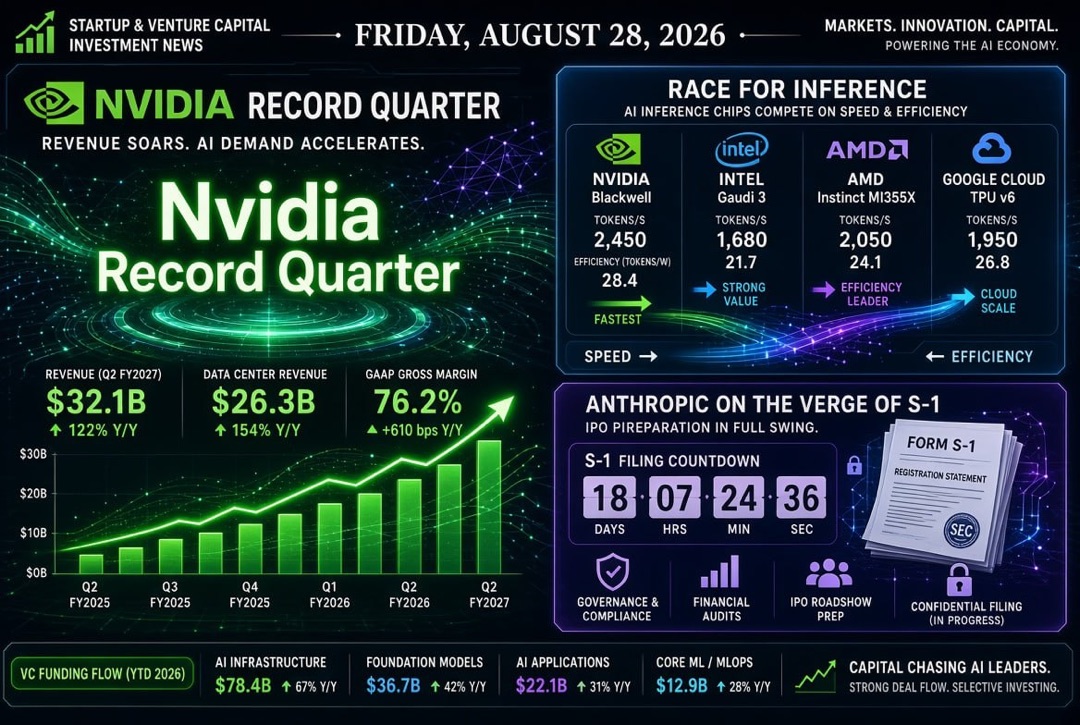
The deal involving Modular also indicates that investors are beginning to reassess companies related to computational architecture. While in 2023-2024, primary interest was concentrated on generative models, by 2026 the focus is shifting towards those who control chips, infrastructure, computational optimization, and cost scaling.
Defense Technologies: Stark and a New European Venture Cycle
The European startup market is gaining new momentum through defense technologies. German drone startup Stark has reportedly secured substantial funding at an estimate of around €3.5 billion. Leading international funds are among the investors, and the deal reflects a broader trend: defense tech is becoming a full-fledged category for venture investments.
This is especially significant for Europe. After a prolonged period of caution regarding the defense sector, venture funds are increasingly viewing drone systems, autonomous navigation, cybersecurity, satellite analytics, and dual-use technologies as promising areas for long-term capital.
A key takeaway for funds is that defense startups are no longer perceived as a narrow niche; they are becoming part of a new industrial policy where private capital, government budgets, and strategic orders are shaping stable demand.
Cybersecurity and Sovereign AI: Dream Strengthens the Trend Towards Critical Infrastructure Protection
Israeli AI cybersecurity startup Dream recently secured $260 million at a valuation of $3 billion. The company is developing solutions to protect government systems and critical infrastructure, including energy, water, and industrial facilities.
For venture investors, this is an important market signal. Cybersecurity is transitioning from classic corporate network protection to an AI versus AI model, where attacks and defenses are increasingly based on automated systems. Amid rising geopolitical risks, the demand for such solutions stems not only from corporations but also from governments.
The most promising areas in the cybersecurity startup market include:
- Protection of critical infrastructure;
- Sovereign AI platforms for governments;
- AI Security Operations Centers;
- Data and model protection in corporate environments;
- Automated detection of AI-generated attacks.
India and Emerging Markets: Growing Interest in Local AI Companies
There is also significant activity in emerging markets. Indian AI and cybersecurity startups continue to attract capital from both international and local funds. For global investors, India is evolving into not only a market for technology consumption but also a source of engineering teams, AI products, and scalable B2B solutions.
There is particularly noticeable interest in companies within the healthcare AI, enterprise automation, fintech infrastructure, and cybersecurity segments. Against the backdrop of high development costs in the US and Europe, venture funds are increasingly viewing emerging markets as a source of more capital-efficient startups.
For investors, this presents two opportunities: entering promising companies at earlier stages and building a geographically diversified portfolio. However, risks are also heightened: regulation, currency volatility, corporate governance quality, and dependence on local demand remain crucial factors for due diligence.
Overall Market Trend: Capital Concentration is Around AI, but Efficiency Demands are Increasing
The global venture capital market in 2026 is showing a record concentration of capital in AI companies. According to industry reports, the first quarter of 2026 was one of the strongest periods in venture capital history, with a significant portion of investments directed towards artificial intelligence, frontier labs, AI infrastructure, robotics, and autonomous systems.
However, funds must understand that the growth in capital volumes does not imply an easy market for all startups. On the contrary, the gap between leaders and other companies is widening. Startups with strong revenue, technological advantages, and access to major corporate clients are receiving mega rounds, while companies lacking proven unit economics face stricter conditions.
In practice, this means that venture funds will be more actively segmenting the market into three groups:
- Infrastructure AI leaders — receiving premium valuations and large rounds;
- Niche B2B startups with revenue — attracting capital at reasonable multiples;
- Companies without sustainable economics — facing down rounds, bridge financing, or acquisition by strategic players.
What This Means for Venture Investors and Funds
For venture investors, the startup news on June 24, 2026, yields several practical conclusions. Firstly, AI infrastructure remains the hottest area, but entering such deals is becoming increasingly expensive. Secondly, defense tech and cybersecurity are evolving into independent investment verticals supported by governments and large corporations. Thirdly, M&A in AI chips and infrastructure could become a key source of liquidity.
Funds should pay attention to the following investment themes:
- AI inference and cost optimization;
- Semiconductors and architecture for data centers;
- Defense and dual-use technologies;
- Cybersecurity for critical infrastructure;
- AI-native enterprise software;
- Healthcare AI and automation of medical processes;
- Capital-efficient startups from emerging markets.
Conclusion of the Day: The Startup Market Enters a Phase of Selecting the Strongest
The overarching picture for Wednesday, June 24, 2026, is as follows: the venture market remains active but is becoming more selective. Baseten's mega round, the new capital from Menlo Ventures, Qualcomm's potential deal with Modular, the growth of defense tech in Europe, and substantial investments in cybersecurity demonstrate that investors are only willing to pay high valuations for companies at the forefront of long-term technological shifts.
For startups, this is a market full of opportunities but also marked by high competition. For venture funds, it is a period where the quality of selection is more crucial than broad diversification. Success will go to those investors who can differentiate between temporary AI hype and genuine infrastructural value, as well as those who can enter companies poised to become strategic assets for corporations, governments, and global technology platforms.