Current Startup and Venture Investment News as of March 23, 2026: Megarounds in AI, Increasing Interest in Infrastructure and Defense Tech, Changes in the IPO Market, and Strategies of Venture Funds
As we approach a new week, the global startup and venture investment market maintains a robust pace, yet it is becoming increasingly polarized. Capital continues to flow actively into artificial intelligence, defense technologies, AI infrastructure, and select fintech segments, while traditional software models and certain late-stage investments face more stringent evaluation and exit requirements. For venture investors and funds, this signifies a market that, while not weakened, has become significantly more selective.
A primary feature of the current cycle is the concentration of capital in a small number of companies and sectors. AI startups continue to attract megarounds, leading platforms accelerate corporate commercialization, and funds are increasingly searching not merely for technology, but for scalable sales channels, access to corporate clients, and sustainable infrastructure revenue. Simultaneously, Europe is enhancing its institutional support for innovation, and fintech and deep tech confirm that the market is no longer limited to generative AI.
Below are key themes shaping the market agenda for Monday, March 23, 2026:
- AI remains the main magnet for venture capital and new "unicorns."
- Venture investments are shifting towards infrastructure, chips, defense, and enterprise solutions.
- Funds and private equity are increasingly looking for ways to accelerate AI monetization through corporate channels.
- Europe is strengthening its position in fintech and deep tech, narrowing the gap with the U.S.
- The IPO and exit market remains open only to quality stories, with weak offering windows closing rapidly.
The AI Sector Remains the Main Attraction for Capital
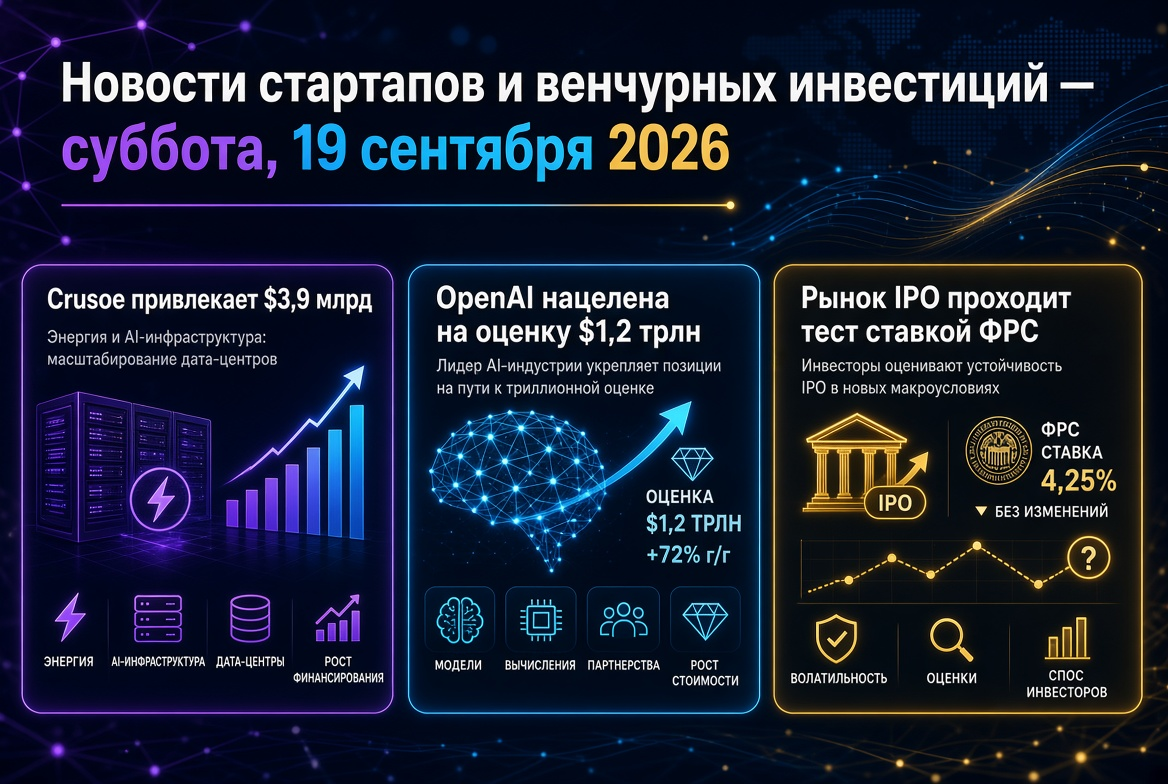
Evaluating the startup market in March 2026 based on capital distribution reveals that the dominance of artificial intelligence is nearly unquestionable. AI startups are responsible for the largest rounds, set new evaluation benchmarks, and dictate the investment agenda of global funds. For venture investors, this has evolved beyond a trendy sector—it is now a fundamental layer of the entire new technological economy—from models and chips to applied corporate solutions.
The market is paying particularly close attention to companies that combine a strong scientific foundation with the capability for industrial scaling. In this context, investments in AI are increasingly viewed not merely as bets on individual products, but as purchases for access to future infrastructure standards. This is why funds are willing to accept high valuations if they see a chance to secure a position among the next generation of platform winners.
Megarounds Confirm Increasing Appetite for Large Bets
Recent weeks have shown that the market is once again prepared for very large deals. The startup AMI Labs, associated with a new wave of research in "world models" and deeper machine logic, has raised over $1 billion, while in the defense segment Anduril is discussing a new multibillion-dollar round that could effectively double its valuation. This signifies an important signal: capital is returning to projects that aspire not to niche functionality but to a strategic role in the industry.
For the startup and venture investment market, this indicates an expansion of the circle of "acceptable megarounds." Previously, super-large deals were concentrated around a few generative AI leaders, but now investors are willing to finance a broader group of companies—within defense tech, AI infrastructure, enterprise AI, and the chip sector. This makes the market deeper, yet simultaneously enhances the divide between leaders and other startups.
The Focus is Shifting from Models to Infrastructure and Corporate Implementation
One of the most significant trends for the future is that venture capital is increasingly flowing towards areas where there is infrastructure, integration, and repeatable corporate revenue. Investments in SambaNova and Axelera AI demonstrate that the market believes not only in model creators but also in developers of computational bases, inference solutions, and specialized AI chips. This is no longer a bet on abstract "AI growth," but rather on specific market bottlenecks where margins will be formed.
Additionally, it is important to highlight the strengthening enterprise vector. Major AI companies are striving to offer not just access to a model, but comprehensive solutions for corporations, funds, and large industrial groups. Practically, this means a growing interest in startups that can integrate into corporate processes, reduce costs, and create measurable ROI. For funds, this is especially crucial, as the market is once again demanding economic strength rather than merely a growth narrative.
The New Link Between Venture Capital and Private Equity is Changing the Market
One of the most significant shifts in March is the closer alignment of the venture investment world, AI platforms, and private equity. Major players are looking into joint structures that will facilitate the faster implementation of AI in portfolio companies and immediately scale commercialization. Essentially, the market is seeking a new format where investing in technology is directly accompanied by a distribution channel, corporate order, and integration at the level of entire groups of companies.
For startups, this opens up a new logic of growth. Winning will not only depend on having the best product but also on how quickly they can gain access to the enterprise ecosystem. For venture funds, this shift is even more pronounced: value creation increasingly relies not just on the next round but on the ability to align companies with paying corporate clients. In this sense, the startup market is becoming closer to the infrastructural model of private markets.
Europe Strengthens Its Position in Fintech and Startup Policy
The European market is also sending strong signals. London is reinforcing its status as a global fintech hub, and Europe is demonstrating noticeable improvement in capital inflow into financial technologies. Amid this, it is notably important that measures are being discussed within the EU to simplify company launches under unified regulations. If these initiatives are fully realized, the European startup ecosystem could receive structural acceleration in the coming years.
For global funds, this means that Europe is not just a secondary market after the U.S., but a fully-fledged platform for deals in fintech, AI infrastructure, cybersecurity, and industrial deep tech. In conditions where some American segments are already overheated in valuations, European assets are appearing increasingly attractive in terms of price, engineering quality, and regulatory predictability.
The Market is Expanding Beyond AI: Healthtech, Cybersecurity, and Defense Tech
Although artificial intelligence dominates the headlines, the venture market is broadening. The recent round for Grow Therapy showcases persistent interest in healthtech platforms with clear business models and strong demand from end-users. In cybersecurity, there remains high interest in developers of solutions that are integrated directly into the workflows of engineers and enterprise teams. Moreover, defense tech is moving out of the "controversial niche" category and solidifying as one of the fastest-growing investment segments.
For venture investors and funds, this is promising news. The market is not confined to a single asset class, thus offering more diversification scenarios. However, funding flows only to areas with either a technological uniqueness, a robust geopolitical driver, or clear commercial applicability. The era of "funding everything technological" has not returned—rather, we are seeing a return to funding the best.
Exits and IPOs: The Window is Open, but Only for the Strongest
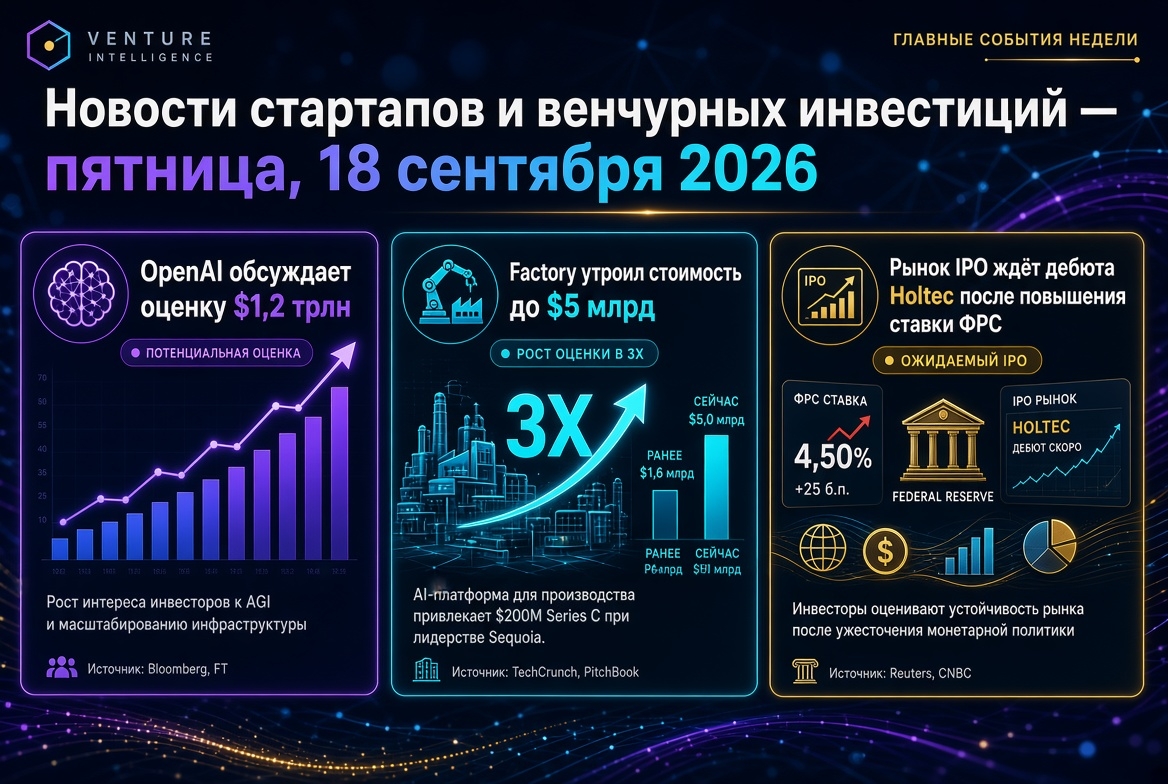
Another important narrative on March 23, 2026, is that the exit market remains uneven. On one hand, some companies are still preparing for the public market, and new confidential filings confirm that interest in IPOs is alive. On the other hand, some issuers are postponing their offerings due to volatility and stricter risk assessment. This particularly pertains to those stories where investors do not see sufficient premiums for entering the market at this time.
For startups, this means they must build their companies ready for multiple scenarios: IPO, strategic sale, secondary deals, or a more extended private cycle. For funds, the logic is even stricter: exits must be earned again. Simply having a brand, growth, or a previous high valuation no longer guarantees liquidity.
What This Means for Venture Investors and Funds in the New Week
As the week commences, the strategy for market participants looks fairly clear:
1. Where Maximum Capital Interest is Concentrated
- AI infrastructure and corporate AI solutions;
- chips, inference, computational platforms;
- defense tech and dual-use technologies;
- fintech in Europe and scalable B2B models;
- healthtech with clear unit economics.
2. What Investors Will Scrutinize Particularly Stringently
- speed of product commercialization;
- access to corporate sales channels;
- margin after scaling;
- technology defensibility and team quality;
- realism of exit scenarios within a 2-4 year horizon.
The main takeaway for Monday, March 23, 2026, is straightforward: the startup and venture investment market remains exceptionally strong, but it no longer tolerates mediocrity. Capital is available, funds are active, and new large rounds emerge almost every week. However, the companies that prevail will be those capable of marrying technological advantage with commercial discipline, as well as those integrated into long-term structural trends—artificial intelligence, corporate automation, security, deep tech, and the new economy's infrastructure. For investors, this continues to be a market of opportunities, but only with high selection accuracy.