Startup and Venture Investment News for Tuesday, June 30, 2026: AI Infrastructure, Major Venture Rounds, Robotics, Fintech, IPO Exits, and Key Trends in the Global Startup Market for Investors and VC Funds
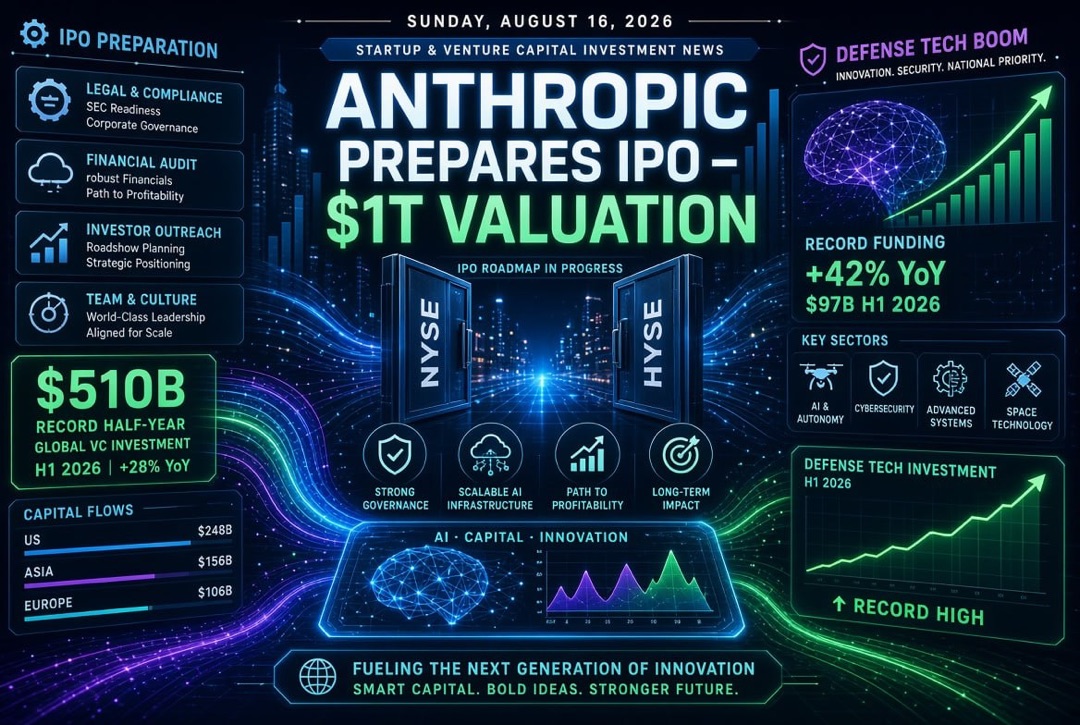
On Tuesday, June 30, 2026, the global market for startups and venture investment is entering a new phase: capital continues to concentrate around artificial intelligence, yet investors are increasingly looking towards infrastructure, robotics, fintech, deeptech, and public exits. Following a record first quarter in 2026, the venture market remains highly active; however, the quality of deals is becoming more important than the quantity of rounds.
The main topic of the day is the shift of venture capital from abstract AI euphoria to more pragmatic investments in AI infrastructure, applied AI services, physical automation, and companies capable of swiftly converting technological advantages into revenue. For venture investors and funds, this signifies a change in investment logic: the market is still ready to pay premium valuations, but only for startups with clear monetization, scalable products, and exit potentials through IPOs or M&A.
Key Agenda for the Venture Market on June 30, 2026
Today's startup and venture investment news is shaped around several major trends that are setting the direction for the global ecosystem:
- AI infrastructure remains the main capital magnet. Investors are funding not only model developers but also companies that provide computation, inference, data, development tools, and enterprise AI deployment.
- Robotics is moving out of the experimental phase. Startups in humanoid robotics and industrial automation are gearing up for the public market.
- The IPO window is gradually opening. Tech companies in the US, China, and Europe are increasingly considering listings as a viable exit mechanism.
- Fintech is once again receiving large investments. Late-stage rounds confirm that investors are ready to return to mature companies with reduced risks and existing revenue.
- Europe and India are strengthening their positions. Regional venture markets are becoming increasingly prominent in the global competition for capital.
AI Infrastructure: The Main Attraction for Venture Capital
Artificial intelligence remains the chief driver of the global venture market. However, while the primary focus from 2023 to 2025 was on foundation models and generative AI products, in 2026, capital is increasingly focused on the infrastructure layer. For funds, this is a more rational bet: infrastructure startups sell tools to a multitude of corporate clients, making them less dependent on the success of a single application.
A notable example is Baseten's major round, which raised $1.5 billion at a valuation of around $13 billion. The company operates in the AI infrastructure segment and helps businesses customize and deploy artificial intelligence models. This is an important signal for the venture market: investors are willing to pay high multiples for startups that solve issues around cost, speed, and scalability in AI implementation.
For venture funds, the key question is no longer "Does the startup have AI?" but rather, "What part of the AI chain does it control?" The highest interest is in:
- infrastructure for inference and computation optimization;
- platforms for enterprise AI deployment;
- AI development tools and no-code/low-code products;
- providers of licensed datasets for training models;
- security, monitoring, and control systems for AI models.
New AI Rounds: From Applications to World Models and Action Models
One of the notable events at the end of June was General Intuition’s $320 million round at a valuation of $2.3 billion. The startup bets on utilizing game content and players' actions to train new models that can better understand the dynamics of the world and agent behavior. This reflects a broader trend: venture investments are shifting from text-based chatbots to world models, large action models, and technologies related to physical economics.
The market is also keeping a close watch on AI startups in application development. Indian Rocket, formerly known as DhiWise, is in talks to raise $40–50 million at a valuation of around $500 million. The company allows applications to be created using text queries, making it part of a global wave of AI development tools competing with products like Cursor, Replit, Lovable, and Bolt.
For investors, this means that the AI application sector remains promising yet increasingly competitive. The winners will not merely be startups with attractive interfaces; rather, they will be companies that can prove:
- sustainable growth of paying customers;
- low costs for generating and processing queries;
- product security against copying by major platforms;
- entry into global markets without excessive sales expense growth.
India: Major Fintech Round and the Return of Late Stage
The Indian startup market has become one of the main sources of venture news in late June. In the week ending June 26, Indian startups raised around $1.09 billion across 14 rounds. A key event was a significant round for fintech company Cred at $900 million, which sharply increased the total financing volume in the region.
For venture investors, this is an important indicator: late-stage investing in India is becoming active once again. After a period of caution, funds are ready to return to mature tech companies if the business demonstrates scale, brand, customer base, and potential for a public market exit. Moreover, the capital structure is changing: a significant portion of large rounds includes not only primary financing but also secondary transactions that allow early investors and employees to partially realize profits.
India remains one of the key regions for global funds due to a combination of demographics, digitization, a strong engineering base, and growing domestic consumption. The most attractive sectors continue to be fintech, AI tools, edtech, consumer tech, B2B SaaS, and infrastructure platforms.
Europe: France Strengthens its Position in AI, Healthtech, and Deeptech
The European venture market maintains a more cautious profile compared to the US; however, certain ecosystems are exhibiting high activity. French tech companies attracted a significant amount of capital at the end of June: a weekly selection of French Tech included 16 deals totaling around €748.5 million, with the largest event being Alan's €480 million round.
For Europe, this is an important signal. The region is gradually developing its own specialization in healthtech, climate tech, industrial AI, defense tech, semiconductors, and applied deeptech. European funds are increasingly competing not only for local projects but also for global companies capable of scaling to the US, the Middle East, and Asia.
The main advantage of European startups is their focus on regulated sectors, where compliance, data protection, corporate client trust, and long-term business model sustainability are critical. For funds, this may imply slower growth speeds compared to Silicon Valley but a more predictable risk profile.
Robotics and Physical AI: A New Wave of Public Companies
One of the most noticeable directions in the venture market is robotics. Agility Robotics has announced plans to go public through a SPAC deal with a valuation of around $2.5 billion. The company is developing a humanoid robot named Digit, focusing on warehouses, logistics, industrial automation, and repetitive physical tasks.
This event is significant not only for the company itself but also for the entire category of physical AI. After several years of demonstration videos and pilot projects, the market is beginning to demand commercial deployment, orders, production capabilities, and proven economics. Investors are paying closer attention to startups capable of merging artificial intelligence, mechatronics, security, and industrial scaling.
The most promising segments of robotics for venture investments in 2026 include:
- humanoid robots for warehouses and logistics;
- autonomous industrial systems;
- healthcare and caring robots;
- AI security systems for working alongside humans;
- components, sensors, and software for robotic platforms.
IPO Market: China, the USA, and Europe Open New Opportunities for Exits
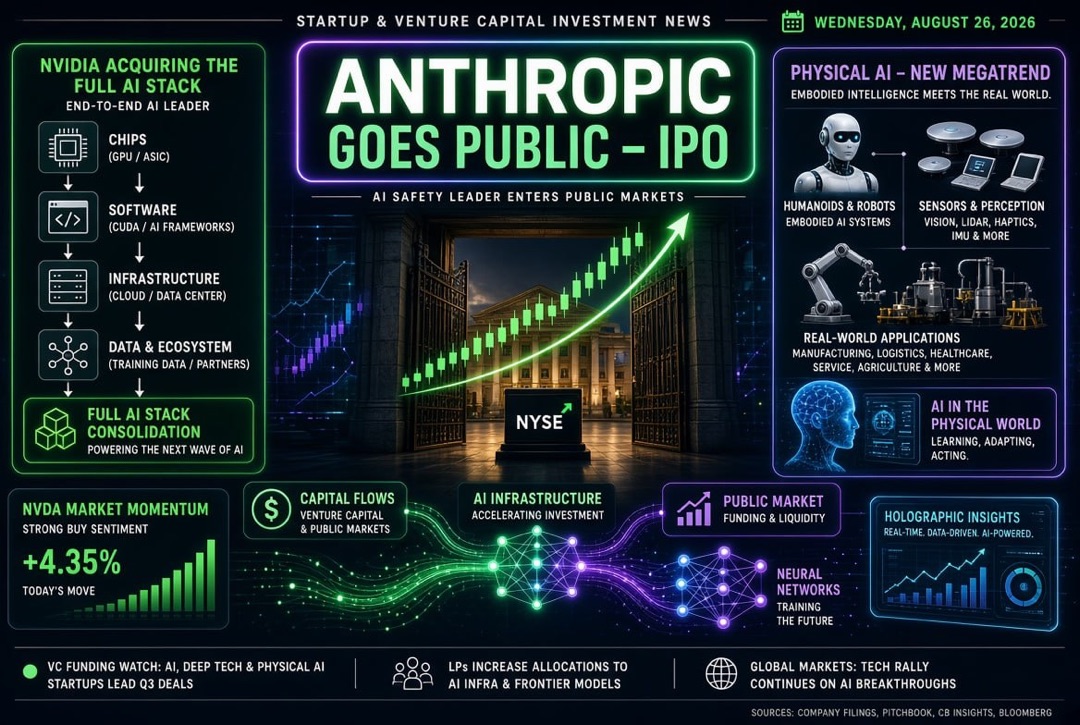
The return of IPOs is becoming one of the key themes for venture funds. The Chinese technology listing market is showing a strong recovery in recent years: companies from AI, semiconductors, robotics, and other strategic sectors are actively preparing for listings on domestic exchanges. For funds, this is particularly important since IPOs remain one of the primary mechanisms for returning capital to limited partners.
In the USA, the market is also gradually reviving: deals in robotics, fintech, AI infrastructure, and defense technologies indicate that investors are once again willing to evaluate fast-growing tech companies. However, the market has become stricter: public investors demand transparent revenues, expense control, clear margins, and a defined path to profitability.
For venture funds, the opening of the IPO window entails three practical effects:
- improved liquidity of portfolios;
- increased trust of LPs in new funds;
- emergence of market benchmarks for valuing private companies.
M&A and Secondary Transactions: The Market Seeks Liquidity
Alongside IPOs, the significance of M&A and secondary transactions is growing. Many funds are still holding assets longer than usual, while limited partners are demanding capital returns. In these conditions, secondary sales of shares, strategic acquisitions, and partial exits are becoming an important part of the venture economy.
Major tech corporations continue to closely monitor startups in the fields of AI infrastructure, cybersecurity, data, robotics, and enterprise software. For strategic buyers, startups remain a way to quickly acquire teams, IP, clients, and technological advantages. For venture funds, M&A has become an alternative exit in situations where IPOs are currently impossible or too risky.
What Matters for Venture Investors and Funds
By the end of June 2026, the startup and venture investment market looks robust but heterogeneous. There is capital available, interest in technology is high, and large rounds continue; however, investors are becoming more disciplined. A simple story of "an AI startup" no longer guarantees a premium valuation.
In the coming months, venture investors should closely monitor several indicators:
- the dynamics of tech company IPOs in the US, China, and Europe;
- the quality of new AI rounds and revenue levels of high-growth startups;
- the development of the physical AI, robotics, and industrial automation markets;
- the activity of later-stage investments in India and Southeast Asia;
- secondary transactions that demonstrate actual demand for shares of private companies;
- the readiness of large corporations to acquire AI and deeptech assets.
The main takeaway for venture funds as of June 30, 2026, is that the market once again offers opportunities for aggressive growth, but the victors will not be those who simply follow the AI trend, but rather those who can choose infrastructure, capital-efficient, and globally scalable startups. Venture investments are entering a phase of more mature selection, where key factors become revenue, technological protection, speed of implementation, and a clear path to liquidity.