Current News on Startups and Venture Investments for April 24, 2026: Key Deals, AI Trends, and Fund Strategies
As of , the global venture market is entering a new phase. Funding is once again available, large funds are becoming active, and the IPO window is gradually starting to open, but the market itself has become noticeably more selective. The main storyline of the week is not merely another boom in AI startups, but a rapid shift of capital towards infrastructure, sovereign computing, deep tech, and regulated segments where investors have protection against commoditization. For venture funds, this marks a significant shift: 2026 is looking less like a "growth-at-any-cost" market and more like a market for strategic assets.
Currently, venture investments are moving along two trajectories simultaneously. At the top, mega-rounds in AI, semiconductors, autonomous transportation, and computing infrastructure are accelerating the market. At the grassroots level, fundraising remains viable, but only for startups with a clear specialization, strong technology, and a defined path to large markets. This is why the current news on startups is important not only as a collection of deals but also as a map of the new structure of global venture capital.
- Capital is growing again, but the record is primarily driven by several major rounds and large funds.
- Europe and the UK are increasingly transitioning to a model of sovereign techno-financing, where money is linked to computing power, cloud services, data centers, and industrial policy.
- Asia is scaling back through AI, infrastructure, and pre-IPO preparations, while Hong Kong is once again looking like a viable exit route for Chinese tech companies.
Market in Numbers: Capital Has Returned, But It Is More Concentrated
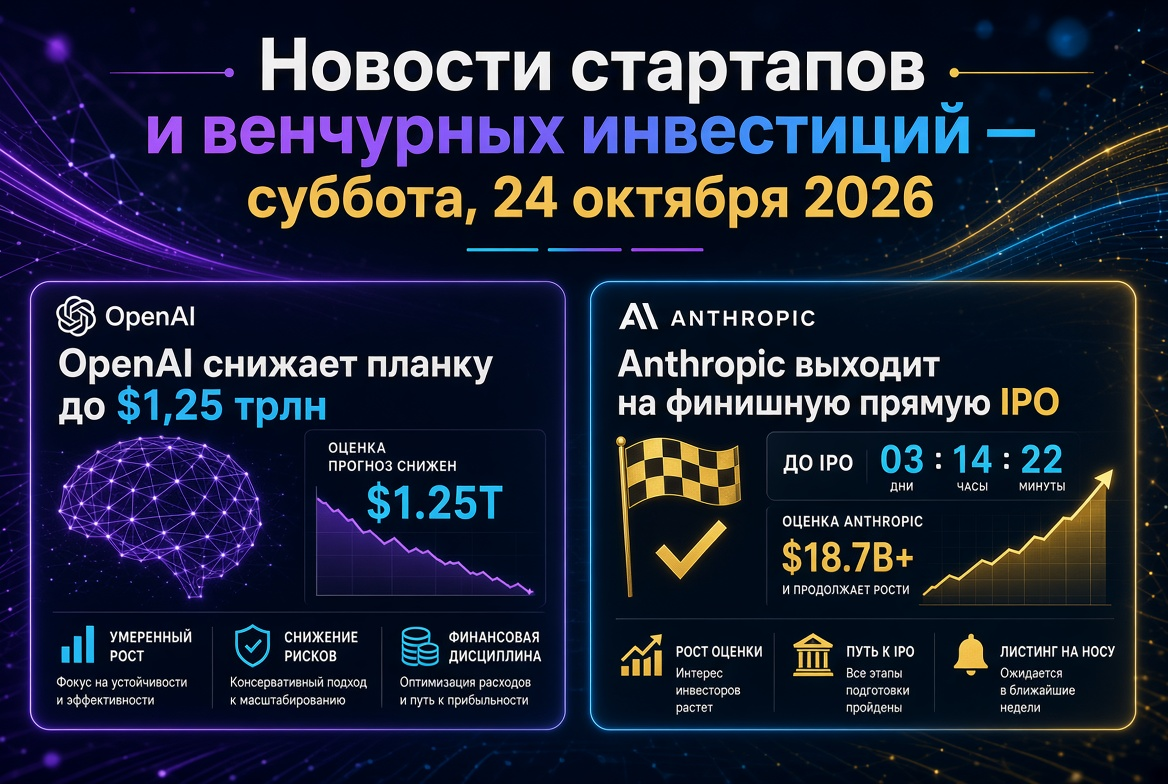
The first quarter of 2026 confirmed that the global venture market can once again show historical highs. The total deal volume surpassed $330 billion, with the bulk of liquidity coming from the US. However, behind this strength lies an important detail: the market has become narrower in breadth and deeper in check sizes. The four largest deals of the quarter — OpenAI, Anthropic, xAI, and Waymo — essentially reset the benchmarks for late-stage investments and significantly intensified the discussion about capital concentration.
This, however, does not mean that early-stage investments have come to a halt. On the contrary, early-stage companies continue to thrive and are increasing their capital, but investors have stopped paying for abstract growth stories. Today, capital is being attracted by startups that can demonstrate either technological depth, a direct path to a regulated market, or clear monetization efficiency. The new cycle of venture investments is built not on promises but on demonstrable strategic utility.
The Main Topic of the Day: Sovereign AI and Control Over Computing Infrastructure
The most significant theme for global investors is sovereign AI. The UK has launched a £500 million Sovereign AI initiative and has already made its first bet on the infrastructure startup Callosum, simultaneously granting several other companies access to state supercomputing resources. Each selected team is being offered not only capital but also computing resources, expedited visa solutions, and institutional support. This is no longer just a classic government program; it is a hybrid of a fund, industrial policy, and a national AI strategy.
Similar shifts are evident in infrastructure. BT and Nscale have announced the creation of up to 14 megawatts of AI power in the UK, expanding the sovereign computing segment for the state and corporate clients. Against this backdrop, European demand for sovereign cloud services, local data centers, and managed AI infrastructure is ceasing to be a niche market. The conclusion for venture capital is clear: growth is shifting from "yet another AI application" to layers of orchestration, inference, chip stack, cloud, and systems that enable countries and large corporations to become independent from external platforms.
USA: Mega-Rounds Continue to Set the Tone, but the Market is Seeking New Access Channels
The American market continues to set the global temperature. OpenAI has closed a round of $122 billion at a valuation of $852 billion, and this scale has sharply raised the bar for the entire private market. However, the more important side effect is that following these mega-rounds, the market is beginning to seek new mechanisms for accessing private tech assets. In this regard, Robinhood Ventures Fund's investment in OpenAI appears not only as a separate deal but also as a sign of further institutionalization of secondary and semi-retail access to private tech.
Simultaneously, the US is reviving its focus on exits. Forge Nano is slated to go public via a SPAC structure, which could provide the company with up to $342 million in gross proceeds, strengthening demand for manufacturing stories at the intersection of AI chips, advanced manufacturing, and defense batteries. Liftoff has returned to the IPO process with a new S-1 filing, indicating that while the exit window remains narrow, it is no longer closed. For American venture capital, this serves as a signal: the market rewards not everything indiscriminately, but companies with industrial, enterprise, or infrastructure logic.
Europe: The Window for Major Deals is Opened, but Investors are Buying Stability Rather than Growth
The European venture market in 2026 appears significantly more mature than just a year ago. The region has set a record in the number of billion-dollar deals and is increasingly moving away from its previous dependence on consumer growth stories. The focus is now on AI infrastructure, fintech platforms, quantum, energy tech, and space tech. This is why deals like those of Nscale, Upvest, IQM, and Univity come together to form a narrative: Europe is willing to pay for technological control, not just revenue dynamics.
The most illustrative story of this week is Bending Spoons' preparation for a potential IPO in the US with a target around $20 billion. This is a significant marker in two respects. Firstly, European tech companies are once again beginning to view the public market as a viable route, rather than an abstract option. Secondly, investors are rewarding not only "pure AI" but also disciplined platforms with clear profitability, M&A logic, and scalable operational models. More applied deals complete the picture: Upvest attracted $125 million for the upgrade of banking investment infrastructure, IQM secured €50 million ahead of its public listing, and French Univity closed a €27 million round for a next-generation satellite network.
Asia: Chinese AI Returns Scale, and Hong Kong is Once Again Becoming an Exit Route
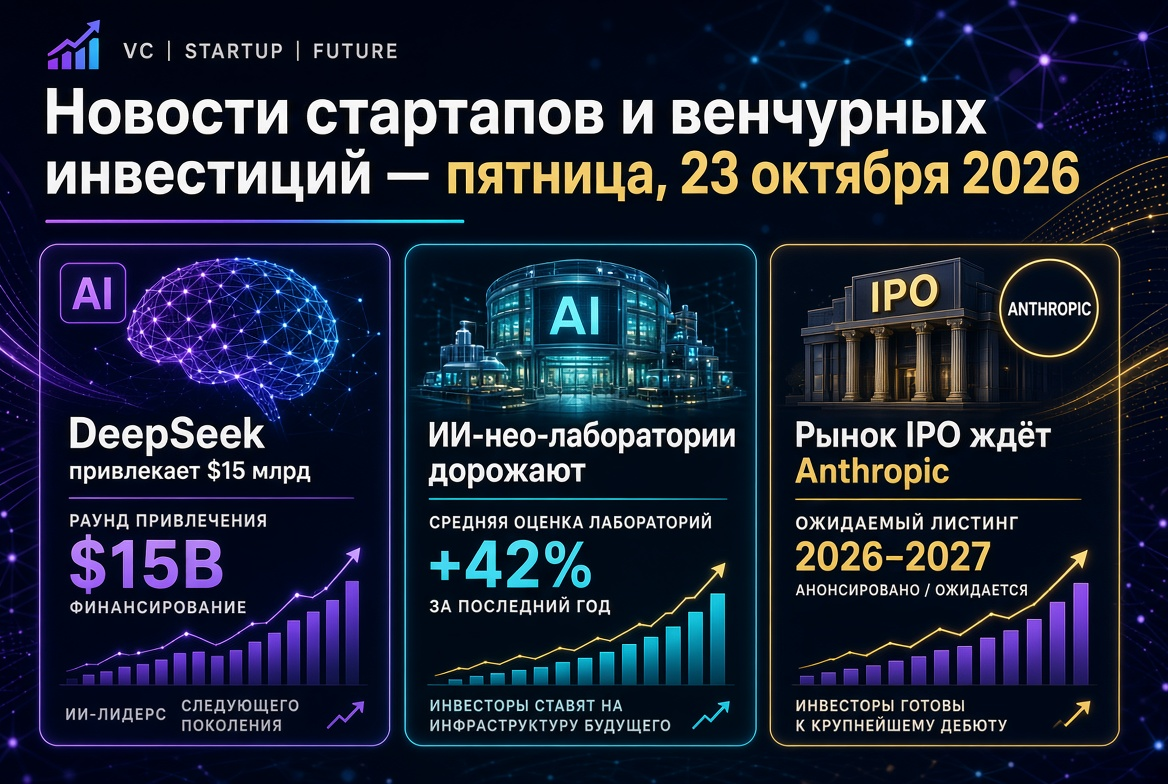
In Asia, attention is once again focused on China and infrastructure stories. Negotiations between Tencent and Alibaba for an investment in DeepSeek at a valuation above $20 billion show that Chinese AI has not disappeared from the global agenda; it is transitioning to a phase of new capitalization. Just days ago, the market was discussing an external round for DeepSeek at a minimum of $300 million, and now the conversation has shifted to a considerably higher valuation and the involvement of major tech groups. This is a direct indicator of how quickly capital needs for front-end models and agentic AI are scaling up in Asia.
Also significant is StepFun's move to restructure its offshore entity ahead of a future listing in Hong Kong. For investors, this serves as a strong signal: Hong Kong is solidifying its position as a working platform for Chinese AI companies and deep tech issuers, while the market itself becomes more intertwined with state and corporate capital. Asia remains more heterogeneous than the US, but here an alternative model of venture growth is forming: a greater role for government, corporations, and infrastructure, less ideology of "quick burn," and more attention to market readiness and managed regulatory architecture.
Sectors Expanding the Venture Agenda Beyond Generative AI
Although AI startups continue to dominate the news agenda, venture investments are increasingly expanding beyond frontier labs. Currently, four segments stand out:
- Space tech. Investments in space companies in the first quarter surged to record levels, nearly doubling quarter-over-quarter. The Univity case confirms that capital is flowing into satellite infrastructure, communication, and low-orbit networks as a strategic asset.
- Biotech. The acquisition of Kelonia by Lilly for up to $7 billion demonstrates that M&A is becoming a fully viable exit route for scientific platforms with strong clinical and applied value.
- Fintech infrastructure. OpenFX raised $94 million with an annual payment volume exceeding $45 billion. This is an important signal that stablecoin and FX infrastructure are rapidly transforming from an experimental segment into an institutional layer of global finance.
- Defense and dual-use. Capital is increasingly finding its way to technologies that address both commercial and governmental needs. Autonomous systems, protected AI tools, industrial software, and infrastructure solutions are benefiting from this logic.
For investors, this means that the best pipeline in 2026 lies not only in "pure AI" but at the intersection of AI with industry, finance, biotech, security, and logistics. There are higher barriers to entry, longer deal cycles, but also significantly more protected margins.
What This Means for Venture Funds and LPs Right Now
In the coming months, funds are developing a new discipline for capital deployment. The venture market is once again providing opportunities to capitalize on growth, but only for investors who can combine a large technological thesis with operational rigor and geopolitical calculation.
- Build a barbell strategy. On one side, infrastructure AI and deep tech assets, and on the other side, vertical software companies with clear unit economics and contract revenue.
- Assess the sovereign viability of businesses. Can a startup operate within data localization, compute, cloud, and national security requirements — this is now a matter of evaluation, not just compliance.
- Prepare portfolios for exits earlier than usual. The IPO and M&A market is coming back to life, but only highly prepared companies with clean structures, clear governance, and predictable profits will be permitted.
- Factor geopolitics into the cost of capital. In MENA, it is already apparent that international investors are becoming more cautious, deals are fewer, and checks are only growing in conviction rounds. This model of risk may quickly spread to other regions.
Investor Insights at Week's End
The news on startups and venture investments as of April 24, 2026, can be distilled into one key idea: the venture market has returned, but it has returned in a new form. Money is flowing not just into trendy startups but into platforms that control computations, infrastructure, distribution, regulation, and exits. The winners of the forthcoming cycle will not be the loudest founders, but those companies and funds that can connect AI, industrial logic, geopolitics, and execution discipline. For the global investor, this is no longer a phase of "seeking the next hype," but a phase of "buying the next layer of control."