Startup and Venture Capital News for Friday, July 3, 2026: Record Venture Capital Volume in H1, Mega-Rounds in AI Infrastructure, Growth in DefenseTech, and Opening of the IPO Window for Tech Companies
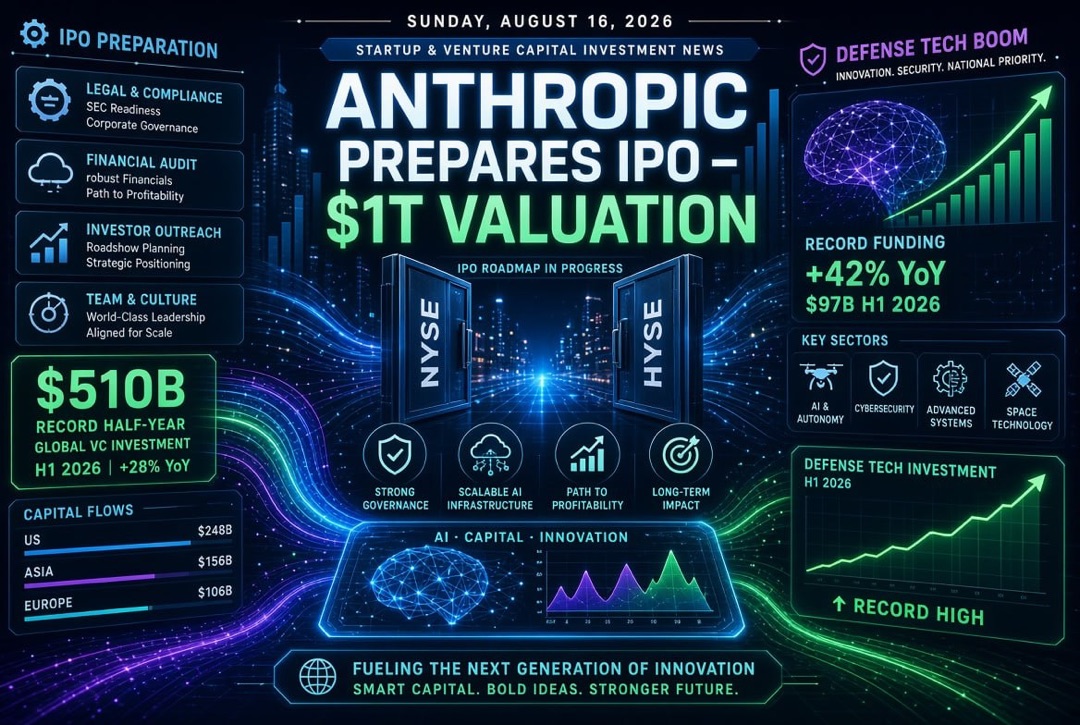
The main topic of the day is the record volume of global venture financing in the first half of 2026. Investments in startups have reached historic highs, with a significant portion of capital directed towards artificial intelligence, computational infrastructure, autonomous systems, and companies poised to become foundational to a new industrial and defense technological architecture.
Global Venture Market: Record H1 and New Capital Concentration
Venture capital in 2026 has become aggressive again, but not uniformly. Money is returning to the market not as a broad stream across all sectors, but through large rounds in the most strategic directions. Startups working with AI, cloud infrastructure, DefenseTech, robotics, and healthcare are receiving disproportionately high shares of funding.
For funds, this signifies an important shift: the market no longer evaluates startups solely based on revenue growth or user count. Investors are focusing on access to computational power, supply chain security, scalability to global markets, and the company's potential to become an infrastructure player.
Key Signs of a New Cycle:
- Capital is concentrating in fewer companies with large valuations;
- AI startups are receiving a premium on multipliers;
- Venture funds are increasingly supporting late-stage companies;
- The IPO and M&A market is becoming a viable exit channel again;
- Institutional investors are returning to tech assets.
AI Infrastructure: The Primary Magnet for Venture Investment
AI infrastructure remains a central theme for venture investments. Not only developers of large language models are in focus, but also companies that provide computation, inference, data processing, GPU cluster management, and cost reduction for AI products.
One of the most notable events has been the new large deal involving Together AI. The company operates in the neocloud segment and provides infrastructure for launching AI models, having raised a substantial funding round and significantly increasing its valuation. This bolsters the thesis that investors are willing to fund not only the "brains" of artificial intelligence but the entire industrial system around it: data centers, clouds, chips, middleware, and tools for enterprise implementation.
For venture funds, this creates a distinct investment map: not only model developers can win, but also infrastructure providers that allow companies to leverage artificial intelligence more affordably and rapidly.
Mega-Rounds for Baseten, Groq, and the AI Inference Market
The AI inference segment deserves special attention. Startups that help launch AI applications faster, cheaper, and more reliably have become one of the most sought-after categories among venture investors. Large rounds for Baseten and Groq indicate that the market views inference not as a supporting function, but as a vital layer of the future digital economy.
For funds, this means increasing competition for deals in companies that address three key challenges:
- Reducing the cost of processing AI queries;
- Enhancing model performance in corporate settings;
- Creating infrastructure for the mass adoption of AI in business processes.
Investors are more frequently considering such startups as analogous to "energy infrastructure" for the new economy: without them, scaling artificial intelligence becomes too expensive and technologically complex.
DefenseTech: Europe Transforms into a Venture Focus
Defense technologies are becoming one of the fastest-growing segments of venture capital. The funding round for Quantum Systems has been a landmark event for the European market: investors are ready to finance manufacturers of drones, autonomous systems, mission management software, and dual-use solutions at levels that just a few years ago were primarily characteristic of the American tech ecosystem.
The rise of DefenseTech is linked not only to geopolitics but also to the changing structure of the defense market itself. Startups are offering faster development cycles, modular solutions, AI management, autonomy, and flexible production models. This makes them competitors to traditional defense contractors and creates a new category of companies – technological "neo-primes."
Investment Considerations in DefenseTech:
- Presence of government and defense clients;
- Speed of production and delivery;
- Compatibility with allies' systems;
- Security of IP and supply chains;
- Export potential in European, US, and Asian markets.
IPO Window: Lime and Bending Spoons Testing Public Market Demand
The revival of the IPO market is an important signal for the venture industry. After a period of weak liquidity, funds are once again able to plan exits through the public market. Lime's placement shows that investors are ready to consider even complex business models if the company demonstrates operational stability, revenue growth, and a pathway to positive cash flow.
Even more telling is the debut of Bending Spoons. The company has built a strategy on purchasing and relaunching well-known digital assets and received a strong response from the public market. For venture investors, this is an important precedent: the market is willing to pay not only for pure AI growth but also for an effective operating model, profitability, and the ability to monetize mature technological products.
If the IPO window remains open in the second half of 2026, it could accelerate capital returns to funds and increase activity in new late-stage investments.
Seed and Early Stage: The Market Remains Alive but More Demanding
Despite the dominance of mega-rounds, early-stage financing has not disappeared from the venture capital landscape. On the contrary, seed and Series A rounds are becoming more quality-driven. Funds are increasingly expecting startups not only to have a strong team and a large market but also proven technological differentiation, initial commercial contracts, clear unit economics, and a realistic path to the next funding round.
In the markets of Europe and India, there is an evident activation of specialized funds. Tapestry VC has closed a new fund to invest in repeat founders, while Sparrow Capital has intensified its focus on the seed stage in India. This affirms a global trend: experienced entrepreneurs and strong local ecosystems are once again becoming a priority for LPs and managing partners.
Capital Geography: The US Leads, Europe Enhances DeepTech, Asia Maintains Scale
The US remains the primary hub for venture capital, especially in AI, cloud, cybersecurity, and enterprise software. However, Europe is strengthening its position in DeepTech, DefenseTech, quantum technologies, industrial AI, and climate solutions. This is important for global funds: the European market is increasingly perceived not as a secondary source of deals, but as an independent tech cluster.
Asia retains strong positions in semiconductors, fintech, manufacturing technologies, and consumer platforms. India continues to develop its seed ecosystem, while Southeast Asia remains attractive for fintech, logistics, agri-tech, and B2B platforms.
What Matters for Venture Funds and Investors on July 3, 2026
The main takeaway for venture investors is that the market is growing again, but has become significantly more selective. A simple narrative around artificial intelligence is no longer sufficient. Winning startups are those with infrastructural significance, protected technology, a strong team, access to corporate clients, and a clear exit strategy.
Investor Focus for the Coming Months:
- AI infrastructure and cost reduction in computing;
- DefenseTech and autonomous systems;
- Chips, inference, and specialized clouds;
- IPO candidates with stable revenue;
- M&A as a channel for liquidity for funds;
- Repeat founders and mature teams at early stages;
- Startups with a global market, not just a local niche.
The Venture Market Enters a Phase of Expensive but Rational Growth
Startup and venture investment news for Friday, July 3, 2026 shows that the global startup ecosystem has once again become a key focus for institutional capital. However, this growth differs from the venture boom of 2020-2021. Today, investors are more cautious about unfounded valuations, paying closer attention to liquidity and preferring companies that can become infrastructure for entire industries.
AI infrastructure, DefenseTech, quantum technologies, robotics, enterprise software, and quality fintech remain the primary zones of interest. For venture funds, the current market opens up opportunities but demands discipline: those who can distinguish temporary hype from companies that are genuinely shaping a new technological economy will emerge victorious.