The Venture Market Enters a New Phase: Capital Concentrates Around Artificial Intelligence, Infrastructure, and Strategic Technologies
The global startup and venture investment market remains under the influence of a single dominant theme—artificial intelligence—as of Saturday, April 25, 2026. For venture investors and funds, this has evolved beyond a mere technological trend into a new capital distribution structure, where the largest funding rounds are directed towards AI startups, infrastructure platforms, developers of agent systems, chips, data centers, and sovereign AI solutions.
Following a record-breaking first quarter of 2026, the market has not entered a pause phase. On the contrary, April demonstrated that investors continue to pay premiums for companies capable of controlling computing power, corporate AI products, model development, and applied automation scenarios. However, along with rising valuations, risks are intensifying: the concentration of capital, overheating in specific segments, geopolitical restrictions, and the potential gap between revenue and the valuation of private companies.
Anthropic Becomes the Center of a New Big Tech Race for AI Assets
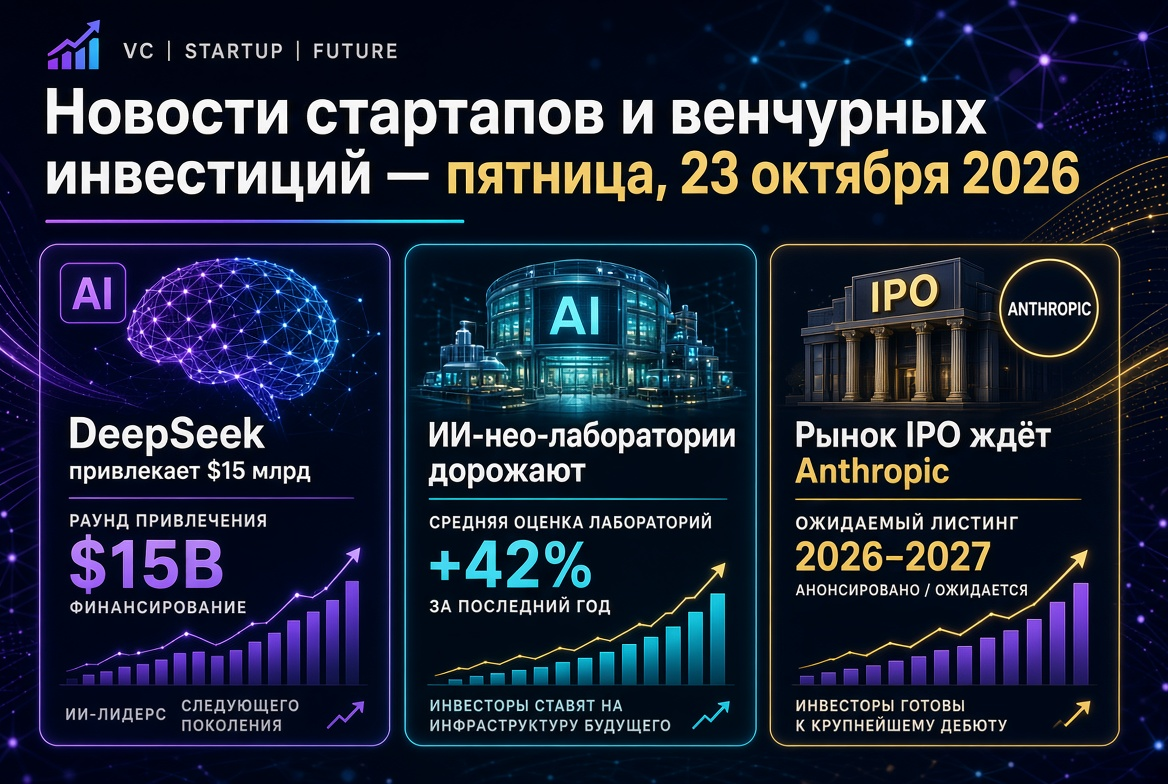
A primary focus in the venture market is the potential massive investment by Alphabet in Anthropic. Market data indicate that Google may invest up to $40 billion in the Claude developer, with part of the capital allocated immediately and the remaining amount contingent upon achieving specific performance targets. For venture funds, this serves as an important signal: the largest technology corporations are no longer limited to cloud partnerships but are effectively securing access to key AI laboratories through long-term funding.
Anthropic has already become one of the main beneficiaries of corporate demand for AI coding, agent solutions, and secure models for businesses. The company has increased its annual revenue growth rate, actively securing agreements on computing power, and remains one of the most valuable private AI assets globally. For investors, this reinforces the key thesis of 2026: the valuation of AI startups is increasingly determined not only by the model itself but also by access to computing, a corporate client base, and the ability to scale infrastructure.
- Key sector: frontier AI and corporate models;
- Investment takeaway: Big Tech is strengthening control over strategic AI companies;
- Risk for funds: rising valuations may outpace fundamental monetization.
Cohere Acquires Aleph Alpha: Europe Bets on Sovereign AI
Another significant event in the startup market is Cohere's acquisition of the German Aleph Alpha. The Canadian AI company is reinforcing its position in Europe, where demand for secure, regulated, and localized solutions for government, finance, energy, defense, and industry is rapidly growing.
For venture investors, this deal is crucial not only as an M&A event but also as an indicator of a new market logic. European clients are increasingly seeking alternatives to the complete technological dominance of American platforms. As a result, sovereign AI is emerging as a distinct investment category. There is growing demand for local models, secure infrastructure, industry applications, and partnerships with large corporate clients.
An additional factor is the involvement of the Schwarz Group, which plans to invest $600 million in Cohere's upcoming round. This demonstrates that strategic investors from the real sector are prepared to finance AI infrastructure not as an experiment but as a component of long-term competitiveness.
China Limits American Capital: Venture Market Becomes Geopolitical
The Chinese technology sector remains one of the most significant areas for global venture capital, but the rules of the game are changing. Reports have emerged concerning the intention of Chinese regulators to restrict the participation of American investors in funding leading technology companies, including AI startups. Sensitive technologies such as artificial intelligence, semiconductors, quantum computing, robotics, and strategic platforms are in focus.
For venture funds, this means that investment analysis can no longer be based solely on market size, growth rates, and product differentiation. Geopolitical risk is becoming part of the due diligence process. Funds will have to consider:
- restrictions on foreign investor entry;
- the risk of blocking secondary transactions;
- potential reduction in the liquidity of shares;
- regulatory barriers to asset sales to strategic buyers.
Against this backdrop, negotiations between Tencent and Alibaba regarding investments in DeepSeek are particularly telling. If foreign capital faces restrictions, domestic technology giants may become the primary sources of late-stage funding for Chinese AI startups.
DeepSeek Intensifies the Asian AI Race
DeepSeek remains one of the most discussed AI assets in Asia. The company, associated with High-Flyer Capital Management, is expected to raise funding at a valuation exceeding $20 billion. This underscores China's ambition to develop its own ecosystem of AI models, chips, computing infrastructure, and corporate applications.
For global funds, the situation surrounding DeepSeek is significant for two reasons. Firstly, Chinese AI companies continue to receive high valuations regardless of political restrictions. Secondly, the Asian venture capital market is gradually shifting towards local capital, state funds, and strategic corporate investors.
This alters the competitive structure. American funds maintain an advantage in access to OpenAI, Anthropic, xAI, Cursor, and other leaders, but the Asian market is becoming less open to external investors. As a result, the global venture market may split into several investment zones: the USA, China, Europe, and neutral jurisdictions like Singapore.
Record First Quarter of 2026: Capital is Abundant, but Unequally Distributed
The first quarter of 2026 marked a historic period for venture capital, with global startup investments reaching approximately $300 billion. However, this figure cannot be interpreted as a uniform recovery for the entire market. The majority of the growth has been concentrated in a few massive deals within AI and related technologies.
The largest rounds for OpenAI, Anthropic, xAI, and Waymo absorbed a significant share of the entire global venture capital. This reveals that the market appears to be record-breaking strong yet extremely concentrated. The key question for venture investors is not whether the market has "returned" but rather "where exactly did liquidity emerge."
- Late stages receive more capital if the company is linked to AI infrastructure.
- Seed and Series A rounds remain active, but investors have become stricter in selecting teams.
- Companies without a clear AI component face more challenges in raising funds.
- Funds increasingly demand proof of revenue, retention, and unit economics efficiency.
Europe Grows Thanks to AI, but Deal Volume Declines
The European venture market showed an increase in investment volume in the first quarter of 2026, while the number of deals significantly decreased. This is an important signal for funds: capital has not vanished, but it has become more selective. Investors prefer fewer deals, larger rounds, and firms with high strategic significance.
For the first time, AI accounted for more than half of European venture funding for the quarter. However, the decline in deal volume suggests that early-stage startups are finding it increasingly challenging to compete for the attention of funds, particularly those lacking technological barriers, a strong team, or clear corporate demand.
The most promising areas in Europe remain:
- sovereign AI and protected corporate models;
- semiconductors and energy-efficient AI infrastructure;
- healthtech and industrial automation;
- defense tech and dual-use technologies;
- energy, climate technology, and grid management.
AI Coding and Agent Platforms Remain Capital Magnets
The AI coding sector continues to attract significant venture investments. Cursor is reportedly negotiating to raise over $2 billion at a valuation of around $50 billion. This exemplifies the high value that investors place on tools capable of transforming the functions of engineering teams and corporate development.
In this context, the $150 million round for Factory at a valuation of $1.5 billion confirms the enduring interest of funds in AI agents for enterprise engineering. Such companies sell not merely productivity enhancement tools but an entirely new operational model for tech departments. If AI agents can take on a significant portion of development, testing, documentation, and code support, the corporate software market may realign in favor of new players.
For funds, this area remains attractive yet risky. Competition is intense, product differentiation cycles are short, and reliance on foundational models and infrastructure providers remains substantial.
Applied AI Goes Beyond Office Software
April's deals indicate that venture investments are increasingly directed towards applied AI for the real economy. Loop raised $95 million to develop an AI platform for predicting supply chain disruptions. NeoCognition secured $40 million in seed funding to develop self-learning AI agents. Era attracted $11 million for its software platform for AI devices.
These transactions reflect a significant shift: investors are searching not only for foundational models but also for products that can be integrated into specific industries. Logistics, industry, energy, infrastructure, devices, customer support, and software development are becoming key fields for monetizing artificial intelligence.
For venture funds, this opens a broader set of strategies. Investment opportunities exist not only in expensive frontier labs but also in vertical AI companies with clear economics, industry expertise, and rapid paths to corporate revenue.
What Venture Investors and Funds Should Focus on in the Coming Weeks
As of Saturday, April 25, 2026, the startup and venture investment market looks strong but heterogeneous. There is an abundance of capital in the system; however, it has become much more concentrated. Funds are willing to pay high valuations for AI leaders, infrastructure, chips, data centers, agent platforms, and sovereign solutions. Traditional SaaS startups, marketplaces, and consumer products lacking a deep technological component find themselves in a more challenging position.
Key factors for investors to monitor include:
- new funding rounds for Anthropic, OpenAI, Cursor, DeepSeek, and other AI leaders;
- the activity of Big Tech as strategic investors;
- restrictions on cross-border venture capital between the USA and China;
- the growing demand for sovereign AI in Europe;
- the state of the IPO window for the largest private tech companies;
- the dynamics of the secondary market for late-stage startup shares;
- the real revenue of AI companies and their ability to justify valuations.
The main takeaway for venture investors and funds is that 2026 is not just the year of artificial intelligence, but a year of power redistribution in technological capital. The companies that succeed are those that control the infrastructure, data, computation, corporate access, and strategic markets. Other startups will need to prove not only growth but also their right to capital in an increasingly competitive environment for investors' attention.