Current Startup and Venture Investment News as of April 15, 2026: AI Sector Growth, IPO Comeback, and Key Market Trends
The global startup and venture investment market enters mid-April with noticeably stronger momentum than at the beginning of the year. Three main themes have emerged: record capital volume in the first quarter, a concentration of funds around artificial intelligence and infrastructure, and a gradual comeback of the IPO market. For venture capitalists, this signifies an important shift: the market is once again ready to fund scale, but does so selectively—in favor of companies with technological advantages, access to computing, strong revenue, or a clear path to the public market.
Against this backdrop, the agenda for April 15, 2026, is shaped not only around significant AI rounds. Investors are increasingly looking at chips, network infrastructure, industrial climate tech, payment platforms, and defense software. Venture capital is once again global, but the geography of deals has changed: the USA maintains its leadership, Asia strengthens its IPO pipeline, while Europe strives to establish itself in deep tech and industrial tech.
Record First Quarter Alters Market Psychology
The main takeaway for participants in the startup market is clear: 2026 has ceased to be a transitional year and is starting to resemble a new growth cycle. Venture investments accelerated sharply in the first quarter, and funds are once again ready to place large checks if they see a platform story and a long technological horizon. This is particularly evident in the AI segment, where capital is concentrated not only in applied products but also in the underlying infrastructure.
- Investors are ready to support large late-stage rounds once again.
- Valuations are increasing primarily for companies with an infrastructural role in the AI chain.
- The market has become more favorable towards IPO scenarios and strategic sales.
- Venture funds are focusing more on asset quality rather than broad diversification for the sake of deal quantity.
In other words, there is money in the market, but it is becoming increasingly asymmetrically distributed. This is why, for startups in 2026, it is critical not only to demonstrate growth but also to prove strategic irreplaceability.
Artificial Intelligence Remains the Main Capital Magnet
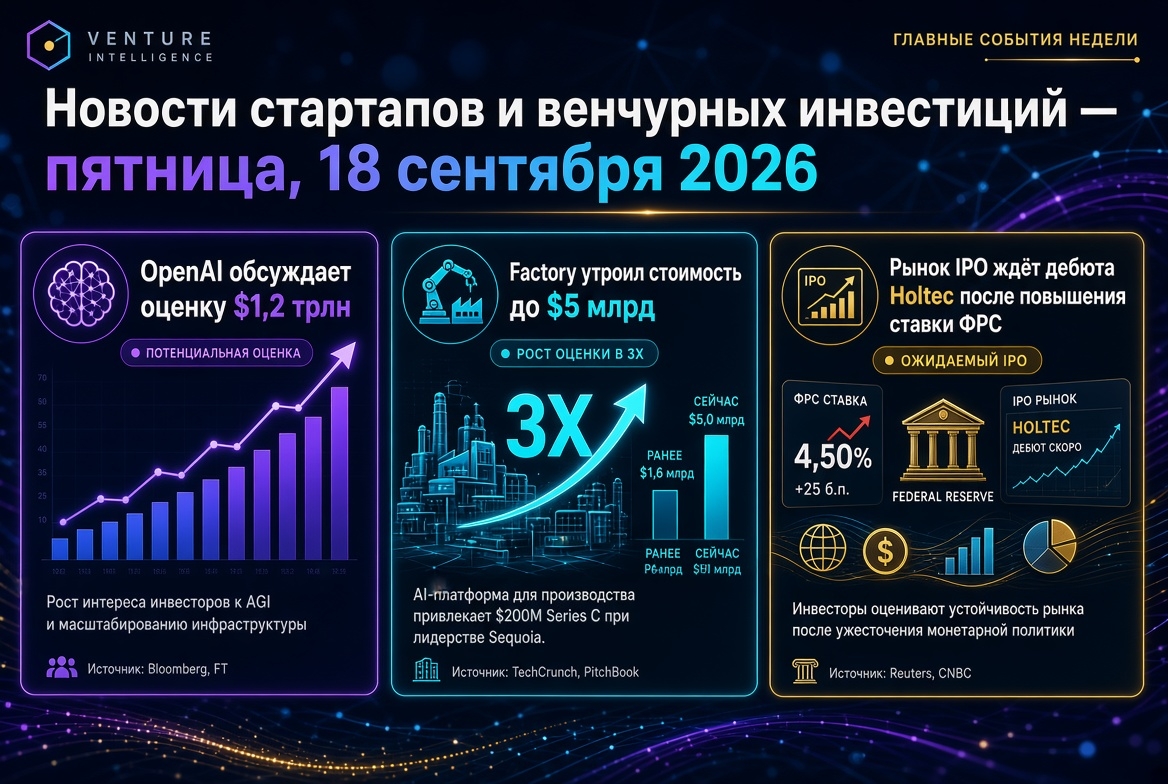
The AI sector continues to set the pace for the global venture market. However, within this theme, a new hierarchy is emerging. Investors show significantly less interest in simple applied wrappers and are much more actively funding teams that control computing, architecture, data center logic, inference chips, and network performance.
This is changing the very structure of deals. Previously, rapid user base growth was the main argument; now, AI startups increasingly depend on three factors: access to hardware, a protected technological base, and the ability to quickly integrate into the client's corporate framework. Consequently, venture investments are shifting from "a beautiful story" to "a hard-to-replicate system."
For funds, this means that the best risk profile often arises not at the level of the end application but deep within the technological stack. It is here that long-term margin is formed, and here that the potential for an IPO or a costly strategic sale most often arises.
IPO Pipeline Revives and Brings Discipline to Valuations
Another significant signal for the startup market is the return of IPO discussions from the category of expectations to practical actions. Preparations for new public offerings are underway in various regions, gradually restoring confidence in late stages. When funds again see a genuine prospect for liquidity, they are more willing to enter large growth rounds.
Notably, public scenarios are being prepared not only by mature platforms in the USA but also by Asian AI companies. This marks an important turnaround for the global venture market: the IPO window no longer appears to be solely an American story. At the same time, the mere fact of impending IPOs forces startups to return to stricter financial discipline—investors are once again closely examining unit economics, pathways to operational margins, and revenue sustainability.
- For late-stage funds, this increases the likelihood of exits.
- For founders, this means heightened requirements for reporting quality and governance.
- For the market as a whole, this creates more realistic benchmarks for valuations.
Asia Strengthens Its Position: China and South Korea Accelerate the Technological Framework
The Asian startup market appears particularly dynamic in April. In China, the state-supported technological leap continues, and venture investments are increasingly directed towards strategic sectors: AI, robotics, chips, and manufacturing technologies. For private funds, this represents not only a new opportunity but also new competition, as state capital increasingly influences pacing, priorities, and valuations.
Simultaneously, the regional IPO pipeline is also strengthening. Chinese AI companies are restructuring their corporate frameworks to meet local regulatory requirements, while South Korean chip developers are preparing for public offerings. This is creating a new picture: Asia is no longer merely supplying startups to the global capital market but is also building its own infrastructure for exits and scaling.
For international venture funds, this shift means that they need to pay closer attention to local rules, political context, and restrictions on cross-border investments. At the same time, Asia remains one of the main sources of new technological leaders today.
AI Infrastructure Becomes a Distinct Class of Venture Assets
It is particularly important that capital is actively flowing not only into models and assistants but also into infrastructure startups. Developers of chips, networking solutions, and basic hardware-software layers are receiving increasingly strong support. This is evident from large rounds involving companies that are building architecture for data centers, inference, and next-generation AI networks.
Such interest is quite rational. If generative AI becomes an industrial standard, the greatest value accrues to those who facilitate scaling and reduce computational costs. This is why the deep tech and semiconductor sectors are no longer seen as niche stories but are now regarded as one of the central segments of the venture market.
From a portfolio strategy perspective, this means a return to interest in more capital-intensive models. Funds are once again willing to wait longer if they understand that the asset can occupy a systemic position in the global technological chain.
Capital Spreads Wider: Fintech, Climate Tech, and Industrial Startups Strengthen Their Positions
While AI remains the dominant theme, the venture investment market in April is not limited to this area. Fintech is gaining new momentum due to cross-border payments, stablecoin infrastructure, and corporate financial services. This is an important signal: investors are again ready to finance segments where growth can be swiftly monetized and a clear revenue stream can be achieved.
Climate tech deserves special attention. Major deals in industrial decarbonization indicate that capital is starting to return to heavy industries, provided there is technological protection, long-term contracts, and political support. This is particularly significant for Europe, as industrial tech and energy transformation may serve as its response to American dominance in software and Chinese leadership in large-scale manufacturing.
As a result, the venture market is becoming more layered. Alongside AI, sectors that previously seemed too capital-intensive or lengthy for a classical VC approach are now rapidly gaining prominence.
New Funds Confirm: Investors Are Preparing Not for a Pause, but for a Long Cycle
The behavior of management companies also reflects the market reversal. The launch of new funds in AI and physical tech, as well as the activity of teams transitioning from major AI companies, indicates that the venture industry is betting on a long investment horizon. This is no longer a tactic for a quick rebound post-slump, but an effort to secure positions in a new technological paradigm.
Most notably, an increasing number of funds are defining their specializations more strictly than before. Instead of broad mandates for "technological growth," funds focused on AI infrastructure, physical AI, defense technologies, industrial software, and new manufacturing chains are emerging. For LPs, this appears more attractive: capital is directed towards clearer themes with distinct theses and measurable demand.
What This Means for Venture Investors and Funds on April 15, 2026
Currently, the global startup and venture investment market is moving towards a model in which the winners are not the loudest companies, but those who control critical nodes of the new economy. For venture funds, this necessitates a more stringent ranking of opportunities and the construction of a portfolio around several strong macro themes.
- AI remains a foundational theme, but the greatest value often arises in infrastructure, chips, and networks.
- The IPO window is gradually reopening, which means late stages can once again become investment attractive.
- Asia is strengthening its own mechanisms for growth and exits, changing the global deal map.
- Fintech, climate tech, and industrial tech confirm that the market is again ready to fund complex sectors when there is a strong project economy.
Wednesday, April 15, 2026, presents investors with a fairly clear picture: the venture market is expanding again but is doing so around more mature and strategically important themes. Startups that can become infrastructure for the next phase of technological growth remain at the forefront. They are the ones setting the agenda for funds, LPs, and corporate buyers around the world.