AI Infrastructure and Major Venture Rounds on May 27, 2026, Shape a New Agenda for the Global Startup Market
As ofWednesday, May 27, 2026, startup and venture investment news is once again focusing on several major themes: large rounds in the artificial intelligence sector, rising valuations for infrastructure companies, rekindled interest in fintech for tech businesses, and heightened competition among funds for access to the best deals. For venture investors and funds, this is not just another wave of optimism but a test of the ability to distinguish fundamental growth from inflated valuations.
The global venture market remains active but heterogeneous. Capital is increasingly directed not towards a wide array of startups but rather to a limited number of companies that control computational infrastructure, AI models, logistics platforms, banking services for startups, and high-scaling applied solutions. Therefore, the main theme of the day is not just growth in venture investments but the concentration of capital in the hands of the strongest players.
AI Remains the Main Magnet for Venture Capital
Artificial intelligence continues to define the agenda of the venture market. In 2026, investors are increasingly looking beyond AI-based applications to the fundamental layers of the new tech economy: computing, infrastructure, model routing, developer tools, autonomous agents, and AI hardware.
For venture funds, this means a shift in investment logic. Previously, startups were primarily assessed based on revenue growth rates, customer retention, and sales efficiency; now, analysis increasingly includes:
- access to computational power;
- cost of inference and model training;
- quality of proprietary data;
- dependency on large AI platforms;
- ability to reduce client operational costs through automation.
As a result, AI startups receive premium valuations, but with this come increasing risks. Investors are becoming more rigorous in evaluating whether a company is an independent tech platform or merely a layer on top of someone else's model.
Stord Raises $250 Million, Demonstrating Fund Interest in "Physical Intelligence"
One of the key events of the day was the substantial round for Stord. The company, which operates at the intersection of e-commerce, logistics, warehousing infrastructure, and software, raised around $250 million at a valuation of approximately $3 billion. This is an important signal for the market: venture capital is returning not only to pure software but also to startups that connect digital platforms with physical infrastructure.
Stord is appealing to funds for several reasons. Firstly, the company competes with large logistics ecosystems by offering brands greater control over delivery, inventory, and customer relationships. Secondly, it is advancing AI and robotics capabilities for managing commercial logistics. Thirdly, its growth reflects the demand for alternatives to monopolized e-commerce infrastructure.
For investors, this segment can be viewed as one of the most practical areas of the AI economy: artificial intelligence functions here not as an abstract technology, but as a tool for optimizing inventory, routing, warehousing operations, and customer service.
OpenRouter and the New Architecture of the AI Model Market
Another important signal for the venture market was the round for OpenRouter, which raised about $113 million. The company is developing a platform that allows developers to access different AI models through a single infrastructure. This approach is becoming particularly relevant in light of the growing number of models, high computational costs, and companies' desire to avoid dependency on a single provider.
For venture funds, OpenRouter reflects a broader trend: the market is gradually shifting from a race for individual models to infrastructure for choice, routing, and optimization of AI queries. This mirrors the development of the cloud market, where value is created not only by computing providers, but also by access management platforms that determine cost, speed, and service quality.
Investors should note that such startups can serve as a critical layer between developers, corporate clients, and model owners. If demand for AI products continues to grow, these infrastructure intermediaries could capture significant economic value.
Hark and Modal Labs Intensify the Race for AI Interfaces and Computation
Large rounds for Hark and Modal Labs indicate that venture capital is betting on two directions simultaneously: user-facing AI interfaces and development infrastructure. Hark raised about $700 million in Series A funding at a valuation of around $6 billion. The company remains relatively secretive but is positioned as a project focused on personalized artificial intelligence, multimodal systems, and hardware solutions.
Modal Labs, on the other hand, raised approximately $355 million and was valued at about $4.65 billion. The company operates in the infrastructure layer, providing developers access to computational resources and environments for deploying AI code. This focus is particularly crucial amidst GPU shortages and increasing demand from biotech, financial companies, research teams, and AI product developers.
For venture investors, these deals signal that the market is willing to pay premiums for companies that tackle one of two major challenges of the AI economy:
- how users will interact with intelligent systems;
- how developers will rapidly and cost-effectively launch AI applications.
Fintech for Startups Again Becomes a Strategic Focus
The fintech company Mercury raised around $200 million, achieving a valuation of approximately $5.2 billion. This is a significant event for the startup market, as Mercury serves tech companies and is betting on a new wave of AI-native entrepreneurs.
Fintech for startups is once again under the focus of venture funds for several reasons. New companies require not just bank accounts but also more complex infrastructures: cash management, treasury, payments, integration with business operating systems, and financial analytics. Following the banking stresses of recent years, investors are particularly attentive to the stability of financial partners within the startup ecosystem.
For funds, this area is also appealing because a strong fintech provider gains access to a vast array of data on startups' behaviors: revenue, expenses, burn rate, payments, hiring, and scaling rates. Such information can become a competitive advantage when launching credit, payment, and analytics products.
India, Biotech, and B2B Commerce Expand the Venture Opportunity Map
While the spotlight remains on the US and AI, venture investments continue to be distributed across other regions. In India, new deals are emerging in B2B commerce and biotechnology. The B2B quick commerce platform Fairdeal.Market raised about $15 million, while the synthetic biotech startup StrainX Bioworks secured approximately $13 million.
These rounds are smaller than those in AI infrastructure but are important for understanding the global market. Investors continue to seek companies that address local but scalable challenges: supplying small businesses, rapid B2B delivery, bioproduction, precision fermentation, and technological supply chain substitution.
For venture funds, such deals may be less "headline-grabbing," but they are more rational in terms of risk-to-valuation ratios. Unlike mega-rounds in AI, local B2B and biotech companies are often valued through understandable metrics: profitability, demand repeatability, market depth, customer acquisition costs, and operational efficiency.
OpenAI, YC, and the New Model of "Tokens Instead of Cash"
One of the most unusual topics of the week was OpenAI's initiative to offer AI tokens to Y Combinator startups in exchange for equity. The very idea is significant for the entire venture market: capital for early companies is not just money, but also access to critical infrastructure.
For AI startups, computing resources, API access, and technological support can be as crucial as a traditional seed round. This alters the negotiating position of founders and funds. Venture investors must now evaluate not only the size of the check but also the quality of the resources received by the startup.
However, this model also raises new questions: dependency on a single provider, future scaling costs, SAFE deal structures, and the risk that the infrastructure partner simultaneously becomes an investor, supplier, and potential competitor.
IPOs and M&A Become the Key Tests for the Venture Ecosystem
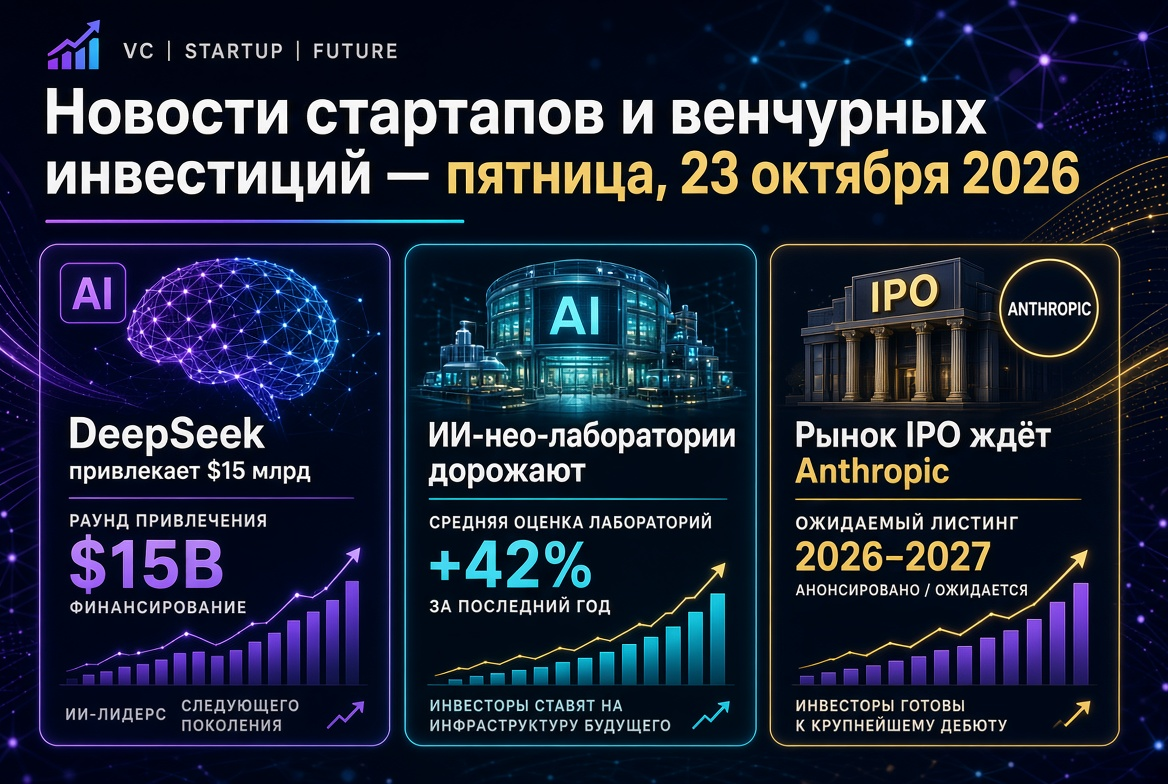
For funds, the main challenge of recent years has been a lack of liquidity. Even with rising valuations for private companies, investors need tangible exits: IPOs, secondary transactions, strategic sales, and M&A. Consequently, market attention is gradually shifting from mere financing to the question: who will be able to go public and confirm private valuations?
Companies in the fields of AI, space, fintech, robotics, and infrastructure potentially could form the basis for a new wave of public placements. However, the market will be selective. Public investors are willing to pay for growth but increasingly demand clear economics: revenue, gross margin, expense control, and long-term technological protection.
For venture funds, this means that the strategy of "growth at any cost" is no longer universal. The best companies must not only demonstrate rapid scaling but also the ability to become public businesses with transparent financial models.
What Venture Investors and Funds Should Monitor
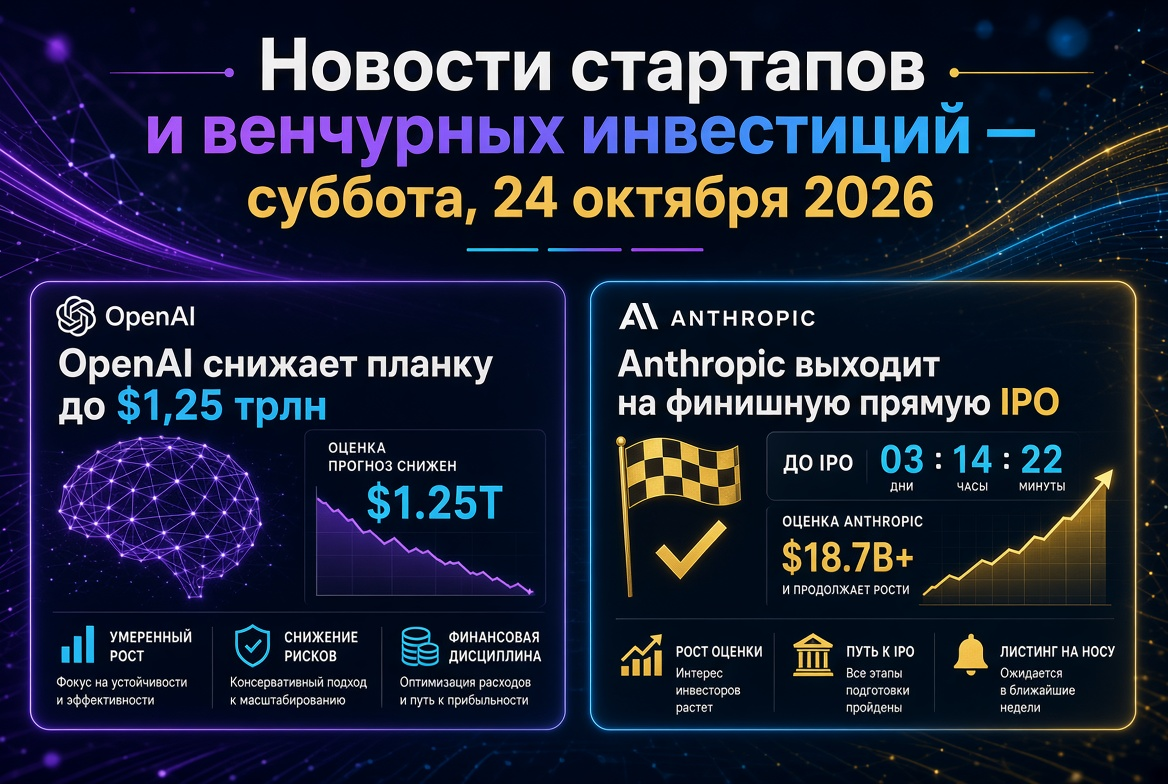
As of May 27, 2026, the startup and venture investment market appears strong but increasingly concentrated. Capital is available, but it is distributed very selectively. Successful firms are those that control infrastructure, data, computing, logistics networks, or financial services for the new tech economy.
In the coming weeks, venture investors should pay particular attention to several factors:
- valuation dynamics of AI infrastructure companies;
- cost of computing and availability of GPUs;
- emergence of new funding models instead of traditional cash equity;
- state of the IPO window for tech companies;
- growth of venture debt as an alternative to dilutive capital;
- geographical diversification of deals in India, Europe, the Middle East, and Southeast Asia;
- quality of revenue for late-stage startups valued above $1 billion.
The main takeaway for funds: the venture market in 2026 is not simply recovering but is restructuring around a new value hierarchy. At the top are AI infrastructure, computing, developer tools, robotics, fintech for startups, and platforms that become essential layers for the digital economy. But the higher the concentration of capital, the more crucial risk evaluation discipline becomes. For investors, the upcoming period will be one of selective rather than mass entry into any startups, focusing on those capable of transforming technological hype into sustainable economics.