Headline of the Day: Oil Market Between Record Deficit and Hopes for a "Hormuz Ceasefire"
Oil prices at the week's close reflect two opposing factors. On one hand, there has been the largest series of attacks on vessels since the war began: after the destruction of five Iranian tankers by American forces, Tehran attacked ten ships near the Strait of Hormuz, with the IRGC promising to escalate responses to any new strikes. On the other hand, a report by the Financial Times indicates that regional diplomats are trying to establish a temporary agreement to manage shipping in the strait, which immediately diminished some geopolitical premiums.
The physical picture remains grim:
- Transit through Hormuz: On Thursday, only seven vessels passed through the strait, down from eleven the previous day and significantly below the average of about 15 over the past ten days; prior to the war, around 130 vessels passed daily.
- Saudi Arabia's production: In August, production declined by approximately 1.9 million barrels per day to 6.24 million barrels per day — the lowest since 1990.
- Second front in the Red Sea: Houthi forces took control of the Yemeni port of Mocha on Thursday, and a series of strikes on facilities in Jazan, Najran, and Abha halted several oil operations and injured 73 people.
Oil: Price Benchmarks and Forecasts After a Week of Growth
Week's Closing Prices
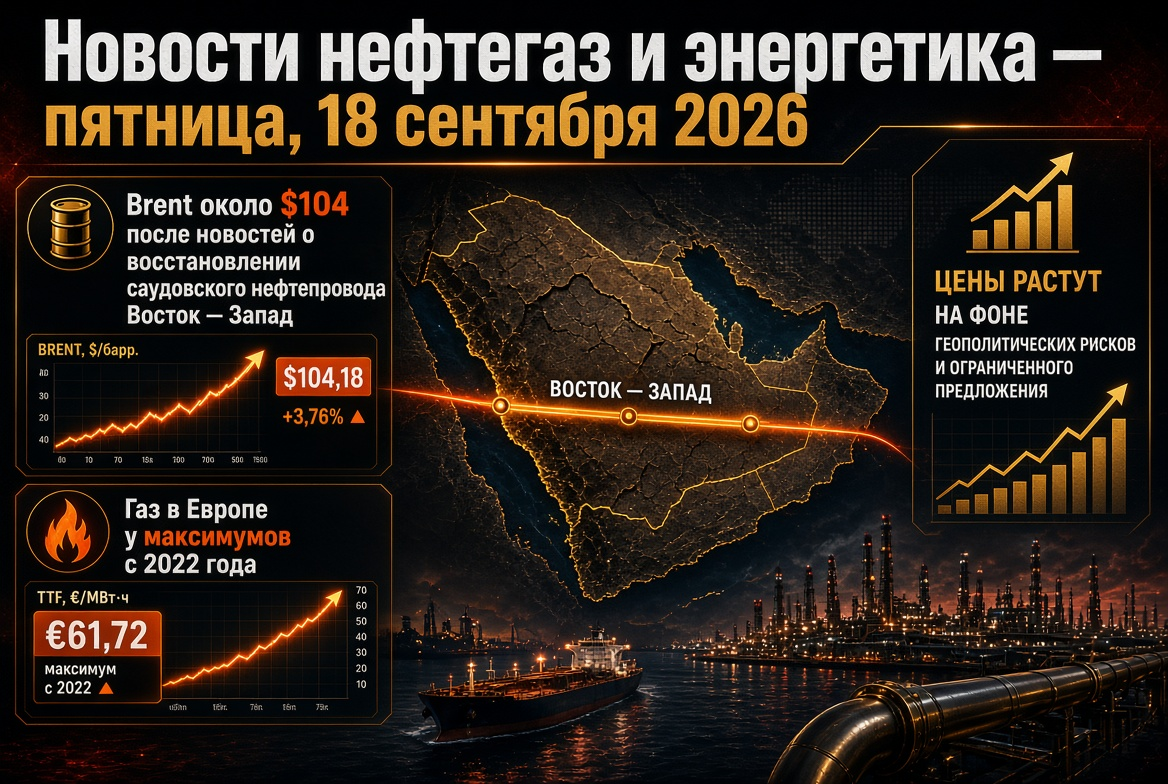
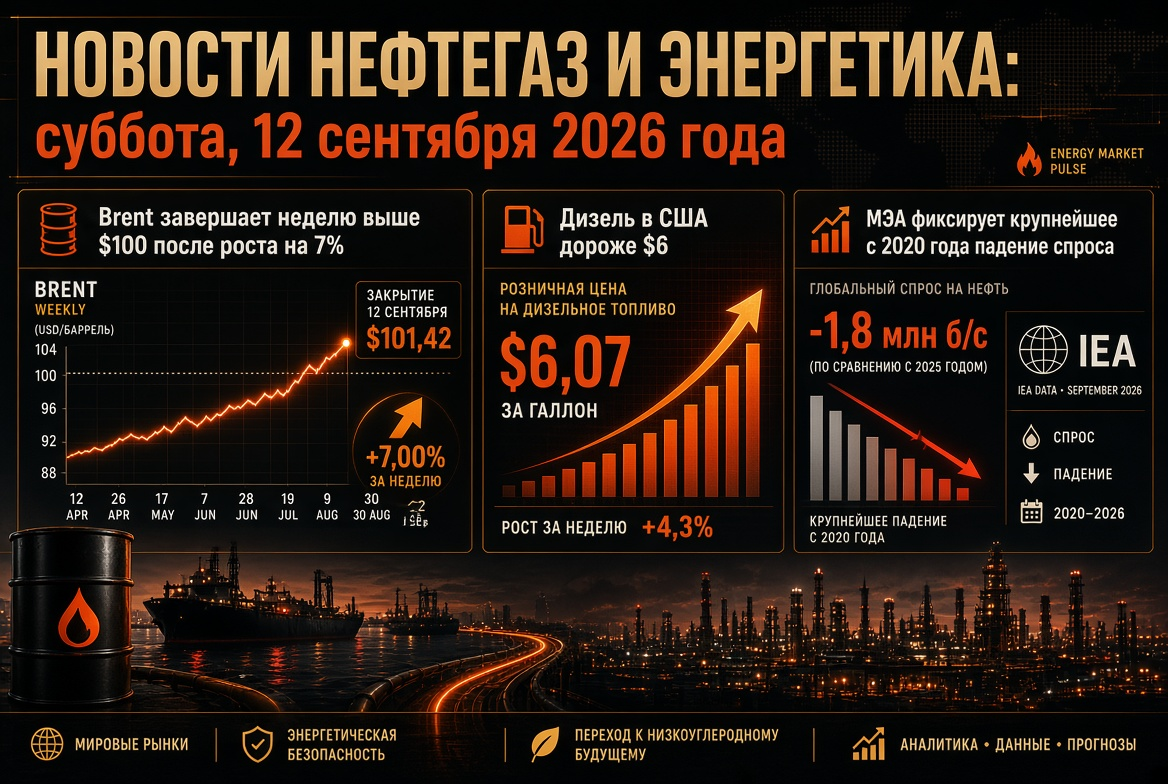
- Brent: Approximately $103–104 per barrel on Friday after reaching an intraday high of over $108 on Thursday; the weekly gain stands over 7%, with the annual peak of $126.41 (April 30) remaining the upper benchmark.
- WTI: Approximately $99 per barrel after briefly surpassing $100.
- U.S. Stocks: Commercial oil inventories decreased by 0.3 million barrels in the week ending September 4; the U.S. Department of Energy raised its production forecast for 2027 to 14.3 million barrels per day.
Revised Bank Forecasts
- Commerzbank raised its year-end Brent forecast to $85 (from $75), jet fuel to $1230 per tonne, and diesel to $1200 per tonne.
- Goldman Sachs anticipates $85 for Brent by December 2026 and $80 in 2027, but allows for a rise above $120 if Gulf production remains 4 million barrels per day below pre-war levels.
- Analysts at UBS and KCM Trade see upward risks amid sustained high volatility.
IEA and OPEC: Two Perspectives on Global Oil Market Balance
The IEA's Friday report was the harshest since the conflict began. The agency expects global oil demand to fall by 2.5 million barrels per day in 2026 — the largest annual decline since the pandemic in 2020 — and a decrease in global supply by 5.7 million barrels per day, or approximately 6%, by 2025. Global reserves fell at a record pace in August — by 3.1 million barrels per day, and the global refining system, in the agency's wording, "is operating at the limit." A return to oversupply has been postponed to 2027.
Conversely, OPEC downgraded its demand growth forecast for 2026 for the fifth consecutive month on Thursday — to 380,000 barrels per day with total consumption at 105.84 million barrels per day — but, unlike the IEA, does not foresee an absolute decline. For 2027, the cartel raised its forecast: a growth of 2.36 million barrels per day to 108.19 million barrels per day, primarily due to China, India, and the rest of Asia. The discrepancy between the two institutions — over 2.8 million barrels per day for the current year — itself reflects the degree of uncertainty that oil companies and traders are operating under.
Refined Products and Refineries: Diesel as the Tightest Segment of the Global Energy Market
The refined product market is outpacing crude oil in price increases. The average retail price of diesel in the U.S. has exceeded $6 per gallon for the first time, and crack spreads for middle distillates are holding at multiyear highs. The reasons are a double blow to global refining:
- restrictions on crude exports from the Persian Gulf and the shutdown of the 400,000 barrels per day refinery in Jazan following attacks from Yemeni territory;
- the Ukrainian campaign of strikes on Russian refineries — over 70 attacks since early 2026, with refining in Russia dropping to its lowest in two decades.
Russia has extended its diesel export ban until September 30 (with discussions on prolonging it until the end of the year), the gasoline export ban remains in effect until January 31, 2027, and the jet fuel ban is in place until the end of November. For the first time in decades, Moscow is importing fuel and has agreed to process oil at a private refinery in Kazakhstan. China, in turn, will increase retail price caps on gasoline and diesel by 260 and 250 yuan per tonne respectively starting September 12 — a signal that the price shock has reached regulated markets in Asia.
Gas and LNG: Europe Enters Winter with TTF Above €80 and Storage at 67%
The European benchmark TTF adjusted to €80.75 per MWh on Friday (a decrease of 1.6%), remaining near highs since December 2022. The price has increased by 32% over the month and by 147% over the year. The blockade of Hormuz has disrupted about 20% of global LNG flows, primarily from Qatar, while European gas storage facilities are only about 67% full, compared to a seasonal norm above 80%. QatarEnergy maintains its target to restore 50% capacity within a month after navigation normalizes, but without a safe passage for tankers, this remains a declaration. Against this backdrop, two ECB representatives suggested on Friday a further rate hike if energy inflation continues to spread to other eurozone prices — a factor that restricts speculative demand for commodities.
Coal: Twelve-Week High Amid Transition from Gas
Newcastle thermal coal traded around $148 per tonne on September 10 — a twelve-week high, reflecting a 14.5% increase over the month and nearly a 47% rise over the year. The LNG shortage is pushing coal generation in Northeast Asia and parts of Europe, while global electricity consumption, driven by data centers and air conditioning, is slowing the displacement of coal. The paradox of the moment: China officially reported that solar energy has surpassed coal in installed capacity for the first time, yet in actual generation, coal remains the largest source of electricity in the world.
Electricity and Renewables: Structural Trend Against Short-Term Chaos
The energy transition remains the only predictable vector in the sector. China is leading in investments, patents, and the export of clean technologies; India is building renewable capacity faster than it can utilize it, and Europe is facing an excess of solar and wind generation, with a lack of storage increasingly leading to negative electricity prices during daytime hours. Every euro increase in TTF enhances the economics of battery storage, grid investments, and long-term contracts for "green" energy. The corporate sector is restructuring its portfolios: Shell has sold a gas power plant in the U.S. for $715 million, while Enbridge is acquiring Tallgrass's pipeline business for $2.55 billion, betting on oil transportation infrastructure.
Logistics and Freight: Tankers as a New Bottleneck
Even with physical volumes, oil exports from the Gulf are constrained by a shortage of vessels. The VLCC freight rate on the Middle East to China route reached a record nearly $800,000 per day, while transportation from the U.S. Gulf to Asia costs $29.5 million per trip, excluding military risks. Redirecting Saudi shipments through the Red Sea and Mediterranean extends voyages by 30 days and strains the fleet, intensifying tonnage shortages for all exporters.
What Energy Market Participants Should Watch Over the Weekend
- Any confirmations or denials of the temporary shipping agreement in the Strait of Hormuz and Tehran's response.
- Statements from the coalition regarding Yemen following the capture of Mocha and the status of the Yanbu terminal — the last major diversion channel for Saudi oil.
- Dynamics of injections into European gas storages and the JKM–TTF spread as an indicator of competition for spot LNG.
- Signals from the Fed and ECB: tightening rhetoric could cool the commodity rally regardless of geopolitics.
- Decisions by Russian regulators on export restrictions and fuel imports ahead of the heating season.
Conclusions and Risks for Investors and Energy Sector Companies
- Oil. The $100 mark has solidified as support; a diplomatic breakthrough regarding Hormuz could quickly drive Brent down to $85–90, whereas new attacks on vessels open the way to $115–120.
- Refined Products and Refineries. Middle distillates remain the most constrained segment; margins for refiners outside conflict zones are at historic highs, while retail prices are a source of political pressure from the U.S. to China.
- Gas. Europe enters the heating season with historically low stock levels; TTF above €90–100 in a cold winter is the baseline, not a stress scenario.
- Coal. Increased demand in Asia and Europe will persist at least until Qatari LNG is restored.
- Renewables and Electricity. Capital is increasingly flowing into solar and wind generation, storage, and grids, but short-term stability of energy systems still relies on gas and coal.
The week's outcome for the global oil and gas sector indicates that the market, for the first time in months, has received a hint of a diplomatic exit from the Hormuz deadlock, but physical indicators — from record diesel prices to the lowest Saudi production since 1990 — suggest that shortages will continue to dictate prices for oil, gas, and electricity for many weeks to come. It is critically important for energy market participants to engage in scenario planning, diversify logistics, and maintain hedging discipline.