Key Late-Week Updates in the Energy Sector
- Oil: Brent is trading around $88–90 per barrel, WTI in the $83–85 range; weekly gains exceed 6%.
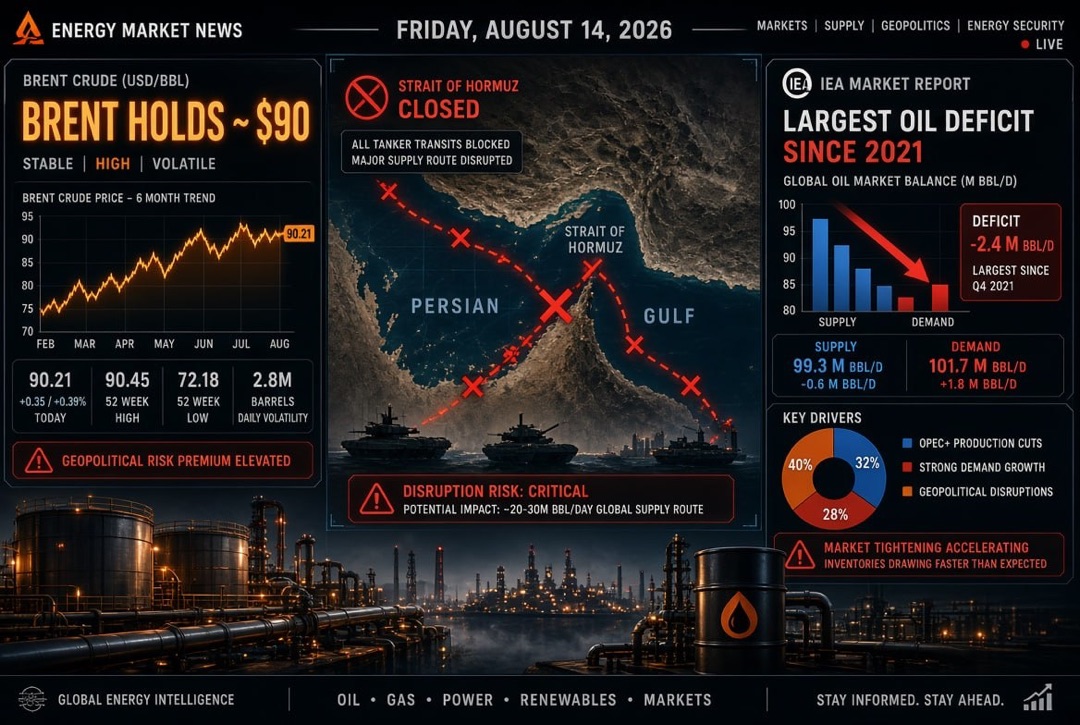
- IEA: August report lowers the forecast for global oil supply in 2026 to 102 million b/d (–4.3 million b/d year-on-year), with a Q3 deficit of 1.8 million b/d.
- OPEC+: Final quota increase approved for September (+188,000 b/d); the alliance is preparing for a pause until year-end.
- Gas: EU storage is only ~55–58% full—about 22 percentage points below the five-year average; TTF is nearly twice as expensive as at the beginning of the year.
- Russia: Ban on gasoline exports extended until January 31, 2027, with diesel restrictions in place until the end of August.
Oil Market: Brent at $90—Geopolitical Risk Premium Remains High
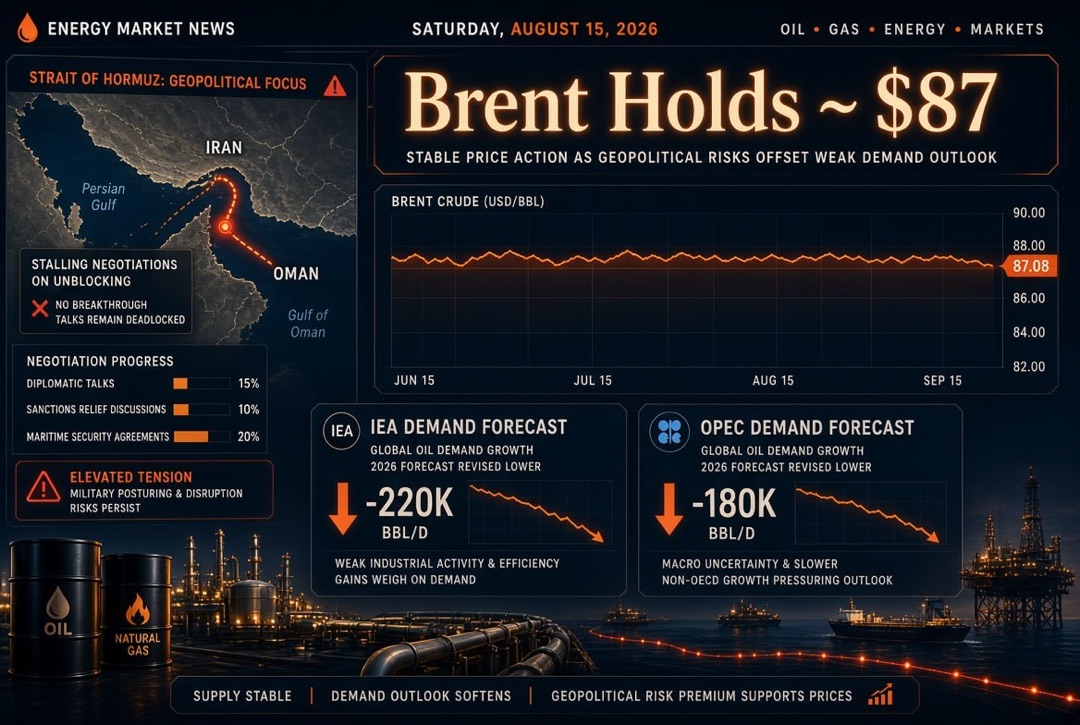
Oil prices are closing the week near two-month highs. The North Sea Brent blend is holding in the $87–90 per barrel corridor, while American WTI sits around $83–85. Over the past month, Brent has risen approximately 4–14% depending on the contract, with a year-on-year increase exceeding 30%. Volatility remains extreme: in July, prices fluctuated within a $40 range per barrel, responding to every signal from diplomatic channels. Meanwhile, the forward curve is deeply backwardated—2027 contracts are trading $8–10 lower than the nearest ones, reflecting expectations of a gradual normalization of supply following de-escalation. Global oil inventories have fallen below 7.9 billion barrels—the lowest level since spring 2025; the accumulated reduction in reserves since the conflict began has reached 410 million barrels.
IEA Report: Supply Declines Faster than Demand
The August report released by the IEA on Wednesday became this week's key fundamental benchmark. The agency has again downgraded its forecasts: global oil supply in 2026 will decrease by 4.3 million b/d—to 102 million b/d, as production growth in the Americas (+1.4 million b/d) only partially offsets losses from the Middle East and Russia. Production in the Gulf countries in July rebounded to 23.9 million b/d but remains 8.3 million b/d below pre-war levels. Demand is also under pressure: due to high fuel prices and disruptions in logistics, global consumption is expected to decline by 1.6 million b/d in 2026—most acutely in Asia and the Middle East. Nevertheless, the agency sees a bottoming out: demand will return to growth in Q4, and in 2027, assuming de-escalation, supply will surge by 8.3 million b/d—to 110.3 million b/d, leading the market into surplus.
OPEC+: Quota Increase Cycle Concluded, Ahead is a Pause
The OPEC+ alliance approved the last increase in quotas for the current cycle—by 188,000 b/d from September—at its meeting on August 2. This step marks the conclusion of the phased unwinding of the voluntary cut of 1.65 million b/d agreed upon in 2023 by seven key participants (Saudi Arabia, Russia, Iraq, Kuwait, Kazakhstan, Algeria, Oman). Formally, Russia's September quota will be 9.949 million b/d, while Saudi Arabia's will be 10.478 million b/d. However, due to military risks and logistical constraints, the increases are largely "paper-based": actual production in several countries is significantly below permitted levels. According to delegates, the alliance plans to pause in Q4—quotas are likely to be frozen until negotiations on the parameters for the 2027 deal begin. The internal resilience of the group remains questionable: the UAE exited OPEC and OPEC+, while Iraq is publicly seeking an increase in its individual limit.
Geopolitics: The Strait of Hormuz—A Major Risk for Global Energy
The US—Iran diplomatic track remains stalled. A ceasefire memorandum signed in mid-June effectively collapsed a month later: attacks on tankers in the Strait of Hormuz have resumed, and the conflict has spread to the Red Sea, where Houthi forces are targeting vessels near the Bab-el-Mandeb Strait. Washington is increasing economic pressure on Tehran, including expanding sanctions and a maritime blockade of Iranian oil exports. For the global market, this means the sustained "risk premium" in oil and LNG prices: under normal conditions, approximately one-fifth of global oil supplies and a significant portion of Qatari liquefied gas pass through the Strait of Hormuz. Any progress in negotiations could quickly cut $10–15 off the price of a barrel—and conversely, new escalation threatens a return to spring highs, when Brent surged to $120.
Gas Market: Europe Faces Winter with Supply Deficit
The European gas market remains tense. EU underground storage is only 55–58% full—this is the lowest seasonal level on record and about 22 percentage points below the five-year average. The filling target for November 1 has been lowered from 90% to 80%, but achieving this is also in question: injection rates lag behind the schedule, LNG imports are 20–25% below the long-term average, and deliveries of Qatari cargoes through the Strait of Hormuz are recovering very cautiously. An additional blow comes from the extension of the emergency shutdown of the Norwegian Ormen Lange field until February 2027, which removes over 1 billion cubic meters from the winter balance. TTF prices are fluctuating between €55–62 per MWh, remaining roughly twice the levels at the beginning of the year. Analysts warn: if injections do not accelerate, the market will begin pricing in winter shortages as early as September—a scenario reminiscent of 2021.
Power and Renewables: AI Data Centers Reshape Energy Balance
In global power generation, demand from artificial intelligence remains the main structural driver. Electricity consumption by data centers in the US has risen from 23 GW in 2023 to around 42 GW in 2026, with projections suggesting that by 2030, they might account for over 10% of all US electricity. This changes the investment logic of the sector:
- Hyperscalers are entering into long-term contracts for nuclear generation—from the revival of energy blocks to agreements for thousands of megawatts of "carbon-free" capacity;
- The commissioning of solar and wind capacities continues to set records, but the rate of load growth is already catching up with the pace of renewable construction;
- The deficit of grid capacities and the lengthening of connection timelines ("time-to-power") are delaying the launch of new sites by 1.5–2 years and stimulating the development of microgrids, storage solutions, and self-generation.
For investors, this signifies a multi-year cycle of capital investments in generation of all types, networks, and energy storage systems.
Coal: An Unexpected Beneficiary of the Energy Deficit
The coal sector is experiencing a renaissance that few could predict just a few years ago. According to US federal statistics, coal generation increased by 13% last year—a rise in demand from data centers and air conditioning during hot seasons prompted energy companies to revive plants that were slated for closure. In Asia, coal remains a cornerstone of energy systems: China and India are maintaining consumption near record levels, and high LNG prices further enhance the competitiveness of coal-fired power plants. Prices for thermal coal remain relatively stable amid persistently high demand, and in the coming years, coal generation is expected to retain a significant share in the global energy balance, despite decarbonization goals.
Russia: Export Restrictions and Stabilizing Fuel Market
The domestic market for petroleum products in Russia remains under manual control. The government has extended the full ban on gasoline exports until January 31, 2027—for both producers and traders; diesel export restrictions are in place until the end of August and, according to Deputy Prime Minister Alexander Novak, will be lifted as the balance is restored. The reason for the stringent measures is the reduced fuel production following drone attacks on refineries and heightened seasonal demand. Wholesale and retail gasoline prices continue to rise, and market participants do not anticipate any significant correction before the fourth quarter. In the export segment, Russia maintains its position as the largest oil supplier to India and China, although actual production—around 9 million b/d—remains below OPEC+ quotas due to infrastructural constraints.
Investor Outlook: Calendar and Scenarios
Key indicators for market participants in the energy sector for the coming weeks include:
- US—Iran diplomacy: any signals concerning the resumption of negotiations regarding the Strait of Hormuz will be a primary price-driving factor for oil and LNG;
- OPEC+ meeting in early September: confirmation of a pause in quota increases and the initial outlines for a 2027 deal;
- Gas injection rates in European UGS: lagging behind the 80% target by November could trigger an early "winter" rally in TTF;
- Global oil inventory dynamics: continued drawdowns will support backwardation and prices above $85;
- Russian fuel market: timelines for lifting diesel restrictions and stabilization of gasoline prices.
The baseline scenario for autumn anticipates sustained high oil and gas prices amid high volatility: the market will balance between a record physical supply deficit in recent years and the prospect of a sharp surplus in 2027 in the event of de-escalation in the Middle East. For the energy sector, this period is marked by heightened risks—while simultaneously reflecting historically high premiums for prudent management of these risks.