Oil and Gas News and Energy for Friday, June 26, 2026: Oil Loses Geopolitical Premium, Gas and LNG Remain at Risk, Refineries and Oil Products Remain Critical for the Global Energy Sector
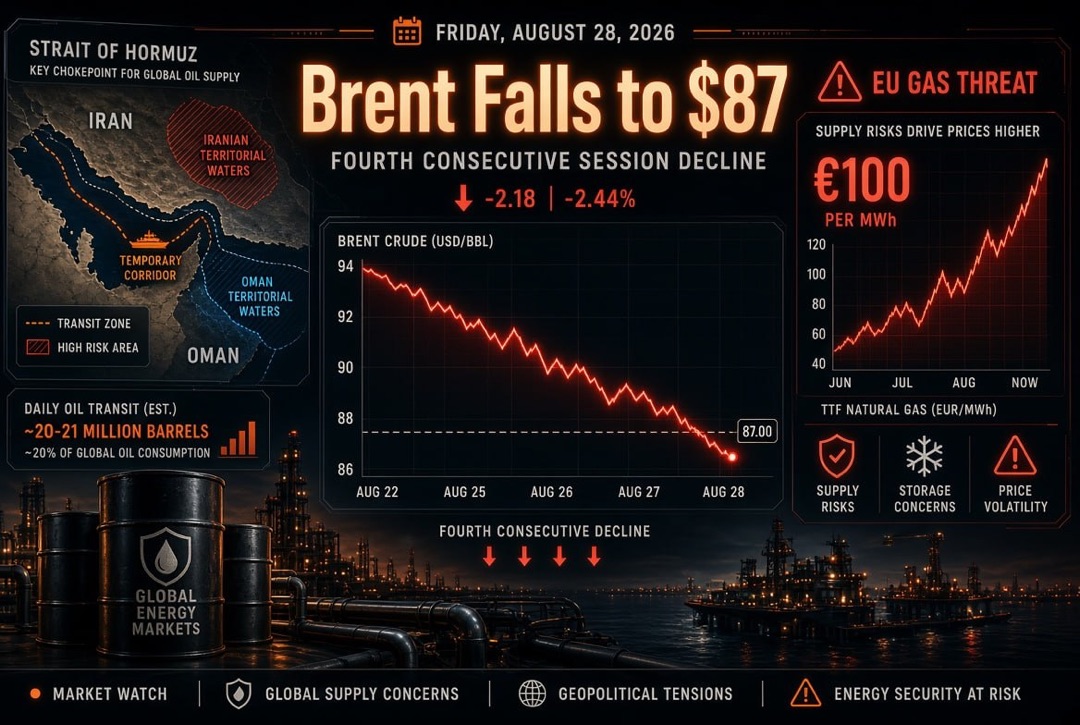
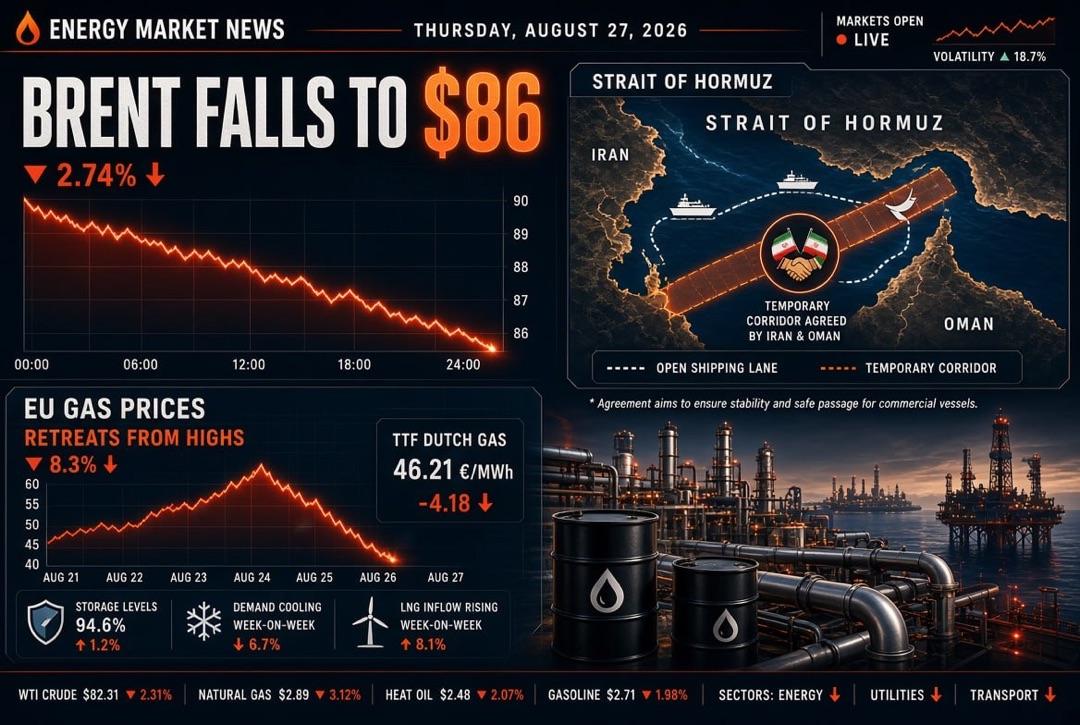
The global fuel and energy complex is entering a phase of sharp risk reassessment on Friday, June 26, 2026. Following the restoration of traffic through the Strait of Hormuz, the oil market is rapidly shedding its geopolitical premium, with Brent and WTI approaching levels not seen since the last round of escalation in the Middle East. However, for investors, oil companies, refineries, product traders, and fuel companies, this does not signal a return to a tranquil cycle.
The key feature of the current moment is the divergence between crude oil prices and the state of the entire energy supply chain. While oil prices are declining on expectations of supply recovery, gas, LNG, oil products, coal, and electricity still reflect structural constraints: logistical delays, infrastructure damage, low inventories, high electricity demand, and competition between Europe and Asia for energy resources. For the global energy sector, this is a period where short-term volatility is gradually yielding to a more complex question: who will restore supplies, processing, and energy infrastructure more quickly?
Oil: Market Reduces Risk Premium, Yet Balance Remains Fragile
The top news in the oil and gas market is the drop in oil prices following a partial normalization of export flows from the Persian Gulf. For global investors, this signals that the market is no longer pricing in a maximum scenario for supply disruptions but is still cautiously assessing risks.
Currently, three factors are simultaneously influencing the oil market:
- Increased Supply from the Middle East. The resumption of tanker traffic through the Strait of Hormuz enhances physical oil availability and lessens fears of shortages.
- Weak Demand Amidst Previous High Prices. Some consumers have already reduced purchases, and industrial demand across certain regions remains uneven.
- Change in the Futures Curve Structure. The transition of certain grades to signs of short-term oversupply indicates that traders expect a softer balance in the coming weeks.
For oil companies, declining prices mean a reduction in excessive profits arising from geopolitical premiums, but can represent a positive factor for refineries and raw material buyers. Cheaper oil improves refining economics if diesel, gasoline, jet fuel, and residual fuel markets remain relatively tight.
Strait of Hormuz: Logistics Recovering, but Insurance and Operational Risks Persist
The Strait of Hormuz remains a central point on the global energy map. Significant volumes of oil, LNG, and oil products pass through this corridor, so even partial normalization of traffic quickly impacts Brent, WTI, Asian oil grades, and freight costs.
However, recovery does not appear entirely linear. Market participants assess not just the fact of route reopening but the quality of recovery:
- How quickly tankers can return to a regular loading schedule;
- Whether insurance premiums for vessels in the region will decrease;
- How quickly damaged terminals, refineries, and export facilities will become operational;
- Whether the political pause between key conflict sides will be maintained.
This is why the news in oil and gas and energy for June 26, 2026, cannot be interpreted merely as "falling oil prices." It is more accurate to say that the market is transitioning from panic to cautious normalization, where each new tanker flow has the potential to alter the balance of prices for oil, oil products, and LNG.
Gas and LNG: Market Awaits Stabilization, but Europe and Asia Compete for Supplies
The gas market remains tighter than the oil market. In the aftermath of the Middle Eastern conflict, LNG market participants are assessing the timeline for recovery of supplies from Qatar, the resilience of export terminals, demand from Asia, and Europe's need to replenish storage ahead of the winter season.
For Europe, gas is once again a matter of energy security. Even with oil prices declining, the price of natural gas and LNG may remain elevated due to several factors:
- The urgency of gas injection into European storage facilities;
- Competition with Japan, South Korea, China, and India for LNG cargoes;
- Delays in restoring certain Middle Eastern capacities;
- Regulatory disputes regarding methane requirements for gas importers in Europe.
For gas companies and LNG traders, this creates an ambiguous picture. On one hand, high prices support producer margins. On the other hand, consumers are increasing pressure on suppliers, accelerating diversification, and more frequently viewing long-term contracts as a tool to protect against spot volatility.
Refineries and Oil Products: More Raw Materials, but Products Remain a Sensitive Link
The refinery and oil products market is now more significant than the typical dynamics of a barrel of oil. Even with Brent's decline, shortages of certain fuel types may continue if refining does not recover synchronously with raw oil production and export.
Industry participants are particularly focused on residual fuel, diesel, jet fuel, and gasoline. Residual fuel exports from the Middle East are recovering but remain below pre-crisis levels. This is crucial for Asia, where residual fuel is used in energy production, marine fuel, and industry. For Europe and the U.S., the key indicator remains the diesel margin: if refining recovers more slowly than crude oil supplies, oil products may increase in price even as oil weakens.
For fuel companies, this means the necessity of managing inventories more carefully. The most important decisions in the coming weeks include:
- Purchasing raw materials at lower prices;
- Locking in margins on oil products;
- Monitoring logistical risks;
- Redistributing supplies between the domestic market and exports.
Electricity: Demand is Rising Due to Heat, Data Centers, and Electrification
The electricity sector is becoming an independent investment driver of the global energy market. Consumption growth is linked not only to industry but also to the development of artificial intelligence, data centers, air conditioning, electric vehicles, and digital infrastructure.
In the U.S., record electricity consumption is anticipated in 2026 and 2027. For investors, this signals a structural demand for generation, networks, energy storage, and gas capacities. In Europe, heatwaves and low wind generation have already shown that energy systems require backup capacity, especially when renewable sources operate inconsistently.
For energy companies, the key task is not just to build more generation but to ensure system flexibility. The highest value comes from:
- Gas power plants as a backup for peak demand;
- Battery energy storage systems;
- Modernization of network infrastructure;
- Virtual power plants and demand management;
- Long-term electricity supply contracts for data centers.
Renewable Energy: China Accelerates Energy Transition, but Demand for Traditional Resources Persists
Renewable energy remains the fastest-growing segment of the global energy sector. China is intensifying its goals for the share of non-fossil sources in electricity generation by 2030, while solar and wind generation continue to displace coal in the long-term electricity production structure.
However, for investors, it is crucial to understand that the growth of renewables does not negate the roles of gas, coal, and oil products in short-term balance. The higher the share of solar and wind, the greater the need for networks, storage, backup generation, and balancing capacities. Thus, the energy transition is not merely a replacement of one resource for another but a complex system where companies capable of managing flexibility will succeed.
The most promising directions in renewable energy and electricity include:
- Utility-scale solar power plants;
- Offshore and onshore wind energy;
- Energy storage systems;
- Grid technologies;
- Hybrid projects: renewables plus gas, renewables plus batteries, renewables plus data centers.
Coal: Asia Temporarily Returns to Demand Due to Expensive LNG and Energy Security
Coal remains a controversial yet important element of the global energy balance. In Asia, demand for thermal coal has surged due to the high cost of LNG, heat, increased electricity consumption, and countries' desires to reduce dependence on volatile gas imports.
China, Japan, and South Korea are increasing their purchases of seaborne thermal coal, while India is striving to utilize domestic reserves more actively and reduce reliance on imports. For the market, this indicates that coal is not disappearing from the global energy landscape despite the growth of renewables. It remains a backup and price competitor to gas, especially during periods of LNG shortages.
For investors, the coal sector is of interest not as a long-term growth story but as a tool for analyzing energy security, generation margins, and regional imbalances. The higher the gas prices, the greater the likelihood of a temporary return to coal generation in Asia.
What Matters for Investors and Energy Sector Participants
As of June 26, 2026, the global energy sector delineates several practical conclusions for investors, oil companies, refineries, gas traders, fuel companies, and electricity producers.
- Oil is cheaper, but the risk has not disappeared. Price declines reflect supply recovery rather than a complete removal of geopolitical uncertainty.
- Gas and LNG remain sensitive to disruptions. Europe and Asia will compete for supplies until stable export flows are restored.
- Refineries may become the main source of margins. If oil products remain scarce, refining will be more attractive than production.
- Electricity is becoming a strategic asset. Data centers, heat, and electrification are increasing the value of networks, generation, and storage.
- Renewables are growing but require balancing. Investments in solar and wind generation must be accompanied by investments in energy system flexibility.
- Coal remains a backup resource for Asia. With high LNG prices, countries in the region are temporarily returning to coal generation.
Conclusion: The Global Energy Market Transitions from Shock to New Configuration
Energy news for Friday, June 26, 2026, indicates that the global energy market is emerging from the acute phase of geopolitical shock, but it is not returning to previous stability. Oil is responding the fastest and is already losing its risk premium. Gas, LNG, refineries, oil products, coal, and electricity are recovering more slowly due to dependencies on infrastructure, logistics, seasonal demand, and regional politics.
For global investors, the main takeaway is that the energy sector is once again a market not just for raw materials but for infrastructure. Winning companies will be those that control not just a single asset, but the entire chain: extraction, transportation, processing, storage, electricity, renewables, networks, and end customers. In the coming weeks, market attention will focus on the speed of recovery in the Middle East, Brent and WTI dynamics, European gas stockpiles, LNG prices in Asia, refinery margins, and electricity demand from data centers.