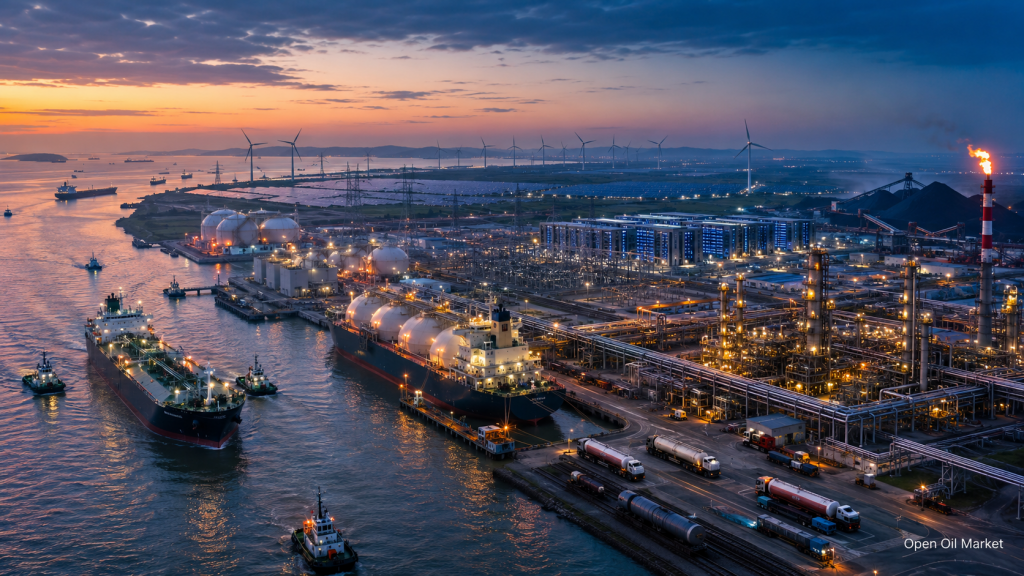
Oil, Gas, and Energy News as of July 18, 2026: Brent $84–85, Hormuz Strait Blockade, Europe's Gas Storage at 49.7%, TTF Gas at 50.6 €/MWh, Greece Blocks 21st EU Sanction Package on LNG, Crisis in Russian Oil Products Market, OPEC+, Coal and Renewables
The Energy sector enters the weekend of July 18, 2026, in a state of structural tension unseen since the 2022 crisis. The resurgence of maritime blockades in the Persian Gulf has essentially paralyzed shipping through the Strait of Hormuz, with Brent crude prices hovering around $84–85 per barrel, while European underground gas storage is less than half full— the lowest level recorded for mid-July since records began. At the same time, Greece has blocked the 21st EU sanction package due to a ban on transporting Russian LNG, while the Russian fuel market is experiencing the most severe deficit of petroleum products in years, as oil refining rates have fallen to their lowest since 2005. Below is a detailed overview of key events in the oil, gas, and energy sector for investors, energy market participants, and oil and fuel companies.
Oil Market: Hormuz Strait Blockade Paralyzes Shipping, Yet Prices Remain Stable
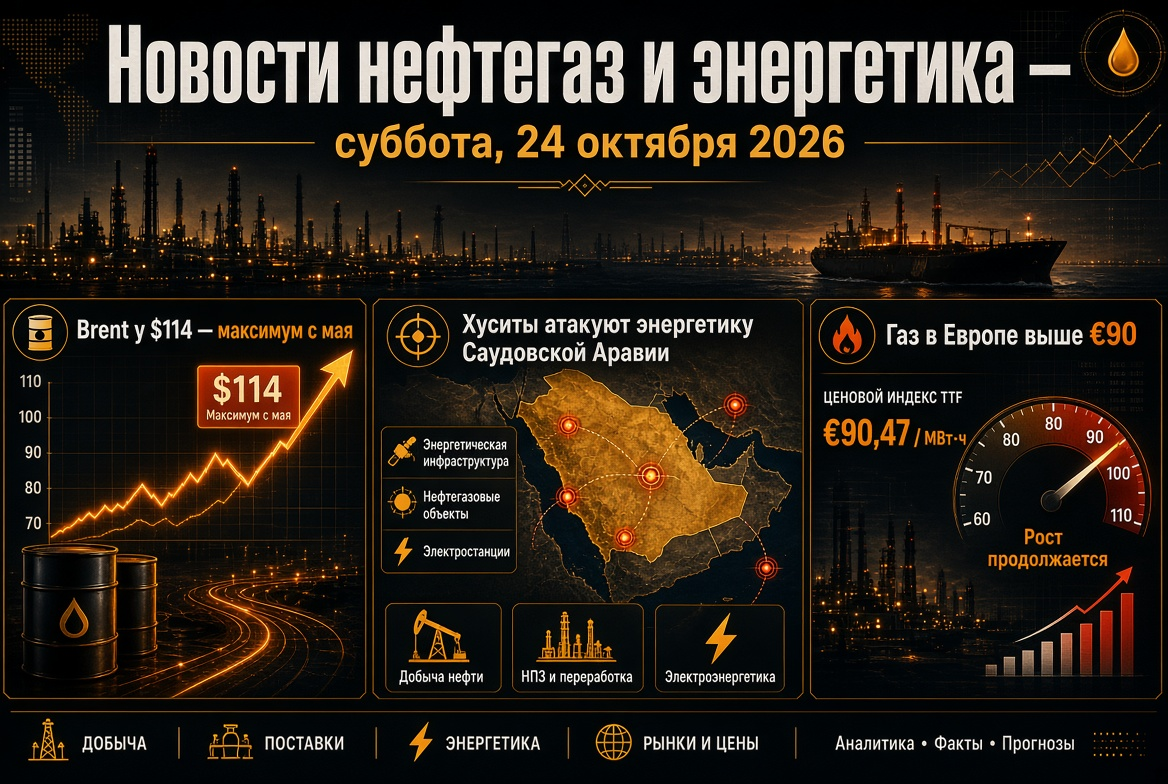
The main paradox of the current moment in the global oil market is that an unprecedented logistical shock is not translating into a price rally. As of the close of trading on July 16, Brent prices were around $84.85 per barrel, a decrease of 0.6% from the previous session. However, since the beginning of 2026, oil prices have risen nearly 39%, with an increase of about 2.6% compared to June levels.
Key factors influencing oil price dynamics include:
- Hormuz Blockade. Following new strikes on military sites in Iran and Tehran's retaliatory actions against bases in the Gulf, shipping through the Strait has virtually ceased. Vessel tracking data shows tankers no longer passing through Omani waters. The U.S. renewed its maritime blockade of vessels heading to Iranian ports on July 14.
- Managed Corridor. A significant number of analysts believe that alternating phases of escalation and de-escalation are keeping oil prices within the $75–90 per barrel range, as market participants strive to avoid more significant fluctuations.
- Monetary Factor. The prevailing understanding that the Federal Reserve is unlikely to ease rates in the near term is restricting expected liquidity and putting pressure on the entire commodity complex.
- Inventories. According to the American Petroleum Institute (API), U.S. commercial crude oil inventories decreased by only 0.564 million barrels in the reporting week, against a consensus forecast reduction of 2.7 million— a mildly bearish factor.
For oil companies and investors, the essential conclusion is that the oil market has ceased to respond linearly to geopolitical events. The risk premium is largely priced in, and further price increases require physical drops in volumes.
OPEC+ Following UAE Exit: Quotas Rise, Production Does Not
The configuration of the oil alliance underwent fundamental changes in 2026. The United Arab Emirates exited OPEC and OPEC+ as of May 1, aiming to increase its own production, a significant blow to the institutional strength of the deal in recent years.
July 2026 Quotas
- Seven key OPEC+ countries—Saudi Arabia, Russia, Iraq, Kuwait, Kazakhstan, Algeria, and Oman—have increased the July quota by 188,000 barrels per day.
- The total alliance quota for July is set at 35.83 million b/d without considering compensations from deal violators.
- Russia's quota for July has been raised by 62,000 b/d to 9.8 million b/d; a similar increase has been granted to Saudi Arabia, increasing its quota to 10.353 million b/d.
- The compensation period for overproduction has been extended to the end of 2026.
Discrepancy Between Planned and Actual Production
A significant narrative in the mid-2026 oil market is the colossal gap between permitted and actual production volumes. In June, OPEC+ increased production by 1.18 million b/d compared to May; however, it fell short of its own target by 7.1 million b/d. The discrepancies across individual countries include:
- Saudi Arabia — minus 3.444 million b/d against the quota;
- Iraq — minus 2.382 million b/d;
- Kuwait — minus 1.176 million b/d;
- Russia — minus 834,000 b/d (actual production in June dropped by 61,000 b/d from May, to 8.928 million b/d);
- Kazakhstan — excess quota of 1.152 million b/d; Oman — 126,000 b/d.
The shortfalls among Middle Eastern producers are directly linked to regional conflict and the inability to export crude. In fact, OPEC+ quotas have lost their function as a supply management tool: the market is balanced not by ministerial decisions but by the state of straits and port infrastructure.
IEA and OPEC Forecasts: Demand is Steady, Supply is in Question
In its July overview, the International Energy Agency adopts a notably cautious stance, revising down its outlook for the oil market and global supply. A month prior, the agency had anticipated that the restoration of transit through the Strait of Hormuz would allow for an increase in world output by about 8 million b/d in 2027, leading to a notable surplus. Revising this outlook indicates that the surplus scenario has been postponed.
In contrast, OPEC remains constructive regarding demand:
- The global oil demand growth forecast for 2027 has been raised to 1.94 million b/d from 1.73 million b/d;
- Growth expectations for the global economy remain at 3.1% for 2026 and 3.2% for 2027;
- The forecast for non-OPEC+ production in 2026 has been increased by 10,000 b/d to 54.84 million b/d.
The long-term outlook also remains inflationary for commodities: according to Russian Deputy Prime Minister Alexander Novak, global oil demand will continue to grow at least until 2050, with the proportion of hard-to-extract reserves (TRIZ) in Russian production potentially reaching 87%.
European Gas Market: Storage is Depleted, Competition for LNG is Intensifying
The most vulnerable segment of the global energy sector as of mid-July 2026 is European gas. The injection season began on April 1, yet by mid-summer, EU underground gas storage is an average of 49.7% full— an absolute low over recent years. At the start of July, this figure was 49.22%.
Reasons for Injection Failure
- Cold Winter of 2025/26 and high extraction rates from gas storage.
- Collapse of Middle Eastern LNG. According to the IEA, liquefied natural gas production in Qatar and the UAE from March to June dropped by nearly 80% year-on-year due to infrastructure damage and shipping issues through the Hormuz Strait.
- Asian Competition. In July, LNG purchases by Asian nations may hit a six-month high of 23.05 million tons, while European purchases are expected to be only 6.9 million tons— a two-year low. China, Japan, and South Korea are increasingly buying American cargoes that would otherwise be headed for Europe.
- Unfavorable Price Conditions, which stunted traders' economic motivation to inject during the first half of the season.
Price Benchmarks
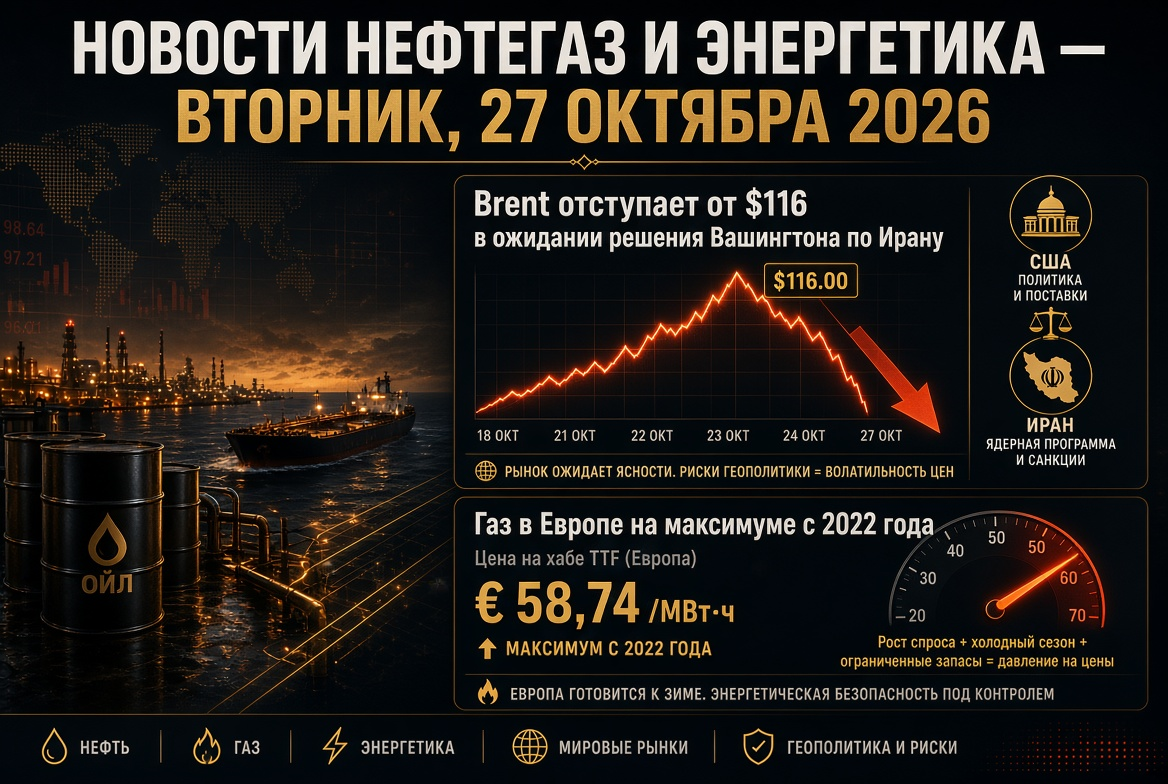
Gas at the TTF hub is trading around 50.6 euros per MWh. At the beginning of July, prices exceeded $535 per thousand cubic meters at the level of 44.13 euros per MWh. A relatively calm scenario for the upcoming months suggests a range of 45–60 euros per MWh. However, any resumption of shipping restrictions in Hormuz and failure to restore Qatari exports could push prices towards 60–80 euros. Additionally, an abnormal heatwave in Europe is increasing electricity demand for cooling.
Sanction Framework: Greece Blocks 21st EU Package
The EU's sanction policy is facing internal resistance. Greece has opposed the 21st sanction package, which includes a ban on EU companies transporting Russian LNG to third countries. The reason is to protect the shipping company Dynagas, owned by Greek businessman Georgios Prokopiou, which operates an ice-class fleet for the Yamal LNG project in Arctic conditions. Athens states that the measure will devastate the Greek shipping industry.
Accompanying circumstances important for market participants include:
- The approval of the 21st package requires support from all 27 countries in the EU;
- Member states have agreed to maintain the price cap on Russian crude at $44.10 per barrel until July 23 while attempts continue to reach a broader agreement;
- Import restrictions on Russian pipeline gas have been effective since June 17, 2026, for short-term contracts, and will come into effect on November 1, 2027, for long-term contracts;
- In December 2025, the EU decided to accelerate its exit from Russian LNG, terminating long-term contracts by the end of 2026 and banning supplies under short-term contracts since April 2026;
- Greece previously submitted a roadmap to the EU for a complete withdrawal from Russian gas by the end of 2027— underscoring the selective, rather than ideological nature of the current veto.
For investors, this episode illustrates a key risk in European energy policy: with gas storage levels below 50% and global LNG shortages, the price of tightening sanctions becomes tangible for the EU member states themselves.
Asia: India Balances Between Import and Cost
Asian consumers remain the primary focus of global energy demand. Recent Indian statistics highlight the effects of the price shock:
- In May 2026, India reduced oil imports by 2%— to 21.95 million tons compared to 22.41 million tons a year earlier;
- At the same time, in monetary terms, deliveries rose almost 1.7 times to $18.98 billion;
- LNG imports in May increased by 3%— to 2.236 million tons;
- Russia became again the largest oil supplier to India in May.
Physical volumes stagnate, while import costs soar— a direct reflection of the loss of discounts and rising logistics expenses. Before the conflict began, nearly half of India's crude oil imports, along with large LNG volumes, were sourced from Persian Gulf countries via the Strait of Hormuz. Some vessels under Indian flags have remained blocked west of the strait. Pakistan officially approached Saudi Arabia back in March, requesting the rerouting of supplies through the Yanbu Port on the Red Sea.
For China, the stakes are equally high: the country receives about a third of its oil via Hormuz, while maintaining a strategic reserve of around a billion barrels. Europe depends on Qatari LNG that passes through the strait for about 12–14%. Up to 30% of global trade in fertilizers also passes through Hormuz, spreading the energy crisis to the agri-food sector.
Russian Oil Products Market: Refining at Its Lowest Since 2005
Russia's domestic fuel market is experiencing the most acute phase of the crisis in recent years. Oil refining in the country has fallen to its lowest level since 2005— a consequence of damage and unscheduled downtime at refineries amid drone attacks. The Central Bank of Russia has noted the negative impact of refinery shutdowns on the dynamics of the economy.
Mechanics of the Crisis
- Supply Compression. Some refineries have reduced output, exchange fuel volumes have fallen, wholesale prices have risen, and retail prices are following suit.
- Market Overheating. In June, sales of AI-95 at trading on the St. Petersburg International Mercantile Exchange (SPbMTSB) dropped to 43%, while the wholesale price per ton of diesel fuel exceeded historical highs. The supply deficit, with a lag of 2–3 weeks, has transferred to retail gas stations.
- Seasonal Peak. The auto season runs from late April to October; the load on gas stations along federal highways M-4 "Don" and M-12 "Vostok" has increased significantly.
- Hoarding Demand. As queues form, drivers fill their tanks and stock up for the future, further exacerbating the shortage.
- Retail Stratification. Large retail chains keep price increases within inflation limits, while independent gas stations in some regions have seen prices rise significantly higher.
Regulatory Measures
- Expansion of damping payments to oil companies, compensating the difference between export and domestic prices.
- Increased control over wholesale sales to prevent the redirection of supplies towards exports at the expense of the domestic market.
- Monitoring of exchange rates with the possibility of prompt regulatory intervention.
- Priority provision for the domestic market — the official line confirmed by Alexander Novak's statements regarding oil companies maintaining gas station prices at inflation levels.
Special attention from regulators is focused on diesel fuel: farmers are preparing for the harvest, carriers are operating at peak capacity, and sharp increases in diesel fuel prices are immediately reflected in food and transportation costs.
Budgetary Dimension: Russia's Oil and Gas Revenues Under Pressure
The financial performance of the sector reflects a combination of sanctions, exchange rate, and production factors. The volume of oil and gas revenues for the Russian Federation in the first half of 2026 has decreased by 22.7% compared to the same period last year. Despite a nearly 39% increase in the dollar price of Brent since the beginning of the year, this decline indicates the combination of a strong ruble, expanding damping payments, discounts on Urals, and a physical decrease in refining.
Meanwhile, the sector is seeking technological solutions: Gazprom Neft has implemented equipment to enhance hydraulic fracturing efficiency, and the demand for gas motor fuel and related equipment is rising— agricultural holdings have begun to transition their fleets to gas, a direct response to the fuel crisis.
Electricity and Renewables: Solar Records amidst Coal Resilience
The energy transition continues to accelerate in 2026, despite hydrocarbon turbulence.
Renewable Energy
- Global solar energy production in 2025 increased by 636 TWh, a 30% increase over the previous year; according to Ember, renewables have for the first time fully met the growth in global electricity demand, preventing an increase in fossil fuel generation.
- Global investments in the energy transition reached $2.3 trillion in 2025.
- The share of renewables has exceeded one-third of global electricity production, surpassing coal.
- According to IEA forecasts, solar energy is expected to surpass nuclear in production by 2026, with the share of renewables in global generation rising from 30% (2023) to 37% (2026).
- India remains the third-largest solar energy market and plans to add 200 GW of solar capacity over the next five years to reach a target of 500 GW of renewables by 2030.
Coal and Balancing Generation
Coal continues to play a structural role in the Asia-Pacific region. China is committed to controlling the growth of coal generation and gradually limiting it between 2026 and 2030; however, amid unprecedented heat and peak load demands for air conditioning, coal capacities remain a safety net for the energy system. The majority of new renewable capacity is still concentrated in Asia— 421.5 GW, or 72% of global growth. For energy systems with a high share of solar and wind, critical investment directions are energy storage systems and grid modernization.
Conclusions for Investors and Energy Market Participants
The configuration of the global energy market as of July 18, 2026, is shaped by several stable patterns that will dictate price movements in the coming weeks:
- Oil. The range of $75–90 per barrel appears to be the baseline scenario. The key trigger for upward movement is not headlines about escalation, but confirmed physical drops in volumes from the Persian Gulf. The downward trigger— restoration of transit through Hormuz, which could pave the way for a supply surplus in 2027.
- Gas and LNG. The European market is the most vulnerable link. Storage levels below 50% in mid-July indicate that any supply disruptions this fall will immediately translate to TTF prices without a buffer. The range of 45–60 euros per MWh is the optimistic scenario; 60–80 euros is realistic under continued restrictions.
- Sanctions. The rift within the EU over the 21st package illustrates that the limit of sanctions pressure is not defined by political will but by the physical availability of alternative gas volumes.
- Oil Products and Refineries. The Russian fuel market remains in a supply deficit; normalization depends on the completion of repairs and restoration of refining capacity, rather than on regulatory measures as such.
- Renewables and Coal. The energy transition is accelerating in electricity generation but does not negate the need for balancing capacities. Investment focus is shifting towards grids and storage solutions.
The overarching takeaway for fuel and oil companies, traders, and institutional investors: the mid-2026 energy market is a logistics market, not a barrel market. Pricing is determined not by the volume of reserves underground but by the ability to deliver feedstocks through several narrow geographical points. Managing risks in such conditions requires not so much precise price direction forecasts but readiness for rapid adaptation to new information.