Venture Market Enters Summer 2026 Under the Sign of Artificial Intelligence, Infrastructure, and Quality Revenue Selection
On Tuesday, May 26, 2026, the global startup and venture capital market continues to operate under a high concentration of capital. The main theme for venture investors and funds is not just the growing interest in artificial intelligence (AI), but the transition of the AI sector into a new phase: funding increasingly flows to companies that control computational infrastructure, create applied AI products, service AI-native startups, or can prove real monetization.
Venture capital in 2026 appears aggressive again, but no longer uniform. Investors are ready to pay a premium for growth speed, access to chips, proprietary models, defense technologies, fintech infrastructure, and corporate AI services. At the same time, funds are scrutinizing revenue quality, cost structure, and startups' dependence on cloud providers. For the global audience of venture funds, this means: the market is once again open for large deals, but the cost of mistakes in due diligence has increased.
AI Remains the Center of Global Venture Capital
The key backdrop for the market is a record concentration of venture financing around artificial intelligence. Following a strong first quarter of 2026 and active April, investors continue to reallocate capital in favor of companies linked to AI models, computing, automation of development, agent systems, and corporate infrastructure.
For venture investors, this is no longer a short-term trend, but a structural shift. Startups that can demonstrate a connection between AI technology and real customer economics are receiving higher valuations. The most sought-after areas include:
- AI infrastructure and access to computing resources;
- AI coding and software testing platforms;
- Personal AI interfaces and next-generation devices;
- Fintech services for AI-native companies;
- Defense and industrial technologies with AI components;
- Biotechnology and synthetic biology.
Thus, the news related to startups and venture investments on May 26, 2026, indicates that capital continues to grow, but this growth must be underpinned by technological advantage, scalable business models, and access to critical resources.
Hark and the Bet on Personal AI Interface
One of the major signals of the week was the large round for Hark—a new AI startup that raised over $700 million in Series A at a valuation of around $6 billion. For an early-stage company, this is an extraordinary amount of capital, demonstrating how highly investors value the opportunity to create the next mass interface between humans and artificial intelligence.
Hark positions itself as a company working on personal intelligence that combines proprietary models and specialized hardware. The round included significant strategic and financial investors, including representatives of the semiconductor and technology industries. For venture funds, this is an important marker: the market is looking for more than just another AI software; it is seeking a new consumer or semi-consumer layer that could replace conventional applications, voice assistants, and parts of operating systems.
Why This Matters for Funds
- AI interfaces are becoming an independent investment category.
- Capital is increasingly funneled into the combination of "model plus device plus user experience."
- Early-stage startups can achieve late-stage valuations if the market sees a chance for platform effect.
Modal Labs: Infrastructure for AI Coding Becomes a Scarce Asset
Modal Labs raised $355 million in a Series C round, achieving a valuation of approximately $4.65 billion. The company operates at the intersection of two major trends in 2026: the rise of AI coding and the shortage of computing resources. Its platform assists developers and AI companies in accessing chips for inference and testing code in an isolated environment before product deployment.
For venture investors, this is a particularly telling deal. Unlike many AI applications, Modal is closer to the infrastructure level of the market. Such companies can win regardless of which specific AI products become leaders among end-users. The more startups create AI services, the greater the demand for tools to launch, test, scale, and optimize computations.
Modal also demonstrates an important criterion for 2026—growth in revenue. Rapid increases in annual sales rates and an expanding network of cloud partners show that investors are increasingly paying attention not only to the technological narrative but also to confirmed customer demand.
Mercury and Fintech Infrastructure for a New Generation of Startups
Fintech company Mercury secured $200 million at a valuation of around $5.2 billion. This round is significant not only for the fintech sector but for the entire venture investment market. Mercury services tech companies and startups, as a new wave of AI-native entrepreneurs creates demand for faster banking, payment, and financial tools.
Fintech for startups is becoming an infrastructure market. Whereas in previous years banks for tech companies were perceived as a service niche, they are now becoming part of the venture ecosystem. Startups need accounts, payments, treasury solutions, liquidity management, and financial analytics integrated into a fast growth cycle.
For funds, this is a signal: around the AI boom, not only AI companies thrive but also the entire layer of supporting infrastructure. The investment opportunity lies not only in models but also in services that help thousands of new companies build business faster.
OpenAI and the New Model of Early Financing: Tokens Instead of Classic Capital
A notable initiative in the venture market came from OpenAI, which offered startups from the current Y Combinator batch $2 million in the form of AI tokens in exchange for equity. For the early-stage market, this could set a significant precedent: computing resources and access to APIs are starting to serve as a form of investment capital.
This model alters the logic of seed financing. For an AI startup, computing power may be just as important as funds for salaries or marketing. If a company receives a substantial amount of AI credits, it can test products faster, launch MVPs, and scale user scenarios. However, for funds and founders, the question arises: what equity percentage should be given for a resource whose cost for the provider may decrease as inference costs decline?
Risks of the "Tokens for Equity" Model
- Potential dependence of the startup on a single AI provider;
- Difficulty in assessing the fair value of computing credits;
- Dilution of shares at an early stage;
- Risk of spending resources without proven product-market fit.
Anthropic Shows That AI Labs Can Approach Operational Profitability
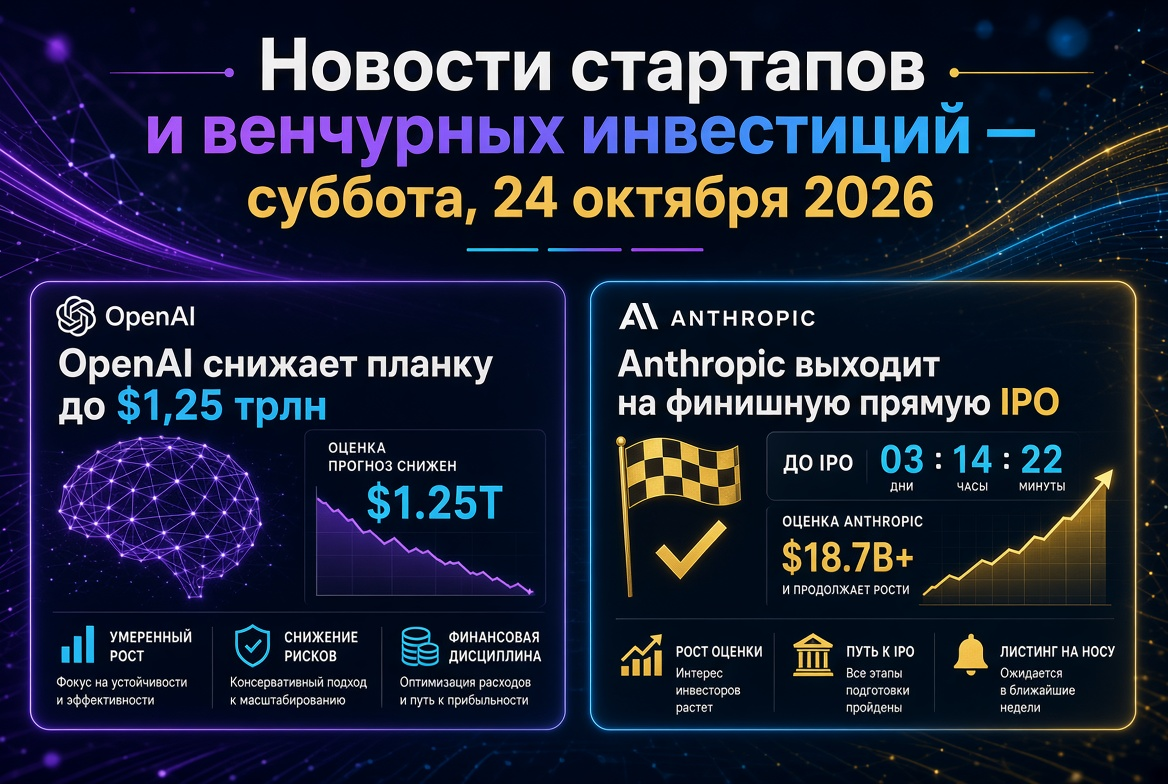
A significant signal for late venture investors has been the reports that Anthropic is nearing its first quarterly operational profit, amid a sharp rise in demand for Claude and corporate AI tools. For the artificial intelligence sector, this is fundamental: until now, investors often viewed frontier AI as a capital-intensive race with vast costs for model training and computing power.
If the largest AI companies can prove not only revenue growth but also operational efficiency, this could change the valuation approach across the entire sector. Venture funds will pay closer attention to the unit economics of AI products, inference costs, the profitability of corporate contracts, and long-term compute obligations.
For mid-level startups, this creates a dual effect. On one hand, successful market leaders increase trust in the AI sector. On the other hand, investors start demanding stricter financial evidence from new companies, not just attractive technological stories.
Anduril and Defense Technologies: Venture Capital Moves to Strategic Industries
Defense startup Anduril raised $5 billion at a valuation of around $61 billion. This deal confirms that defense tech remains one of the strongest categories within the venture market. Geopolitical tensions, military modernization, and increased demand for autonomous systems and software-hardware platforms are driving sustained interest from funds.
For venture investors, defense technologies are attractive for several reasons:
- Large government contracts and long-term orders;
- High barriers to entry for competitors;
- Connection with AI, robotics, sensors, and autonomous systems;
- Potential for strategic M&A and public offerings.
However, this sector requires more sophisticated analysis. Funds need to consider regulatory constraints, export controls, political risks, and revenue dependence on government budgets.
India, Biotechnology, and Regional Diversification of Venture Capital
Against the backdrop of the US dominance in AI deals, regional growth stories are emerging. The Indian biotech startup StrainX Bioworks raised $13 million to develop its synthetic biology and precision fermentation platform. The company is advancing technologies for industrial biomanufacturing, including the scaling of fermentation processes.
Such deals are important for global venture funds, as they indicate the expansion of the investment landscape beyond Silicon Valley. Biotechnology, agri-tech, industrial fermentation, and new materials could become the next areas where local scientific expertise and manufacturing advantages form global companies.
It is also worth noting the interest in Indian B2B trade and fintech. Udaan's negotiations for additional capital from existing investors show that funds continue to support large platforms when they see potential recovery in margins and operational efficiency.
What Venture Investors and Funds Should Monitor Going Forward
The news from startups and venture investments on Tuesday, May 26, 2026, offers several practical insights for funds. First, AI remains the primary magnet for capital, but within the sector, there is a growing division between infrastructure, applied software, interfaces, hardware, and financial services. Secondly, late rounds have become large again; however, valuations require deeper analysis of revenue, profitability, and reliance on computing resources.
In the coming weeks, investors should closely monitor the following factors:
- New mega-rounds in AI infrastructure and defense tech;
- Trends in inference costs and chip availability;
- The emergence of alternative financing models through compute credits;
- The state of the IPO window for late-stage tech companies;
- Growth of regional ecosystems in India, Europe, and the Middle East;
- The quality of ARR, CARR, and other revenue metrics in AI startups.
The main takeaway for the venture market: 2026 becomes a period where capital is again ready to take risks, but those risks must be technologically and financially justified. It is not enough for startups to merely have AI in their pitches; companies must control key resources, grow quickly, have strong teams, and be able to prove that their product will be a part of the new infrastructure of the global digital economy.