Global Startup and Venture Capital News for Monday, 18 May 2026: Rise of AI Rounds, Fund Interest in Robotics, AI-Biotech, Corporate AI Platforms, and the Return of Tech IPOs to Investor Agendas
As of Monday, 18 May 2026, the global venture capital market maintains a high pace but is becoming increasingly concentrated. Money continues to flow into startups, yet distribution is uneven: major venture capital funds and strategic investors are betting on artificial intelligence, computing infrastructure, robotics, biotechnology, and corporate AI platforms. For venture investors and funds, this means a shift from a broad growth market to a market of selective bets, where not only technology and team matter, but also access to capital, computing resources, corporate clients, and potential exit via IPO or M&A.
The main theme of the week is not just growing interest in AI startups, but the formation of a new venture capital structure. Companies capable of becoming infrastructure nodes of the future economy are taking centre stage: from artificial intelligence models and AI agents to industrial robots, drug platforms, and employee training systems. Venture investments are becoming larger, more institutional, and increasingly resemble strategic infrastructure deals.
AI Remains the Centre of the Global Venture Market
Artificial intelligence continues to drive the startup and venture capital market dynamics. Following a record first quarter of 2026, investors are increasingly splitting the AI sector into several directions: foundational models, applied AI products, computing infrastructure, corporate automation, industrial AI, and scientific platforms.
For venture funds, it is important that the market no longer perceives AI as a single category. Capital is now flowing primarily to those startups that can demonstrate scalability, technological defensibility, and economic impact for clients. The most sought-after projects are those that:
- reduce companies’ operational costs;
- replace or augment expensive human labour;
- create proprietary data and models;
- have direct access to the corporate market;
- can rapidly generate meaningful revenue.
That is why investor attention is shifting from abstract AI presentations to startups with measurable demand, repeatable sales, and clear unit economics.
Anthropic and Major AI Labs Set a New Benchmark for Valuations
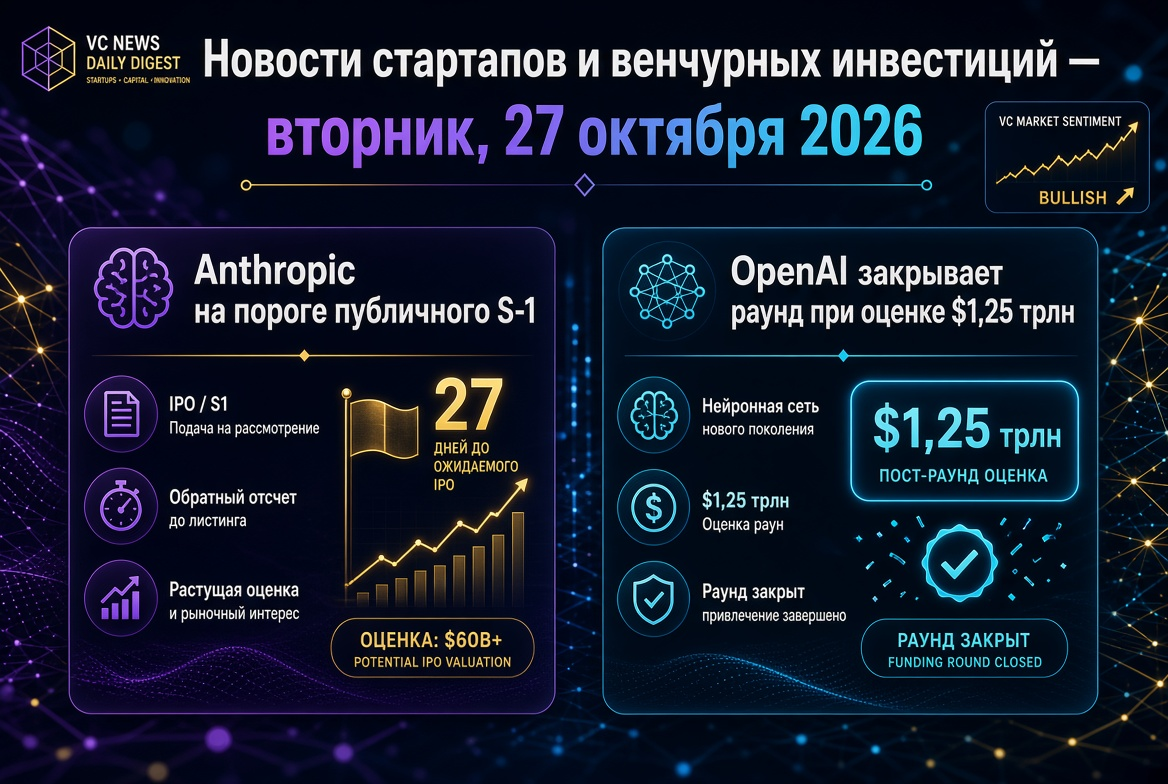
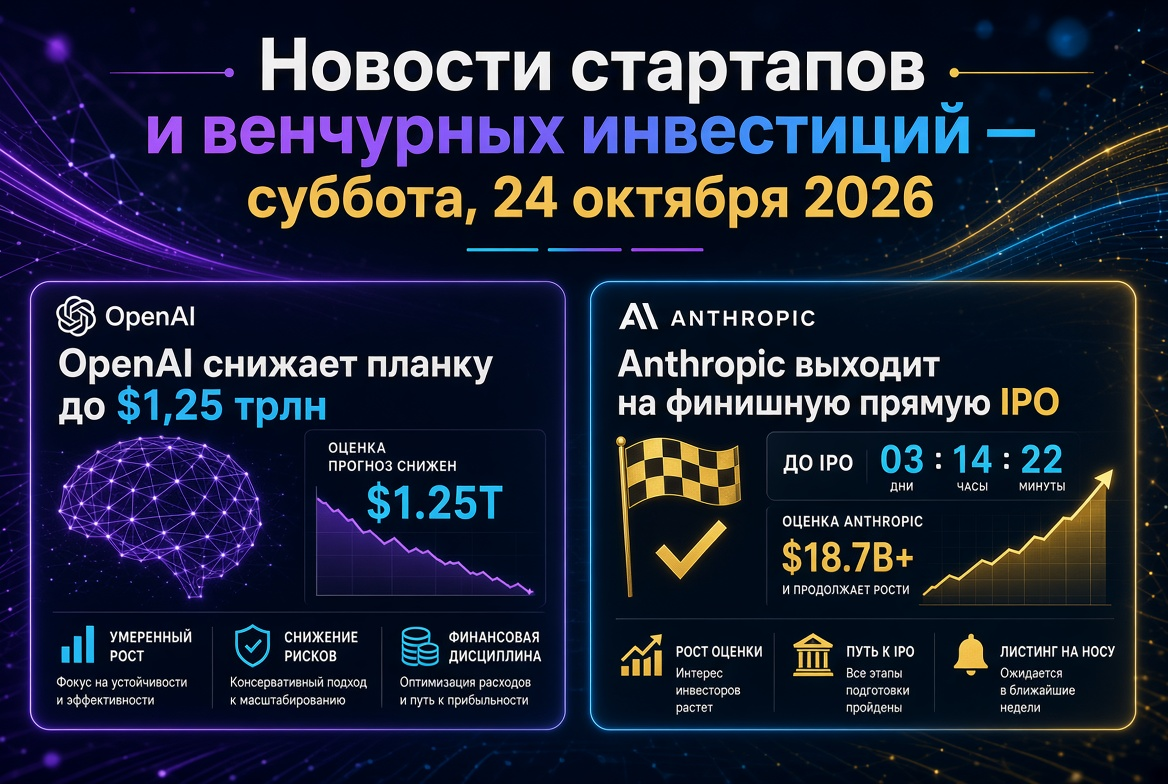
One of the key reference points for the market remains Anthropic. Reports of a potential new funding round valuing the company at over USD 900 billion have intensified debate on how far venture capital is willing to go in the race for AI leaders. Even if such valuations still require confirmation via a deal, the very fact of negotiations shows that the largest funds view leading AI companies as future systemic platforms, comparable in significance to the largest public technology corporations.
For venture investors, this is an important signal. Rising valuations in the upper echelon of AI create a gravitational pull across the entire ecosystem: capital flows into development tools, cloud infrastructure, specialised chips, model security, corporate AI agents, and industry-specific applications. At the same time, the risk of overheating increases, particularly for startups without sustainable revenue.
Funds must balance two tasks: not missing the next platform wave and not overpaying for companies that may prove dependent on others’ models, expensive computing, and rapidly shifting corporate budgets.
AI-Biotech Emerges as a Leading Venture Investment Vertical
The Isomorphic Labs deal has become one of the most notable events in the AI-biotech sector. The company, linked to the Google DeepMind ecosystem, raised USD 2.1 billion to scale its AI drug development platform. This confirms that venture investments in biotechnology are once again becoming large, but capital is now increasingly directed not only toward classic laboratory research but toward technology platforms capable of accelerating molecule discovery and reducing research costs.
For venture funds, the AI-in-medicine vertical looks especially attractive for three reasons:
- the healthcare market remains global and capital-intensive;
- a successful technology can scale through partnerships with pharmaceutical companies;
- artificial intelligence can shorten early-stage research timelines.
However, risks are also high. Even a strong AI platform must undergo clinical trials, regulatory scrutiny, and prove effectiveness beyond computational models. Hence, AI-biotech becomes a vertical for funds with a long investment horizon and deep expertise.
Robotics and Physical AI Become a New Megainvestment Zone
Industrial robotics is emerging as one of the most discussed areas on the venture market. Mind Robotics, tied to the founder of Rivian, raised USD 400 million and received a valuation of approximately USD 3.4 billion. The deal shows that investors are beginning to view physical AI as the next layer of technology growth after software-based AI agents.
Robots for factories, warehouses, logistics, and production lines are becoming especially relevant against a backdrop of labour shortages, rising production costs, and companies’ desire to automate complex operations. Unlike purely software startups, such companies require more capital, take longer to scale, and face engineering risks. But if successful, they can capture large industrial markets.
For venture funds, this means the emergence of a distinct class of deals: capital-intensive startups with a strong hardware component, AI models, industrial clients, and potential strategic value for automakers, logistics groups, and industrial corporations.
Corporate AI Applications Show Rapid Revenue Growth
Against the backdrop of megavaluations for major AI labs, the market is closely watching more applied startups. The AI sales automation platform Monaco raised USD 50 million in a Series B round. Investor interest is driven not only by the artificial intelligence theme but also by the company’s fast commercial growth.
The segment of AI for sales, customer support, financial analysis, and back-office operations is becoming one of the most practical directions for venture investment. Here investors see a short path to revenue: companies are willing to pay for products that help cut costs, boost productivity, and replace some manual work.
However, competition in this segment will be fierce. Startups will have to compete not only with each other but also with major platforms such as Salesforce, Microsoft, Google, and HubSpot. Therefore, the main criterion for funds will not be the presence of an AI feature, but the startup’s ability to embed itself into the customer’s workflow and retain them over the long term.
Europe Strengthens Its Position in AI Education and Workforce Training
The European venture market is also gaining new growth points. Multiverse raised USD 70 million at a valuation of approximately USD 2.1 billion, strengthening the AI learning and workforce training vertical. This deal reflects a broader trend: companies worldwide are beginning to invest not only in AI tools but also in adapting employees to the new technology environment.
For investors, this is an important niche at the intersection of edtech, enterprise software, and HR-tech. The mass adoption of artificial intelligence requires employee retraining, changes to corporate processes, and the creation of new educational platforms. Startups that can demonstrate training effectiveness and link it to productivity improvements may become attractive targets for late-stage rounds and strategic deals.
IPOs Return to the Venture Capital Agenda
After a period of caution, the IPO theme is back on venture investors’ radar. British AI company Quantexa is viewed by the market as a potential candidate for a public listing in the coming years. For the European technology sector, this is particularly important: the region needs successful public stories that can prove local startups’ ability to grow to a global scale and provide funds with liquidity.
A revival of the IPO market has direct implications for the venture ecosystem. Without exits, funds face pressure from LPs, limited capital distributions, and more difficult fundraising. Successful technology company listings can restore confidence in late-stage deals and support mature startup valuations.
At the same time, the public market remains demanding. Investors will look at revenue, margins, corporate governance, customer retention, and the company’s ability to articulate its role in the AI economy.
What Matters for Venture Investors and Funds This Week
For Monday, 18 May 2026, venture investors enter the market with cautious optimism. Capital is available, but it is concentrated around companies that can become infrastructure leaders or quickly prove commercial effectiveness. For funds, the key reference points for the week are:
- new rounds in AI infrastructure and corporate AI applications;
- valuation dynamics of the largest AI startups;
- deals in robotics, defence tech, AI-biotech, and industrial automation;
- signals from the IPO market and public investors’ readiness to embrace growth technology stories;
- activity of strategic buyers and large corporations in M&A.
The main takeaway for the startup and venture capital market is that 2026 is shaping a new model of technology financing. Winning is not just about fast startups, but companies able to become part of critical infrastructure: computing, industrial, medical, educational, or corporate. For venture funds, this creates substantial opportunities but simultaneously raises the bar for risk analysis, valuation discipline, and growth quality.
The global venture capital market remains active, but it is increasingly unforgiving of weak project economics. Startups with real revenue, a technology barrier, a clear customer base, and a liquidity pathway are taking the lead. It is precisely these companies that will shape the key investment agenda for the months ahead.