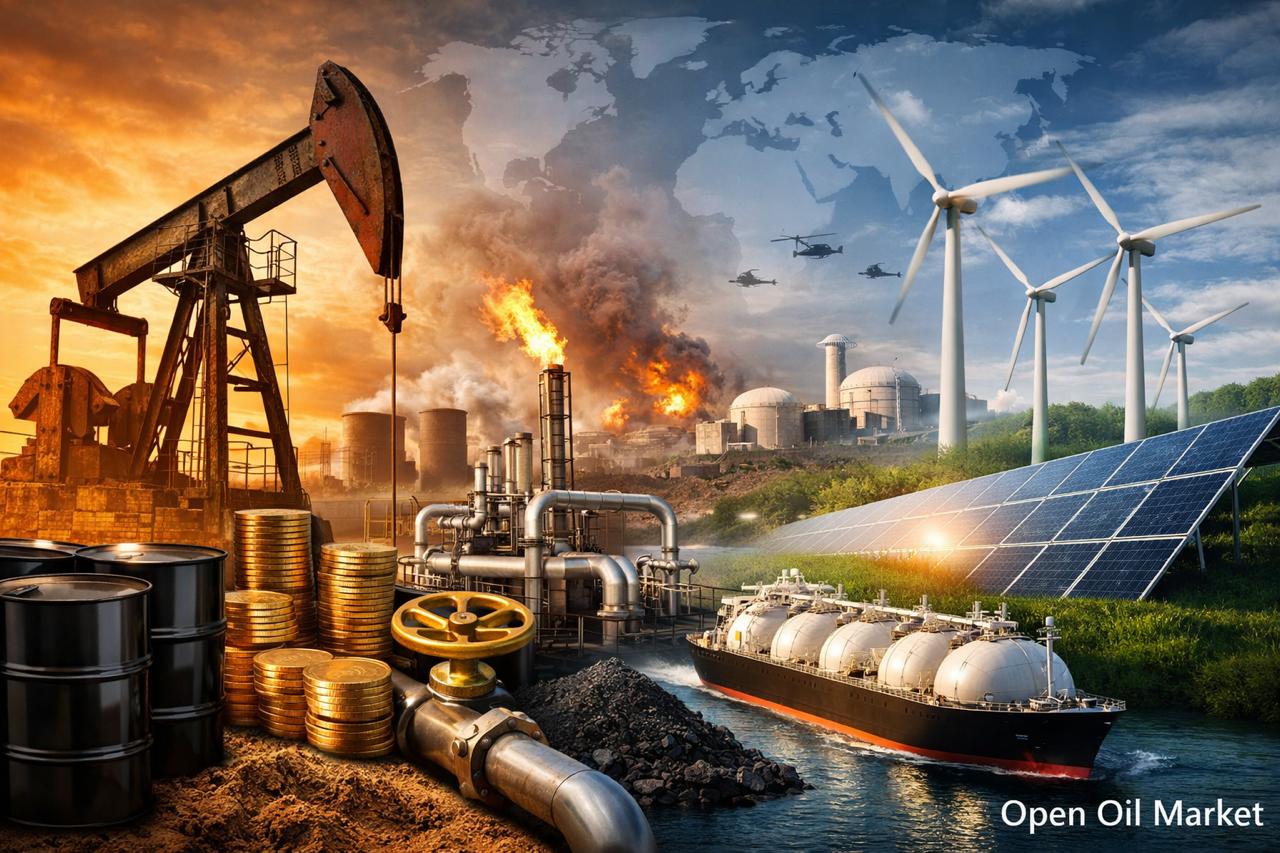
Current News from the Oil, Gas, and Energy Sector for Thursday, December 25, 2025. Oil, gas, electricity, renewable energy sources, coal, refineries, and key events in the global fuel and energy complex—an overview and analysis for investors and market participants.
Today’s overview covers key events in the global fuel and energy complex. Oil markets are finishing the year relatively steadily, aided by the measured actions of OPEC+ and an increase in supply, while geopolitical factors—from sanctions to attempts at peace resolution—continue to influence supplies. The energy sector is witnessing record achievements in renewable and nuclear energy, while global coal demand reaches a historical high before an anticipated decline.
OPEC+ Maintains Production to Stabilize the Market
- It has been decided to keep current oil production quotas for the first quarter of 2026 to prevent a potential oversupply in the market.
- OPEC+ countries have already returned approximately 2.9 million barrels per day to the market from previously reduced volumes, but the total production cut of about 3.2 million barrels per day will remain in effect until the end of 2026.
- The meeting took place amid a new attempt by the U.S. to reach a peace agreement between Russia and Ukraine. OPEC+ is aware that the success of negotiations and a possible easing of sanctions could add additional oil volumes to the market, while a failure would intensify sanction pressures and limit Russia's exports.
Oil Prices Remain Stable
Global oil prices are ending the year without sharp fluctuations, stabilizing in an average range. Brent is hovering around $62–63 per barrel, while WTI stands around $58–59, reflecting a balance between steady demand and sufficient supply.
- At the beginning of the week, prices rose by about 2% against strong macroeconomic data from the U.S.: GDP growth in Q3 exceeded expectations, boosting fuel demand forecasts.
- Additional support for prices came from disruption risks. Newly imposed U.S. sanctions on Venezuela's oil sector and strikes on oil export infrastructure in the Black Sea raised market concerns.
- However, by the end of 2025, Brent had fallen by approximately 15%. The oil market displayed an unusually narrow price corridor ($60–80) even amidst geopolitical upheaval—thanks to record production in the U.S. (over 13.5 million barrels/day) and rising supplies from non-OPEC countries that compensated for shocks.
- Refineries upped their output of oil products, and commercial oil and fuel inventories in the U.S. rose in December. This kept gasoline and diesel prices from jumping at year-end.
Natural Gas: Comfortable Stocks and Moderate Prices
The natural gas market is entering winter fairly calmly. In Europe, wholesale gas prices have stabilized around €27 per MWh—at their lowest since spring 2024—due to high stocks and steady LNG inflow.
- Gas underground storage in the EU is over 70% full at the start of winter, significantly above long-term averages, reducing the risk of shortages even in cold weather.
- Liquefied natural gas imports remain high, compensating for the cessation of pipeline supplies from Russia. Major consumers (Germany, Italy, etc.) are actively purchasing LNG on the spot market, diversifying sources.
- In the U.S., natural gas prices (Henry Hub) are around $5 per million BTU. Record production levels and high LNG export volumes are keeping the American market balanced, although periods of extreme cold lead to temporary price spikes.
Geopolitics and Sanctions: Impact on Energy Supplies
Political conflicts and sanctions continue to affect global energy markets, creating both disruption threats and expectations for improvement in the future.
- The U.S. administration has tightened measures against Venezuela's oil sector: tankers carrying Venezuelan oil have been sanctioned. In December, several vessels were intercepted and forced to return, posing risks of overflowing local storage and reduced production in the country.
- Amid the ongoing conflict in Ukraine, strikes on energy infrastructure have increased. In November, a Ukrainian drone damaged the CPC pipeline terminal near Novorossiysk, cutting December exports of Kazakhstan’s CPC Blend oil by a third (to about 1.14 million barrels/day) and forcing some volumes to be redirected away from the Black Sea.
- Despite the tightening of U.S. sanctions in the fall against leading Russian oil companies ("Rosneft" and "LUKOIL"), their effect on the global market has been limited. Russian oil exports remain close to multi-month highs thanks to alternative logistics, although the Urals grade is trading at a significant discount to Brent.
Renewable Energy Sources: Record Wind and Investment Levels
The renewable energy sector continues to gain momentum worldwide, setting new records for capacity and attracting substantial investments—even amid political risks.
- The UK reached a historic peak in wind power generation on December 5, generating 23,825 MW, more than half the country’s needs at that time. Strong winter winds and the expansion of offshore wind farms made the record possible.
- According to BloombergNEF, global investments in new renewable energy projects reached a record $386 billion in the first half of 2025. The bulk of the funding is directed towards solar and wind generation development, as well as energy storage systems to integrate renewables.
- In the U.S., a federal court has lifted a ban on building new wind energy projects on federal lands and offshore, imposed earlier this year. This decision paves the way for large offshore wind farms and supports state plans to increase the share of clean energy.
- China maintains its global leadership in renewable energy: the total capacity of renewables in the country surpassed 1.88 TW (roughly 56% of total capacity). The massive deployment of solar and wind stations, along with energy storage systems, has allowed China to keep CO2 emissions stable despite economic growth.
Nuclear Energy: A Return to Large Capacity
After a prolonged decline in the global nuclear sector, a revival has emerged. Countries are reassessing the role of nuclear generation as a stable low-carbon energy source, aiming to reduce dependence on fossil fuels.
- In Japan, preparations are underway for the partial restart of the largest nuclear power plant, Kashiwazaki-Kariwa. TEPCO has received approval from the Niigata prefectural authorities and plans to launch Unit 6, with a capacity of 1360 MW, on January 20, 2026—the first reactor started by the company since 2011. The full restoration of the 8.2-gigawatt plant will be gradual and will take several years.
- The Japanese government has announced support measures for the nuclear sector aimed at doubling the share of nuclear energy in the energy balance. A system of state loans and guarantees for reactor modernization is being introduced; currently, 14 out of 33 reactors remaining after the Fukushima disaster have resumed operations.
- The return to nuclear energy is also seen in other countries. In Europe, Finland has launched the Olkiluoto-3 reactor, while France and the UK are investing in new nuclear power plants. In the U.S., extending the lifespan of existing units and financing modular reactors are being considered.
Coal Sector: Peak Consumption and Gradual Decline
The global coal market reached a historic peak in 2025, but a trend reversal is expected ahead. According to the International Energy Agency, global coal consumption rose by 0.5% to 8.85 billion tons in 2025. By the end of the decade, a slow decline in coal demand is anticipated as renewables, nuclear energy, and natural gas displace it from generation.
- In the U.S., coal consumption for power generation increased in 2025. This was due to last year's spike in gas prices and a presidential directive to extend the operation of coal-fired power plants slated for closure.
- China remains the largest consumer of coal, accounting for around 60% of the country’s electricity generation. In 2025, coal demand in China stabilized; a gradual decline is expected by 2030 due to the large-scale deployment of renewable capacity. Beijing's policy aims to peak emissions by 2030, implying a reduced role for coal.
Corporate News: Deals and Strategies of Energy Companies
The end of the year is marked by significant corporate moves in the energy sector, reflecting companies' efforts to optimize portfolios and adapt to new conditions.
- BP is selling 65% of its subsidiary Castrol (lubricants) to the American investment fund Stonepeak for $6 billion. The deal values the Castrol business at $10.1 billion; BP will retain 35% in the new joint venture. The proceeds will go towards reducing debt and paying dividends, following a strategy aiming to increase the returns from traditional areas.
- In Russia, foreign partners are expressing interest in returning to the market despite sanctions. Indian ONGC and Japanese SODECO have maintained their stakes in Sakhalin-1, while a preliminary agreement between ExxonMobil and Rosneft on compensating losses signals the readiness of major players to resume cooperation as soon as the political situation improves.
- Technological deals are occurring in electricity and infrastructure. For instance, American Alphabet (parent company of Google) announced in December the acquisition of Intersect Power, which develops renewable energy projects and data centers, for $4.7 billion. This will allow Alphabet to accelerate its development of renewable-generation capacities while reducing dependence on overloaded power grids.