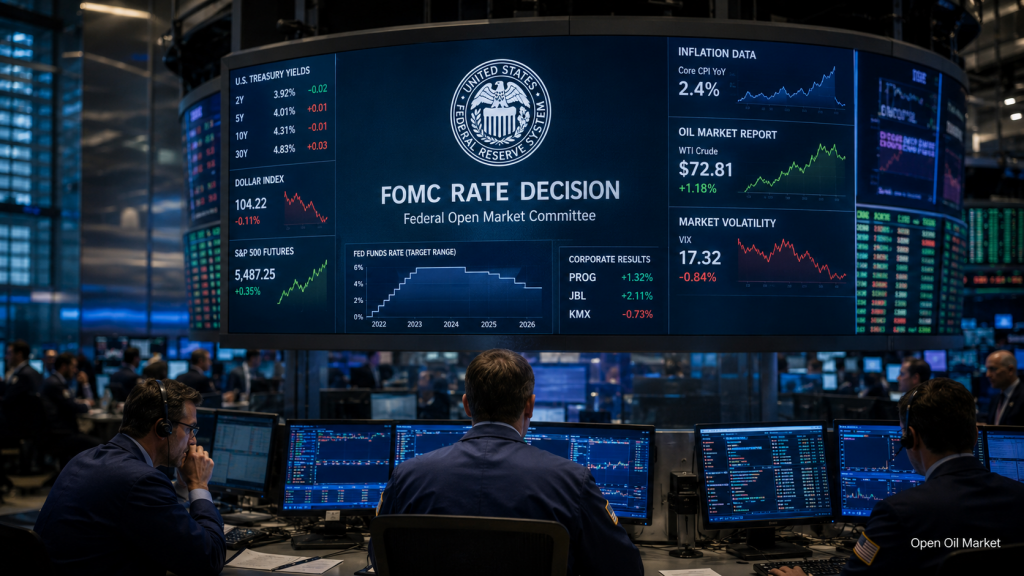
Economic Events and Corporate Reports for Wednesday, June 17, 2026: FOMC Interest Rate Decision, UK and Eurozone Inflation, IEA Oil Report, EIA Inventory, Russia CPI, and Reports from Progressive, Jabil, and CarMax
Wednesday, June 17, 2026, is set to be one of the most eventful days of the week for global markets. Investors will be focused on several key blocks: the US Federal Reserve's interest rate decision, the FOMC press conference, consumer inflation data from the United Kingdom, the final CPI assessment for the Eurozone, the IEA's monthly oil report, EIA inventory statistics in the US, and inflation rates in Russia. Additionally, the geopolitical backdrop is defined by the third day of the G7 summit in France and a dinner between Emmanuel Macron and Donald Trump at the Palace of Versailles.
For investors from the CIS, this day is significant not only due to macroeconomic statistics but also due to the potential reevaluation of expectations regarding interest rates, currencies, commodity assets, technology sector stocks, insurance companies, car dealers, and industrial suppliers. The market will assess how well the global economy is positioned to withstand a combination of high inflation, expensive oil, tight monetary policy, and geopolitical uncertainty.
Main Theme of the Day: FOMC Interest Rate Decision and US Federal Reserve Press Conference
The key event of Wednesday will be the meeting of the US Federal Reserve. The interest rate decision is expected at 21:00 MSK, followed by the FOMC press conference at 21:30 MSK. For global investors, this is the main focus of the day, as the Fed's interest rate remains a fundamental factor for evaluating stocks, bonds, the dollar, gold, oil, and emerging markets.
The base market scenario anticipates no change in the interest rate. However, investors will be keenly interested not just in the decision itself, but also in the tone of the regulator's comments. Attention should be particularly drawn to:
- the assessment of inflation risks in the US;
- rhetoric regarding future reductions or maintenance of rates;
- forecasts for economic growth and the labor market;
- updated expectations from FOMC members regarding the trajectory of the interest rate;
- the reaction of US Treasury yields.
If the Fed adopts a cautious or hawkish stance, pressure may increase on growth stocks, the technology sector, cryptocurrencies, and currencies of emerging countries. Conversely, a softer rhetoric could support the S&P 500, Nasdaq, gold, and riskier assets.
UK Inflation: A Test for Sterling and UK Bonds
At 09:00 MSK, consumer inflation CPI data for the UK for May will be released. This indicator holds direct significance for the British market, as the Bank of England continues to balance between the risks of economic slowdown and the necessity to keep inflation under control.
If CPI exceeds expectations, it may increase pressure on UK government bonds while supporting the pound due to expectations of a prolonged period of high rates. For the UK equity market, such a scenario will be ambiguous: banks may benefit while the consumer sector, real estate, and highly leveraged companies may face pressure.
For CIS investors, UK inflation is an important component of the overall picture of global monetary policy. If inflation remains robust in both the US and Europe, it diminishes the likelihood of a swift transition to a loose cycle by major central banks.
Eurozone: May CPI and Christine Lagarde's Speech
At 12:00 MSK, data on consumer inflation in the Eurozone for May is expected. Following this, at 13:50 MSK, Christine Lagarde, President of the European Central Bank, will speak. This is a significant sequence of events for the euro, European bonds, and indices such as Euro Stoxx 50, DAX, and CAC 40.
Investors will evaluate whether the statistics confirm persistent inflationary pressures in the Eurozone. If CPI figures prove resilient, the ECB may maintain a cautious position and refrain from hastening monetary easing. This is particularly vital for companies sensitive to capital costs: real estate, industry, utilities, and consumer firms.
Lagarde’s remarks could set the tone for European markets in the latter half of the day. The key topics will include inflation, energy prices, the resilience of the Eurozone economy, credit conditions, and the impact of geopolitical factors on business activity.
G7 in France: Geopolitics as a Market Factor
The third day of the G7 leaders' meeting in France adds a political context to the markets. Discussions will primarily revolve around Ukraine, energy security, trade imbalances, sanctions policies, Iran, artificial intelligence, and the resilience of the global economy. For investors, not only will the final communiqué be important, but also signals regarding the coordination of G7 countries on trade, financial stability, and commodity markets.
Special attention will be drawn to the dinner between Emmanuel Macron and Donald Trump at the Palace of Versailles. The market will be alert to any signals regarding US-European relations, sanctions policies, energy issues, and potential trade agreements. For European companies, exporters, the energy sector, and the defense industry, the G7 geopolitical agenda could be just as significant as macroeconomic statistics.
Oil Market: IEA Report and EIA Inventory Data in the US
At 11:00 MSK, the IEA’s monthly oil market report is expected to be released. For investors in the oil and gas sector, commodity assets, and currencies of oil-exporting countries, this report is one of the key benchmarks of the month.
The main questions for the oil market are:
- how does the IEA assess global oil demand for the second half of 2026;
- to what extent are supplies resilient amid geopolitical risks;
- how are commercial inventories changing in OECD countries;
- what demand-supply balance is being established for Brent, WTI, and Urals;
- does the risk of shortages in the oil products market persist.
At 17:30 MSK, EIA data on oil inventories in the US will be released. This statistic traditionally influences Brent and WTI prices, stock quotations of oil and gas companies, the oil service sector, and inflation expectations. A decrease in inventories may support oil prices, while an increase could limit rallies in the commodity sector.
US: Retail Sales as a Consumer Demand Indicator
At 15:30 MSK, data on US retail sales for May will be published. This is one of the main indicators of the state of the American consumer, which significantly impacts the US GDP. For the stock market, this figure is essential across several sectors: consumer sector, banks, payment companies, car dealers, logistics, e-commerce, and durable goods manufacturers.
Strong retail sales could confirm the resilience of the US economy but simultaneously heighten inflation concerns and lower the likelihood of easing Fed policies. Conversely, weak data could support expectations for future rate cuts but raise alarm about corporate revenues and margin pressures.
Russia: Consumer Inflation and Its Impact on the MOEX Market
At 19:00 MSK, consumer inflation data for Russia is anticipated. For investors in the MOEX market, this indicator is crucial regarding expectations for the key rate, bond yields, the banking sector, developers, consumer companies, and dividend plays.
If inflation shows signs of slowing down, this could bolster expectations of future monetary policy easing and interest in domestic demand stocks. If inflationary pressure persists, the market may price in a protracted period of high rates, which would be negative for highly leveraged companies and positive for certain banks and money market instruments.
Corporate Reports on June 17: US, Europe, Asia, and Russia
Wednesday’s corporate calendar is primarily concentrated in the US. Before market opening, investors will be watching the reports from Progressive, Jabil, and CarMax. These companies are significant for various market segments: insurance, industrial electronics, AI infrastructure, car dealers, and consumer credit.
Major American Companies Reporting Before Market Opening:
- Progressive (PGR) — a key player in the US insurance sector. Investors will assess the dynamics of insurance premiums, the combined ratio, auto insurance losses, and the impact of inflation on insurance payout costs.
- Jabil (JBL) — a major manufacturing and engineering contractor linked to electronics, cloud infrastructure, and AI supply chains. The main focus will be on demand from data centers, margins, and revenue forecasts.
- CarMax (KMX) — the largest publicly-traded used car dealer in the US. The market will be looking at vehicle sales, credit risks, financing costs, and consumer behavior in the US.
After the US Market Closes:
- Smith & Wesson Brands (SWBI) — the report may attract interest from investors tracking consumer demand and the specialized industrial sector in the US.
- Safe Bulkers (SB) — a shipping company sensitive to freight rates, global trade, commodity flows, and the dynamics of the dry bulk market.
Among additional public companies in the global calendar, notable mentions include AeroVironment, eToro Group, AO World, Castings, Speedy Hire, KDX Realty Investment Corporation, MIRAI Corp., Ichigo Office REIT, NTT UD REIT Investment Corporation, and several companies from Hong Kong. However, in the largest representatives of Euro Stoxx 50, Nikkei 225, and MOEX on June 17, no comparable block of reports stands out, thus shifting the primary corporate focus of the day towards the US market.
For Russian companies, it is more essential to monitor corporate events than earnings reports: shareholder meetings, dividend decisions, and registry closures by specific issuers. For investors in Russian stocks, this could influence local liquidity and short-term dynamics of individual securities.
Key Event Calendar for the Day (Moscow Time)
- 09:00 — United Kingdom: May CPI Consumer Inflation.
- 11:00 — Monthly IEA Oil Market Report.
- 12:00 — Eurozone: May CPI Consumer Inflation.
- 13:50 — Speech by ECB President Christine Lagarde.
- 15:30 — United States: Retail Sales for May.
- 17:30 — United States: EIA Oil Inventory Data.
- 19:00 — Russia: Consumer CPI Inflation.
- 21:00 — United States: FOMC Interest Rate Decision.
- 21:30 — FOMC Press Conference.
What Investors Should Pay Attention To
Investors should view Wednesday, June 17, as a day of heightened volatility. The primary risk lies in a sharp reevaluation of interest rate expectations following the Fed's decision and the FOMC comments. If the regulator signals a prolonged period of tight policy, growth stocks, long bonds, and rate-sensitive sectors could come under pressure. Conversely, if the rhetoric is softer than expected, the market could gain momentum for growth.
The second important block includes inflation in the UK, Eurozone, and Russia. These data will shed light on the persistence of the global inflation problem. The third block pertains to oil: the IEA report and EIA statistics could influence Brent, WTI, oil and gas stocks, and currencies of commodity economies.
Among corporate reports, key interest lies in Progressive, Jabil, and CarMax. Progressive will reflect the state of the insurance sector, Jabil will showcase demand for AI infrastructure and global supply chains, and CarMax will provide insight into the health of the American consumer and the auto financing market. Collectively, these reports will give investors a broader picture: whether corporate profits remain resilient amid high capital costs, inflation, and geopolitical risks.
The fundamental strategy on such a day is not to focus solely on one event. It is crucial to consider the signals from the Fed, inflation data, oil metrics, corporate reports, and the G7 geopolitical landscape. This combination will ultimately determine the short-term direction of global markets, the dynamics of the dollar, risk appetite, and investor sentiment in the US, Europe, Asia, and the CIS markets.