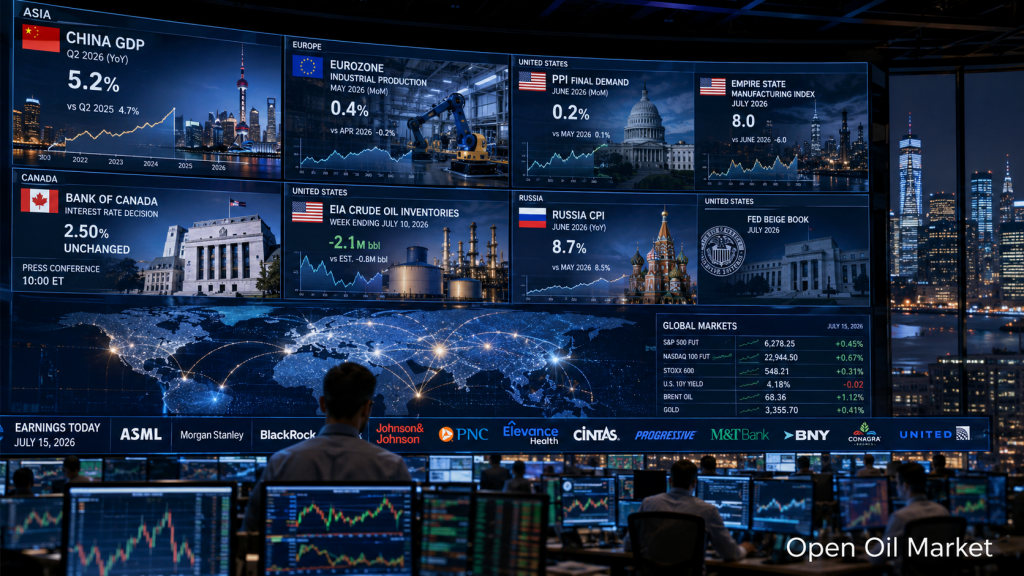
Economic Events and Corporate Reports on Wednesday, July 15, 2026: China's GDP, Eurozone Industry, US PPI, Bank of Canada's Rate Decision, EIA Oil Stocks, Inflation in Russia, Fed Beige Book, and Results from ASML, Morgan Stanley, BlackRock, and Johnson & Johnson
Wednesday, July 15, 2026, is set to be one of the most eventful days of the week for global financial markets. Investors will receive new data on China's economic growth, Eurozone industrial production, producer price inflation in the US, and consumer price dynamics in Russia. The Bank of Canada's interest rate decision, Fed Chairman Kevin Warsh's testimony before the Senate, and the publication of the Fed's Beige Book will also significantly impact currencies and bonds.
The corporate calendar will be equally busy. ASML, Morgan Stanley, BlackRock, Johnson & Johnson, PNC Financial, BNY, Elevance Health, Cintas, and other major public companies will release their earnings reports. After the US market closes, attention will shift to United Airlines, J.B. Hunt, and Kinder Morgan.
Major Economic Events Calendar for July 15, 2026
- 05:00 MSK — China: GDP for Q2 2026.
- 12:00 MSK — Eurozone: Industrial production for May.
- 15:30 MSK — US: Empire State Manufacturing Index for July.
- 15:30 MSK — US: Producer Price Index (PPI) for June.
- 16:45 MSK — Canada: Bank of Canada's interest rate decision.
- 17:00 MSK — US: Kevin Warsh's testimony before the Senate Banking Committee.
- 17:30 MSK — Canada: Bank of Canada's press conference.
- 17:30 MSK — US: EIA weekly oil and petroleum products report.
- 19:00 MSK — Russia: Operational estimate of consumer inflation.
- 21:00 MSK — US: Publication of the Fed's Beige Book.
China's GDP: Testing the Resilience of the World's Second-Largest Economy
The main event of the Asian session will be the release of China's GDP for Q2 2026. The consensus expects a slowdown in annual growth rates to around 4.5% after 5% in the first quarter. The export sector continues to support China's economy; however, internal consumption, real estate investment, and private business demand remain less robust.
For investors, both the final figure and the structure of economic growth will be critical. Stronger data may buoy Chinese stocks, industrial metals, oil prices, and currencies from commodity-exporting countries. Conversely, a weak result will heighten expectations for additional stimulus from the People's Bank of China and the government.
The most sensitive areas to the publication will be:
- Asian stock indices and shares of Chinese technology companies;
- Oil, copper, iron ore, and other commodity assets;
- Australian Dollar and currencies of emerging markets;
- European luxury goods and automotive manufacturers.
Eurozone Industry and US Producer Inflation
Eurozone industrial production statistics for May will be released during the European session. The previous figure indicated a growth of 0.1% month-on-month, so the market will assess whether the industrial sector has maintained positive momentum amid high energy costs, trade restrictions, and weak external demand.
The primary US indicator for the day will be the PPI for June. Following the consumer inflation data release, the manufacturing price statistics will help gauge cost pressures on companies and the future trajectory of the core PCE index, which the Fed uses as a key inflation benchmark.
Investors should focus on:
- Core PPI excluding food and energy;
- Cost of transportation, logistics, and financial services;
- Influence of oil, gas, and tariffs on production costs;
- Extent of cost increases being passed on to end consumer prices.
Simultaneously, the July Empire State Index will be released. In June, the index was at 5.7 points. Further growth will support the resilience of the US manufacturing sector, while a decline into negative territory will heighten concerns about slowing US economic activity.
Bank of Canada's Rate Decision and Kevin Warsh's Testimony
The Bank of Canada is widely expected to maintain its key rate at 2.25%. The main intrigue will revolve around the regulator's rhetoric. The Canadian economy is facing inflation risks, household sensitivity to borrowing costs, and uncertainty in external trade.
At 17:00 MSK, Fed Chairman Kevin Warsh will present the semiannual monetary policy report to the Senate Banking Committee. The market will look for signals regarding acceptable inflation levels, future interest rate prospects, and the impact of oil prices on the US economy.
A more hawkish stance could strengthen the dollar and US government bond yields, while neutral or dovish commentary may boost sentiment in equity markets and increase demand for gold and other rate-sensitive assets.
Oil Stocks, Inflation in Russia, and the Fed's Beige Book
The US Energy Information Administration's report will be a significant event for the oil market. Preliminary expectations indicate a potential decline in commercial oil stocks of around 2.7 million barrels. However, the reaction of Brent and WTI will also depend on gasoline and distillate stocks, refinery utilization rates, and the dynamics of US production.
In Russia, an operational weekly estimate of consumer prices will be published. Following a slowdown in annual inflation to around 6%, investors will assess whether the disinflation trend persists. This statistic is essential for the expectations surrounding the key rate of the Bank of Russia, OFZ yields, the ruble exchange rate, and the cost of financing for Russian companies.
The day will conclude with the Fed's Beige Book—a summary of the economic situation across American federal districts. Particular attention will be given to the labor market, consumer spending, price pressures, credit availability, and the effect of trade policy on businesses.
Corporate Reports Before the US Market Opens
The highlight of the corporate events in Europe will be ASML's report. The semiconductor equipment manufacturer previously guided the market to expect quarterly revenues of €8.4–9 billion and a gross margin of 51–52%. Investors will evaluate the volume of new orders, demand for EUV and High-NA systems, shipments to China, and forecasts for the capital expenditures of the largest chip manufacturers.
Among the largest US companies reporting before the main trading session are:
- Morgan Stanley—trading revenue, investment banking, asset management, and M&A activity;
- BlackRock—assets under management, inflow into ETFs, commission revenue, and technology platform development;
- Johnson & Johnson—sales of pharmaceuticals, medical devices, and updated annual forecast;
- Elevance Health—medical spending, insurance premiums, and healthcare program margins;
- PNC Financial, BNY, M&T Bank, and First Horizon—net interest margin, loan portfolio quality, reserves, and deposit dynamics;
- Progressive—growth in insurance premiums, loss ratios, and auto insurance profitability;
- Cintas—demand from small and medium-sized businesses, revenue growth, and operational margins;
- Conagra Brands—consumer demand, pricing strategy, and influence of raw material costs;
- Community Trust Bancorp—lending, deposits, and regional banking activity.
European Reports and Companies After Market Close
In addition to ASML, quarterly results will be released by the Swedish grocery chain Axfood. Swiss company Richemont will publish sales data for the first quarter of the new financial year, which will serve as a gauge for demand for jewelry and luxury items in China, the US, Europe, and Japan. Partners Group will disclose the volume of assets under management as of the end of June.
After the US market closes, three notable companies are expected to report:
- United Airlines—passenger demand, pricing, flight load factors, fuel costs, and transportation outlook;
- J.B. Hunt Transport Services—freight dynamics, intermodal segment, and state of industrial demand;
- Kinder Morgan—transportation of gas and petroleum products, cash flow, and infrastructure project execution.
Regional Focus: S&P 500, Euro Stoxx 50, Nikkei 225, and MOEX
For the S&P 500, results from Morgan Stanley, BlackRock, Johnson & Johnson, and regional banks will provide insight into the health of the financial sector, healthcare, and the American consumer. ASML's report will be a significant benchmark for the Euro Stoxx 50 and the global semiconductor industry.
Nikkei 225 will primarily react to China's GDP, the yen's dynamics, and ASML's demand forecasts for chip manufacturing equipment. There are no substantial reports from major Japanese companies on July 15 comparable in scale to ASML or the largest US banks.
For the Moscow Exchange, the main drivers will be data on Russian inflation, oil prices, and expectations for the Bank of Russia's further decisions. There are no major financial reports from leading MOEX issuers scheduled for that day.
What Investors Should Focus On
- China's GDP Growth Rates. The result relative to expectations will determine sentiment in commodity assets and Asian markets.
- US Core PPI. An acceleration in producer inflation could increase bond yields and put pressure on growth stocks.
- Kevin Warsh's Rhetoric. Any signals about changing the Fed's rate trajectory could trigger movements in the dollar, gold, and US indices.
- ASML's Report. Order volume and management's outlook will be a test of the resilience of the global investment cycle in artificial intelligence.
- US Bank Results. Net interest margin, reserves, and investment banking fees will indicate the quality of profits in the financial sector.
- Oil Stocks and Russian Inflation. These indicators will determine the dynamics of Brent, the ruble, OFZs, and Russian oil and gas stocks.
The economic events and corporate reports on July 15, 2026, will form a comprehensive picture of the state of the global economy. The Asian session will be influenced by China's GDP, the European session by industrial statistics and ASML's results, and the American session by PPI data, the Fed chairman's testimony, and the earnings reports of major financial and industrial companies. The high concentration of events increases the likelihood of notable movements across currency, debt, commodity, and equity markets.