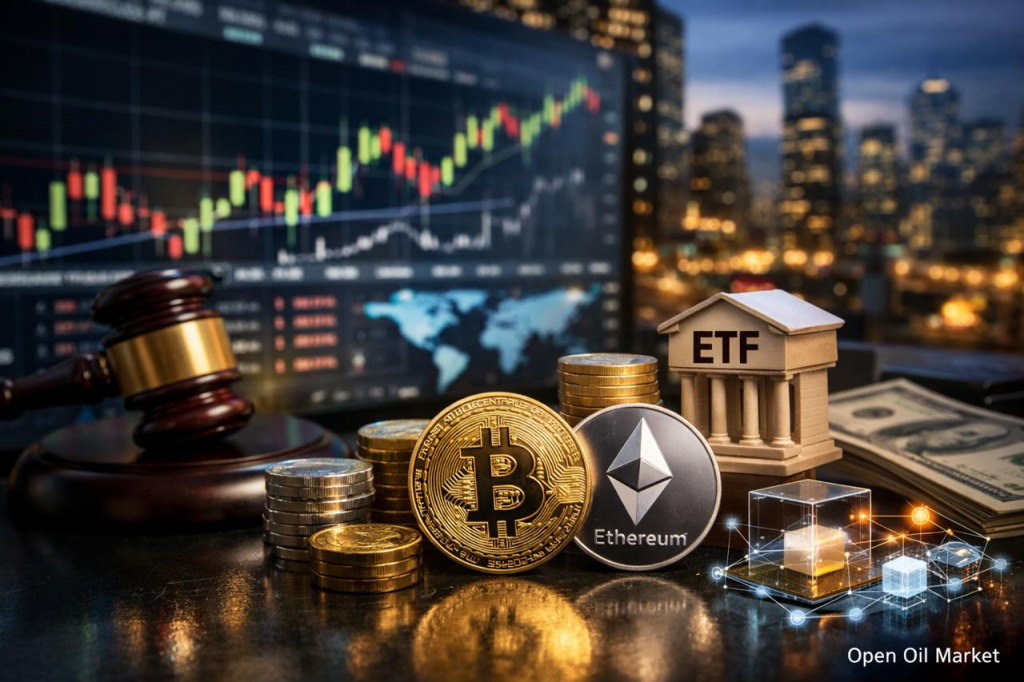
Current Cryptocurrency News as of March 24, 2026, Including Analysis of Bitcoin, Ethereum ETF, and Overview of the Top 10 Cryptocurrencies
As of March 24, Bitcoin is positioned as the primary safe-haven asset within the cryptocurrency market. Even during correction periods, capital continues to flow predominantly into BTC rather than a wide array of altcoins. This serves as a significant signal for institutional investors: the market remains risk-averse, with demand concentrating on the most liquid and comprehensible asset.
The current dominance of Bitcoin confirms that the market has not yet entered a full-blown alt-season. This means that strategies for accumulating positions in cryptocurrencies remain selective: investors prefer quality, liquidity, and a clear institutional narrative over an aggressive bet on the entire segment.
- Bitcoin retains its status as the foundational asset for global crypto portfolios.
- Large capital continues to flow primarily into the most liquid instruments.
- The growth of BTC dominance limits the opportunity for a broad rally among most altcoins.
Ethereum Lagging in Dynamics but Retains Strategic Importance
Ethereum continues to play a second-tier role in the cryptocurrency market, yet Ether is currently facing a more complex reassessment challenge. For Bitcoin, sufficient institutional demand and the status of a digital reserve are adequate, while for ETH, investors increasingly require validation of real network activity, sustainable demand for infrastructure, and a clear investment thesis.
This does not imply a weakening of Ethereum's position as a platform. Rather, the market is becoming more demanding: Ether must prove its value through network usage, the development of tokenization, the stability of the stablecoin ecosystem, and the activity of applications. For long-term investors, this creates a more complex, yet more intriguing scenario: ETH remains a strategic asset, but its trajectory in 2026 appears less straightforward than that of Bitcoin.
ETFs Remain a Systemic Driver, but the Market Has Become Sensitive to Flow Changes
One of the main topics for cryptocurrencies on Tuesday remains exchange-traded funds (ETFs) on digital assets. Through ETFs, institutional demand gains the most comprehensible and regulated entry channel into the market. However, the market no longer reacts to the mere existence of ETFs as news — investors are now monitoring the quality and stability of the flows.
Recent weeks have shown a mixed picture: following a series of inflows, the market has also encountered episodes of outflows. This represents an important shift. In 2025, the very existence of ETFs was a driver of revaluation, while in 2026, the pace of daily capital inflows, investor reactions to corrections, and funds' sensitivity to the macro environment play a more significant role.
- For Bitcoin, ETFs remain the channel for institutionalizing demand.
- The situation for Ethereum is more complicated: the market demands a stronger fundamental justification.
- Any weakness in flows quickly reflects on overall market sentiment.
Regulations Become Not Just Risks but a Quality Filter
Regulatory matters remain central to the industry. In the United States, the market is tracking the slowdown in progress on legislative initiatives related to the structure of the crypto market and rules for stablecoins. This reduces the likelihood of a rapid regulatory catalyst that some market participants had hoped for.
Concurrently, Europe continues to progress under the MiCA framework, focusing on unified rules, transparency, and raising standards for industry participants. For the global market, this signifies an important shift: cryptocurrencies are increasingly moving away from a "grey area" status and integrating more into the regulated financial infrastructure landscape.
For investors, this environment is mixed. On one hand, it limits speculative enthusiasm. On the other, it creates conditions for a more mature market, where the largest, technologically resilient, and compliance-ready players thrive.
Asset Tokenization Enhances the Fundamental Investment Case for the Industry
One of the key topics in March has been the tokenization of traditional financial instruments. While the ETF market has linked cryptocurrencies to investment flows, tokenization takes the next step — embedding blockchain into the very architecture of the financial market.
The development of solutions for tokenized securities shows that the industry is gradually moving away from the narrow logic of "cryptocurrency as a separate asset class" toward a broader model where blockchain becomes the infrastructural level for the settlement, storage, and circulation of financial instruments. For investors, this is particularly significant, as such a transformation expands the addressable market for digital assets well beyond spot trading of Bitcoin and altcoins.
Top 10 Most Popular Cryptocurrencies: Market Structure is Changing
The composition of the largest cryptocurrencies by market capitalization on the eve of March 24, 2026, indicates that the market remains both mature and dynamic. Traditional leaders maintain their positions in the top ten, but new centers of power are already becoming apparent within it.
Top 10 Most Popular Cryptocurrencies by Market Capitalization
- Bitcoin (BTC)
- Ethereum (ETH)
- Tether (USDT)
- BNB (BNB)
- XRP (XRP)
- USDC (USDC)
- Solana (SOL)
- TRON (TRX)
- Dogecoin (DOGE)
- Hyperliquid (HYPE)
This list is significant for several reasons. Firstly, the high positions of USDT and USDC confirm that stablecoins remain a foundational element of the crypto economy. Secondly, the resilience of Solana, XRP, and TRON shows that investors continue to seek liquid alternatives to Ethereum. Finally, the presence of Hyperliquid in the top ten demonstrates how rapidly the market can integrate new infrastructural narratives into the upper echelons of capitalization.
Altcoins Are Selectively Rising: The Market Demands Practical Value
The main feature of the current phase is that altcoin growth has ceased to be uniform. Investors are no longer willing to buy the entire market based on high beta to Bitcoin. Projects with specific specializations are coming to the forefront: trading infrastructure, payment scenarios, stablecoin ecosystems, high-performance blockchains, and tokenization-related services.
This is why, in 2026, the logic of investing in cryptocurrencies is becoming closer to venture selection rather than a broad speculative cycle. The winners are not the most prominent names but those capable of retaining users, liquidity, and economic activity within the ecosystem.
What Does This Mean for Global Investors?
For the international audience of investors, the digital asset market on Tuesday, March 24, appears to be a blend of opportunities and discipline. Growth potential remains, but the environment requires more fine-tuning of portfolios and greater sensitivity to macro factors, regulatory news, and flow structures.
- The market's foundational asset remains Bitcoin.
- Ethereum is still strategically important but requires more careful assessment.
- Stablecoins and tokenization have become central themes in the industry, rather than supplementary ones.
- Altcoins require a selective approach and a departure from the idea of "buying everything in sight."
In other words, cryptocurrencies are entering a phase where success depends not only on the overall market direction but also on the quality of the selected exposure. For professional investors, this is good news: market maturity enhances the value of analysis and reduces the role of random noise.
Conclusion: The Cryptocurrency Market is Maturing but Remains Sensitive to News
The cryptocurrency news as of March 24, 2026, highlights a market that cannot be described solely in terms of hype and retail speculation. Bitcoin maintains leadership as the primary liquid asset, Ethereum seeks new grounds for reevaluation, ETFs continue to direct institutional capital, and tokenization strengthens the long-term foundation of the entire industry.
Nevertheless, the immediate outlook remains dependent on macroeconomic factors, political context, and regulatory decisions. For investors, this means one thing: the crypto market still offers significant potential, but success in 2026 will favor those capable of combining strategic vision with rigorous asset selection and disciplined risk management.