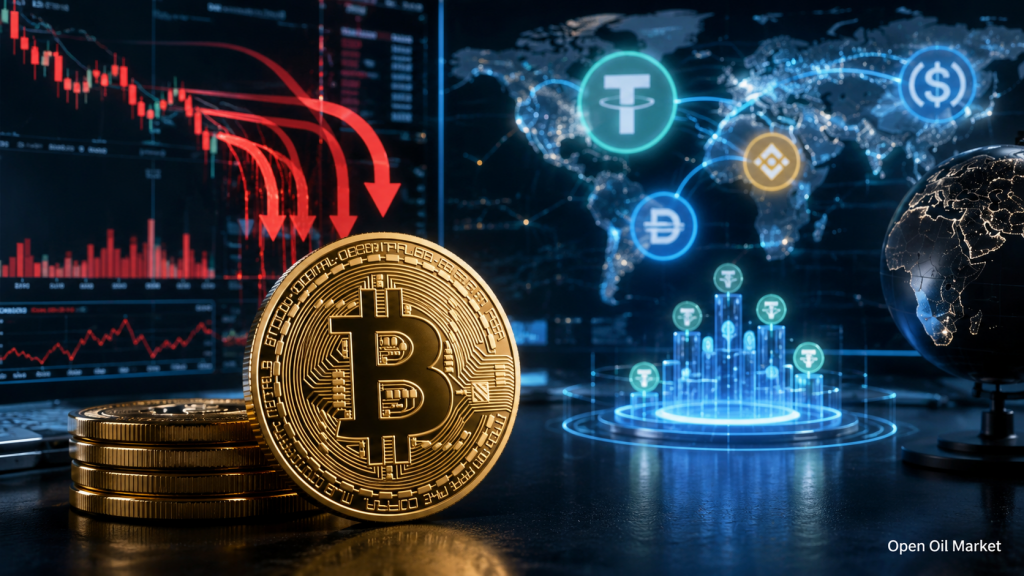
Global Cryptocurrency Market on June 13, 2026: Bitcoin, Ethereum, ETF, Stablecoins, and Top 10 Digital Assets for Investors
The global cryptocurrency market approaches Saturday, June 13, 2026, in a state of cautious recovery after a volatile week. Bitcoin holds around an important psychological zone following a steep decline, Ethereum remains under pressure from weak institutional demand, and investors are increasingly eyeing stablecoins, payment infrastructure, asset tokenization, and regulated ETF products. For the global investor audience, the key question now is not just whether Bitcoin, Ethereum, XRP, Solana, or BNB will rise in the coming days, but which segments of the crypto market will maintain long-term investment appeal after another correction phase.
Market Overview: Cryptocurrencies Recover, But Momentum Remains Weak
The main news in cryptocurrencies for June 13, 2026, is that the market is attempting to stabilize after a significant drop; however, a confident turnaround is not yet visible. Bitcoin remains the primary indicator of sentiment, but its dynamics do not appear as self-sufficient as in previous cycles. Digital assets are increasingly dependent on global liquidity, risk appetite, bond yields, U.S. stock market performance, Federal Reserve rate expectations, and competition from technological megatrends, including artificial intelligence.
For investors, this means that cryptocurrency news can no longer be viewed in isolation. Bitcoin, Ethereum, Solana, XRP, and other digital assets have become part of a broad risk curve: when capital flows into tech stocks, IPOs, AI infrastructure, and the money market, cryptocurrencies receive less inflow. Conversely, when global investors seek high returns and are willing to take risks again, the crypto market quickly returns to focus.
Bitcoin: The Market Tests the Resilience of the Largest Cryptocurrency
Bitcoin remains the central asset of the cryptocurrency market, but its role is changing. Following a period of fervent institutional interest and growth in ETF products, the market is encountering the downside of financial institutionalization: when exchange-traded funds experience outflows, pressure on prices intensifies more quickly than in previous cycles.
At the time of writing, Bitcoin was trading near the $63,000 zone, making the current range particularly significant for short- and medium-term investors. On one hand, maintaining this area indicates that demand for the largest cryptocurrency remains. On the other hand, the lack of strong inflows into Bitcoin ETF suggests that institutional investors are not in a hurry to return aggressively to the asset.
Key Considerations for Investors Regarding Bitcoin
- Maintaining key support levels after the recent decline;
- The dynamics of inflows and outflows from Bitcoin ETFs;
- The behavior of public companies holding Bitcoin on their balance sheets;
- The correlation of Bitcoin with Nasdaq, AI stocks, and global risk assets;
- A decline in Bitcoin's market dominance amid the rise of stablecoins and specific altcoins.
Ethereum: Weakness in ETFs and Anticipating New Drivers
Ethereum also remains under pressure. Despite its status as the second-largest cryptocurrency and a key platform for smart contracts, DeFi, tokenization, and blockchain infrastructure solutions, ETH is yet to show sustainable independent momentum. Investors continue to evaluate Ethereum not just as a digital asset, but also as a technological platform that the market expects to see grow in real-world utility.
A key risk for Ethereum is the weak performance of spot ETFs and insufficient demand from large institutional players. Nevertheless, the long-term investment thesis surrounding Ethereum remains intact: the tokenization of real assets, DeFi infrastructure, corporate blockchain solutions, and calculations in stablecoins are still tied to smart contract ecosystems.
Cryptocurrency ETFs: A Key Indicator of Institutional Demand
One of the critical factors for the cryptocurrency market remains ETF behavior. In 2024–2025, ETFs became a bridge between traditional finance and digital assets. By 2026, this instrument operates bidirectionally: it can not only attract capital but also accelerate outflows in deteriorating sentiment conditions.
For investors, it is particularly important to monitor three directions:
- Bitcoin ETF — a measure of confidence in the largest digital asset.
- Ethereum ETF — an indicator of institutional interest in smart contracts and Web3 infrastructure.
- ETFs for Solana and XRP — a signal of potential capital rotation from the largest cryptocurrencies into riskier but potentially more rewarding assets.
If outflows from Bitcoin and Ethereum ETFs continue, the market may remain under pressure. However, if a sustained inflow starts, it will be one of the first signs of a revival in global investor confidence.
Stablecoins: The Main Structural Theme of the Crypto Market
Amid the volatility of Bitcoin and Ethereum, stablecoins are playing an increasingly significant role. Tether, USDC, and other dollar-pegged digital assets are becoming not just tools for trading within the crypto market but part of the global payment infrastructure. Their importance is growing in cross-border payments, remittances, corporate transactions, DeFi, and markets with limited access to banking services.
For investors, not only the issuance of stablecoins is crucial but also the entire infrastructure around them: wallets, custodial services, compliance platforms, payment gateways, blockchain analytics, and reserve management systems. This segment could become one of the most resilient areas of growth in the crypto industry, even if Bitcoin and Ethereum prices remain volatile.
Top 10 Popular Cryptocurrencies in Focus of the Global Market
For investors monitoring cryptocurrency news and forming a global watchlist, the largest and most liquid digital assets remain in focus. Their roles vary: some are used as a store of value, others as payment infrastructure, and others as technological platforms.
| Cryptocurrency | Ticker | Market Role |
|---|---|---|
| Bitcoin | BTC | The primary digital asset and market indicator |
| Ethereum | ETH | The platform for smart contracts, DeFi, and tokenization |
| Tether | USDT | The largest dollar stablecoin for liquidity and transactions |
| BNB | BNB | The ecosystem token of a major exchange and blockchain infrastructure |
| USDC | USDC | The regulated stablecoin for institutional transactions |
| XRP | XRP | An asset for payment solutions and cross-border transactions |
| Solana | SOL | A high-performance blockchain for applications, DeFi, and tokens |
| TRON | TRX | A network with high activity in stablecoin transfers |
| Dogecoin | DOGE | A meme cryptocurrency with high recognition and speculative demand |
| Cardano | ADA | A blockchain platform focused on scalability and research |
Solana and XRP: Capital Rotation into Altcoins
Solana and XRP remain two key altcoins for investors looking for opportunities beyond Bitcoin and Ethereum. Solana attracts attention due to its high throughput, developer activity, DeFi applications, and interest from ETF investors. XRP remains in focus due to its role in cross-border payments, institutional use, and increased liquidity.
However, in the current market phase, it is crucial for investors to distinguish between short-term capital rotation and sustainable trends. The increasing interest in Solana and XRP may be driven not only by fundamental factors but also by the search for higher yields after Bitcoin and Ethereum's lackluster performance. Consequently, such assets require stricter risk management.
Regulation: The Crypto Market Becomes Part of the Global Financial System
Global regulation of digital assets is gradually strengthening. The U.S., Europe, Asia, and the Middle East are developing different approaches to cryptocurrencies, stablecoins, tokenization, and custodial services. For investors, this creates a dual effect. On one hand, regulation mitigates some infrastructural risks and opens the door to larger capital. On the other hand, it raises requirements for issuers, exchanges, payment companies, and DeFi projects.
A particularly important theme remains stablecoins. The more actively they are used in payments, the more attention is paid to reserves, transparency, liquidity, cybersecurity, and the ability of issuers to maintain the peg to the dollar in stressful conditions.
What Investors Should Focus on June 13, 2026
For global investors, the cryptocurrency market on June 13, 2026, does not appear as a clearly bullish market but as one of selection. In this phase, understanding where long-term value is forming is more important than predicting short-term movements.
- Bitcoin remains the main indicator of trust in the crypto market.
- Ethereum depends on demand for smart contract infrastructure and tokenization.
- Stablecoins are becoming central to global digital transactions.
- ETFs reveal the actual behavior of institutional capital.
- Solana and XRP may benefit from rotation but carry increased risk.
- BNB, TRON, Dogecoin, and Cardano remain assets to monitor but require different valuation approaches.
The main takeaway for investors: the cryptocurrency market is evolving from an era of mere speculation to one of infrastructure, regulation, and institutional selection. Bitcoin and Ethereum remain foundational assets of the sector, but an increasing number of investment opportunities are emerging around stablecoins, payment solutions, tokenization, custodial services, and regulated financial products. These directions may determine the next phase of growth in the global cryptocurrency market.