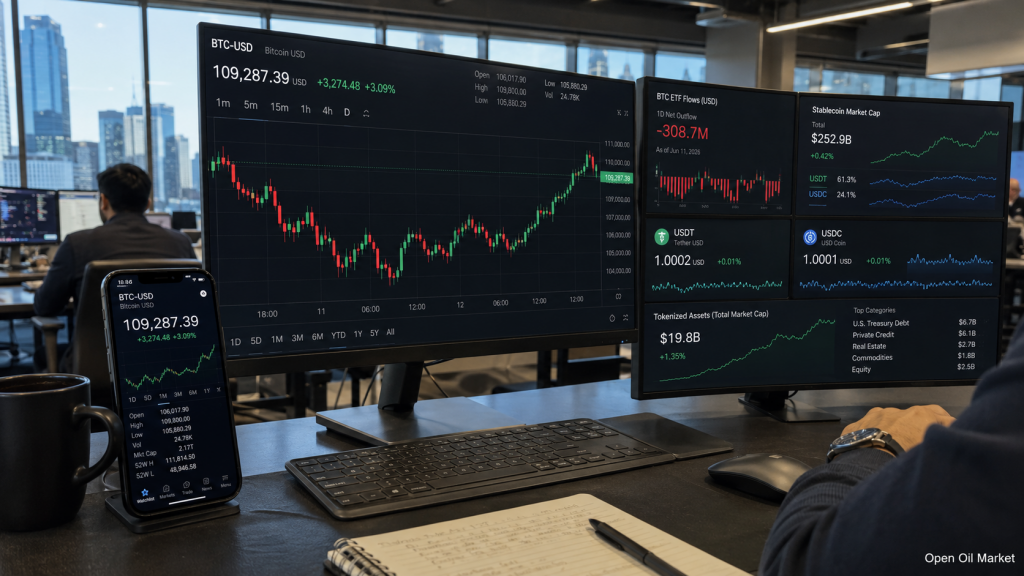
Cryptocurrency News for Friday, June 12, 2026: Bitcoin Recovers After ETF Outflows, Stablecoins Strengthen Their Role in Liquidity, and Asset Tokenization Emerges as a Key Trend in the Global Crypto Market
The global cryptocurrency market enters Friday, June 12, 2026, in a state of cautious recovery after a period of high volatility. Investors are reassessing Bitcoin, Ethereum, and the largest altcoins not only as speculative assets but also as part of a broader financial infrastructure where the importance of ETFs, stablecoins, tokenized assets, and regulation of digital finance is growing.
The key theme of the day is the reallocation of capital within the crypto market. Bitcoin remains the primary benchmark for investors; however, its dynamics increasingly depend on flows into exchange-traded funds (ETFs), macroeconomic expectations, and competition from the tech sector. At the same time, stablecoins, the tokenization of real assets, and blockchain infrastructure are becoming central focal points for institutional players in the U.S., Europe, Asia, and emerging markets.
Overall Picture of the Cryptocurrency Market: Cautious Recovery After Pressure
The global cryptocurrency market remains in a phase of risk reassessment. Following significant fluctuations at the beginning of June, investors are closely monitoring liquidity, sentiment in ETFs, and the behavior of the largest digital assets. The total market capitalization hovers above several trillion dollars, and daily trading volumes indicate that interest in digital assets persists even amid the caution exhibited by major participants.
For global investors, three factors are currently critical:
- the dynamics of Bitcoin as the primary indicator of risk appetite;
- the behavior of Ethereum and Solana as technological blockchain platforms;
- the rising share of stablecoins as instruments for liquidity and transactions.
Cryptocurrencies remain sensitive to expectations regarding interest rates, inflation, bond yields, and stock market sentiments. The greater the uncertainty in the global economy, the more cautious investors are regarding their portfolio structure and the quality of digital assets.
Bitcoin: The Market Seeks Balance After ETF Outflows
Bitcoin continues to be the leading asset in the cryptocurrency market, but its investment role is evolving. If BTC was previously viewed primarily as "digital gold" and a bet on limited issuance, it is now increasingly analyzed as an institutional asset dependent on capital flows through ETFs, the behavior of large funds, and macroeconomic liquidity.
The primary risk for Bitcoin is the continued outflows from spot ETFs. Mass capital withdrawals from funds intensify pressure on the market, as ETFs have become one of the key channels for institutional investors to access cryptocurrencies. Some analysts view such outflows not only as a flight from Bitcoin but also as the result of closing arbitrage strategies and reallocating capital between asset classes.
For investors, this means that Bitcoin remains a foundational indicator of the crypto market, but short-term dynamics may be unstable. Important signals to watch for include:
- changes in flows into Bitcoin ETFs;
- the behavior of long-term holders;
- the correlation of BTC with the stock market and tech stocks;
- the level of demand from institutional investors.
Ethereum: Focus on Infrastructure, DeFi, and Tokenization
Ethereum remains a key platform for smart contracts, decentralized finance, asset tokenization, and corporate blockchain solutions. Despite price pressure on ETH in recent months, fundamental interest in the network continues due to developers, DeFi protocols, tokenized bonds, money market funds, and payment solutions.
For investors, Ethereum is crucial not only as a cryptocurrency but also as an infrastructural asset. While Bitcoin reflects demand for a digital reserve asset, Ethereum demonstrates demand for programmable finance. As interest in the tokenization of real assets grows, Ethereum and competing networks could become the backbone of a new infrastructure for funds, banks, and fintech companies.
Stablecoins: The Key Indicator of Cryptocurrency Liquidity
Stablecoins have become one of the most significant topics in the global digital asset market. Tether, USDC, and other dollar tokens are used not only for trading cryptocurrencies, but also for cross-border payments, liquidity management, DeFi operations, and storing digital dollars in countries with limited access to banking infrastructure.
The increasing importance of stablecoins indicates that the crypto market is gradually shifting from speculation to payment and settlement infrastructure. For investors, this is an essential structural signal: future returns may be generated not only from rising coin prices but also from companies building wallets, payment gateways, custodial services, compliance systems, and solutions for tokenized settlements.
However, stablecoins carry specific risks:
- the quality of reserves and transparency of backing;
- regulatory requirements in the U.S., Europe, and Asia;
- sanciton control and AML rules;
- operational resilience of blockchain networks.
Regulation: U.S. Tightens Rules for Stablecoins and Digital Assets
In 2026, the regulation of cryptocurrencies is becoming one of the main factors for the global market. The U.S. continues to shape rules for payment stablecoins, including issuer requirements, anti-money laundering measures, sanctions compliance, and financial transparency. This increases the burden on crypto companies while simultaneously making the market more comprehensible for banks, funds, and major payment systems.
For investors, this translates to cryptocurrencies moving from the "gray zone" into regulated financial infrastructure. Stricter rules may reduce space for weaker projects while strengthening positions of major players with transparent reserves, legal structures, and access to institutional capital.
Tokenization and Banks: Traditional Finance Turns to Blockchain
One of the key global trends is the convergence of the banking system and blockchain infrastructure. Major financial institutions are increasingly exploring tokenized deposits, digital bonds, 24/7 settlements, and the issuance of traditional assets in a blockchain format. This does not necessarily mean direct growth for all cryptocurrencies but confirms long-term interest in distributed ledger technology.
This shift is significant for the market. If the early crypto market was built around the idea of being an alternative to banks, the new phase is associated with the integration of crypto technologies into traditional finance. The most promising areas appear to be:
- tokenization of money market funds and bonds;
- settlements between banks and corporations in real-time;
- institutional custody of digital assets;
- infrastructure for regulatory compliance.
Top 10 Popular Cryptocurrencies for Global Investors
As of June 12, 2026, investors should closely monitor the ten most significant crypto assets that reflect different segments of the digital market:
- Bitcoin (BTC) — the primary market indicator and foundational digital asset.
- Ethereum (ETH) — the infrastructure for smart contracts, DeFi, and tokenization.
- Tether (USDT) — the largest stablecoin and key liquidity tool.
- BNB (BNB) — the token of the Binance ecosystem and BNB Chain.
- USDC (USDC) — a regulated dollar stablecoin with an institutional focus.
- XRP (XRP) — an asset for cross-border payments and settlement infrastructure.
- Solana (SOL) — a high-performance network for DeFi, applications, and tokenization.
- TRON (TRX) — a network with high activity in the stablecoin transfer segment.
- Dogecoin (DOGE) — an indicator of retail demand and speculative sentiments.
- Hyperliquid (HYPE) — a representative of the growing decentralized derivatives segment.
These assets cannot be viewed as a single investment class. Bitcoin, Ethereum, stablecoins, payment tokens, and DeFi projects have different sources of demand, varying risks, and distinct use-case scenarios.
What This Means for Investors
For investors, the cryptocurrency market as of June 12, 2026, remains high-risk but is more mature than in previous cycles. The primary challenge is separating infrastructural trends from short-term speculation. Bitcoin continues to set market direction, but the growth of stablecoins, tokenization, and banking blockchain solutions indicates that the next phase of development may be linked not only to price increases but also to the integration of digital assets into real financial processes.
Investors should focus on several key areas:
- capital flows into Bitcoin and Ethereum ETFs;
- stablecoin regulation in the U.S. and other jurisdictions;
- the development of tokenized assets and banking infrastructure;
- the resilience of major blockchain networks under pressure;
- liquidity dynamics in USDT, USDC, and other dollar tokens.
Cryptocurrencies continue to represent a global market, where decisions made by investors in the U.S., Europe, Asia, Latin America, and the Middle East quickly impact liquidity and prices. Therefore, the primary strategy for market participants is to monitor not only Bitcoin and Ethereum charts but also broader signals: regulation, ETF flows, stablecoins, tokenization, and institutional capital behavior.