Cryptocurrency News for Tuesday, July 21, 2026: Bitcoin at Key Level $65,000, Return of Inflows to Bitcoin ETF, Dynamics of Ethereum, Solana, XRP, BNB, Stablecoins, and Top-10 Cryptocurrencies for Investors
Cryptocurrency news for Tuesday, July 21, 2026, presents a mixed picture for investors: Bitcoin stabilizes around the key zone of $65,000, Ethereum remains under pressure relative to historical levels, Solana is trying to maintain speculative capital interest, and stablecoins continue to strengthen their role as the settlement infrastructure of the digital market. Global cryptocurrency market demand remains cautious: investors are closely evaluating the dynamics of Bitcoin ETFs, regulatory prospects in the U.S., institutional player activity, and liquidity conditions in the top-10 most popular cryptocurrencies.
The main intrigue of the day is whether the digital asset market can transition from technical recovery to sustained growth. After a period of outflows from cryptocurrency ETFs and reduced risk appetite, investors are again testing Bitcoin as a macro asset, but are not yet ready to aggressively increase positions without new catalysts.
Bitcoin: $65,000 Zone Becomes the Main Psychological Level
Bitcoin remains the central asset of the cryptocurrency market. As of the preparation of this overview, BTC is trading around $65,000, making this zone a key reference point for short-term investors. Holding above $64,000–65,000 will be perceived by the market as a stabilization signal, whereas moving below this range might reignite discussions about demand weakness and a retest of lower levels.
For institutional investors, Bitcoin is currently more appealing not just as a speculative asset but also as an indicator of overall risk sentiment. In 2026, BTC has a stronger correlation with stock market sentiment, the Fed's monetary policy, and inflows into ETFs. This diminishes its previous status as an independent asset but enhances Bitcoin's significance in global portfolios as a tool for alternative liquidity.
Bitcoin ETF: Inflows Return, but Market Expects a Greater Scale
One of the key topics for investors remains Bitcoin ETFs. After a period of notable outflows, funds are once again flowing into the market; however, the inflow volume looks moderate compared to the scale of previous pressures. This indicates that the ETF segment is no longer an unequivocally negative factor, yet it has not fully become a driver of a new rally.
Three indicators are crucial for the cryptocurrency market:
- stability of daily inflows into spot Bitcoin ETFs;
- behavior of institutional investors as BTC moves above $65,000;
- ability of ETF products to absorb sales from short-term holders and corporate treasuries.
If inflows continue for several weeks, Bitcoin could receive fundamental support. Conversely, if investors begin withdrawing capital again, the cryptocurrency market will remain vulnerable to declines.
Ethereum: Pressure Persists, but Stablecoins and Tokenization Sustain Long-Term Interest
Ethereum remains the second most significant asset in the global cryptocurrency market, but ETH's performance in 2026 appears less assured than many investors had anticipated. The token is trading around $1,600, and the market is closely monitoring whether Ethereum can regain its premium through increased activity in stablecoins, DeFi, tokenization of real assets, and corporate blockchain solutions.
The main argument in favor of Ethereum is the network's infrastructural role. A large portion of the stablecoin, smart contract, and tokenized asset ecosystem remains linked to Ethereum or compatible networks. However, for ETH's growth, investors need to see not just technological activity but also sustained demand for the token itself.
Solana, XRP, and BNB: Investors Looking for Liquid Alternatives to Bitcoin
Among the largest altcoins, investor attention is focused on Solana, XRP, and BNB. Solana is holding around $78 and remains one of the key assets for those betting on high-performance blockchains, applications, meme coins, and retail activity. However, SOL remains sensitive to market risk sentiment: when risk appetite increases, it can outpace Bitcoin, while during liquidity declines, it may fall faster than the market.
XRP is attractive to investors as an asset related to cross-border payments and expectations of further development of regulated infrastructure. BNB retains its significance due to the Binance ecosystem, trading activity, and utilization within major cryptocurrency services. For global investors, these assets are not replacements for Bitcoin but components of a broader diversification strategy within the digital asset market.
Stablecoins: USDT and USDC Become the Infrastructure for Digital Settlements
Stablecoins remain one of the strongest sectors in the cryptocurrency market. USDT and USDC rank among the top 10 most popular cryptocurrencies and serve as digital liquidity for exchanges, DeFi, cross-border payments, and settlements among market participants. For investors, this is an important signal: demand for cryptocurrencies is increasingly linked not only to speculation but also to payment infrastructure.
In 2026, stablecoin regulation is becoming a central theme for the U.S., Europe, and Asia. The clearer the rules regarding reserves, disclosures, and issuer oversight, the higher the likelihood that banks, payment companies, and large financial groups will enter the digital asset market.
Top-10 Most Popular Cryptocurrencies for Investors
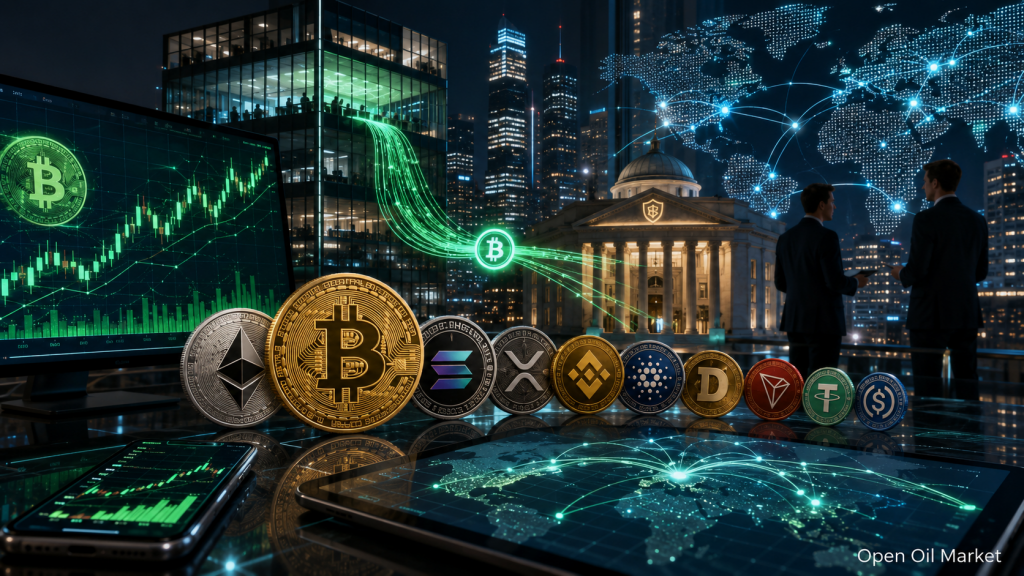
For a global audience of investors, not only short-term price movements are important, but also the structure of the top ten cryptocurrencies in the market. The top-10 most popular cryptocurrencies by capitalization and market value can now be viewed as the core of a digital portfolio:
- Bitcoin (BTC) — the main reserve asset of the cryptocurrency market and an indicator of institutional demand.
- Ethereum (ETH) — the foundational infrastructure for smart contracts, DeFi, and tokenization.
- Tether (USDT) — the largest stablecoin and a key tool for cryptocurrency liquidity.
- BNB (BNB) — a token of a significant exchange and blockchain ecosystem.
- USD Coin (USDC) — a regulated stablecoin with institutional positioning.
- XRP (XRP) — an asset focused on payments and cross-border settlements.
- Solana (SOL) — a high-performance blockchain for applications, DeFi, and retail activity.
- TRON (TRX) — a network with high activity in stablecoin transfers.
- Dogecoin (DOGE) — the largest meme coin, sensitive to retail demand and market sentiment.
- Cardano (ADA) — a blockchain project with a focus on technological upgrades and long-term development.
Cardano and Technological Upgrades: The Market Focuses on Infrastructure Quality
Cardano has once again drawn attention following the Van Rossum network upgrade. For investors, this serves as a reminder that the cryptocurrency market assesses not only the price of tokens but also the technological maturity of blockchains. Upgrades that enhance performance, security, and developer convenience can sustain interest in the project even during periods of weak market performance.
However, technological development alone does not guarantee price growth. For ADA, as well as other altcoins, real users, applications, liquidity, listings, institutional support, and the network's ability to compete with Ethereum, Solana, and other platforms are crucial.
Regulation and Institutional Capital: The Key Factor of the Second Half of 2026
Cryptocurrency regulation is becoming a key topic for the entire global market. Investors are awaiting progress on U.S. legislation regarding digital assets, regulations for stablecoins, requirements for exchanges, custodians, and ETF products. The sooner clear norms emerge, the higher the likelihood of expanded institutional participation.
A telling event remains the interest of traditional financial players in the crypto business. Investments by large market makers, banks, and payment companies in cryptocurrency infrastructure indicate that digital assets are gradually becoming part of the global financial market. However, risks persist: the absence of unified regulation, potential sell-offs by major holders, volatility in ETF flows, and competition from AI stocks.
What Investors Should Focus on July 21, 2026
Investors should assess the cryptocurrency market not only through the daily dynamics of BTC, ETH, or SOL but also through several fundamental indicators. On Tuesday, July 21, 2026, the key benchmarks will be:
- Bitcoin's ability to hold above the $64,000–65,000 range;
- Continuation or halt of inflows to Bitcoin ETFs;
- Ethereum dynamics against the backdrop of interest in stablecoins and tokenization;
- Behavior of liquid altcoins — Solana, XRP, BNB, TRX, DOGE, and ADA;
- News on digital asset regulation in the U.S., Europe, and Asia;
- Overall risk appetite in global equity markets.
The base scenario for the cryptocurrency market remains cautiously neutral. Bitcoin has stabilized but has not yet garnered enough momentum for confident growth. Ethereum retains its long-term infrastructural value but requires heightened network activity. Altcoins may exhibit local spikes; however, for investors, priority remains on liquidity, regulation, ETF flows, and project quality.
Thus, cryptocurrency news on July 21, 2026, indicates a market that has emerged from the panic phase but has not yet transitioned into a phase of broad recovery. For long-term investors, this period is one for selecting robust assets, controlling risks, and carefully analyzing the top-10 most popular cryptocurrencies in the global digital asset market.