Global Cryptocurrency Market on July 15, 2026: The Rise of Bitcoin and Ethereum, Spot ETFs, Stablecoins, and Leading Altcoins
Bitcoin remains the leading asset in the cryptocurrency market and effectively serves as an "index of trust" for digital assets. Following a downturn attributed to rising geopolitical tensions and concerns regarding Federal Reserve policy, buyers have returned to the market amid softer inflation data in the U.S. For investors, this is an important signal: BTC remains sensitive to dollar liquidity, interest rate expectations, and the behavior of stock indices.
The key question as of July 15 is whether Bitcoin can secure itself above the nearest technical resistance levels and convert the short-term rebound into a more sustainable movement. So far, the market appears not as an aggressive rally but rather as an attempt to stabilize after sell-offs. This makes BTC attractive for institutional investors but retains high risk for short-term speculators.
- Positive factor — recovering demand following the release of macroeconomic data;
- Neutral factor — high dependence on decisions made by the Federal Reserve;
- Risk factor — geopolitics and potential oil price increases;
- Market signal — investors are once again tracking inflows into spot Bitcoin ETFs.
Ethereum Strengthens Its Position Through DeFi, Tokenization, and Institutional Demand
Ethereum has recently appeared stronger than many altcoins. ETH is supported by several fronts: the development of DeFi, interest in the tokenization of real assets, infrastructural solutions for banks, and expectations for inflows into Ethereum ETFs. For the global market, Ethereum remains not just a cryptocurrency, but a fundamental platform for smart contracts, stablecoins, tokenized funds, and corporate blockchain solutions.
The main investment argument for Ethereum lies in its role within the digital financial infrastructure. While Bitcoin is viewed as a digital reserve asset, Ethereum is often considered a technological platform. This is why ETH may receive additional support during periods when investors return to themes of tokenization, staking, blockchain infrastructure, and Web3 applications.
Spot Crypto ETFs Remain the Main Channel for Institutional Capital
Flows into spot ETFs remain one of the most important indicators for the cryptocurrency market. At the beginning of July, U.S. Bitcoin and Ethereum ETFs ended a period of consistent outflows, after which the market began to pay closer attention to the daily dynamics of the funds. For institutional investors, ETFs remain a more convenient and regulated way to access Bitcoin and Ethereum without directly holding crypto assets.
However, the situation is heterogeneous. On some days, inflows are recorded, while on others, outflows occur, indicating a tactical redistribution of capital rather than an unconditional return to a "bullish" market. For investors, it's crucial not to focus on a single daily figure, but to observe a series of indicators: if positive flows persist for several consecutive weeks, it may serve as a basis for revising expectations across the entire crypto market.
- Bitcoin ETFs demonstrate the resilience of demand from traditional asset managers.
- Ethereum ETFs reflect interest in smart contracts, DeFi, and tokenization.
- Outflows from ETFs signal a decrease in risk appetite.
- Stable inflows could support BTC, ETH, and the largest altcoins.
Stablecoins Move to the Forefront of Regulation and Global Payments
One of the main topics of the week is the regulation of stablecoins. The U.S. Federal Reserve is preparing rules for payment stablecoins under the GENIUS Act, while major issuers, including USDC, are strengthening their ties with banking and payment infrastructure. This could mark a turning point for the market: stablecoins are gradually moving from the grey area of crypto trading to the segment of global digital payments.
USDT and USDC remain the largest stablecoins and critical sources of liquidity for the cryptocurrency market. Their role is particularly evident during periods of volatility: investors utilize stablecoins as "cash within the blockchain" to quickly switch between Bitcoin, Ethereum, Solana, XRP, and other assets. The stricter and more transparent the regulation becomes, the greater the likelihood of banks, payment companies, and institutional clients entering the space.
Top 10 Popular Cryptocurrencies for Investors
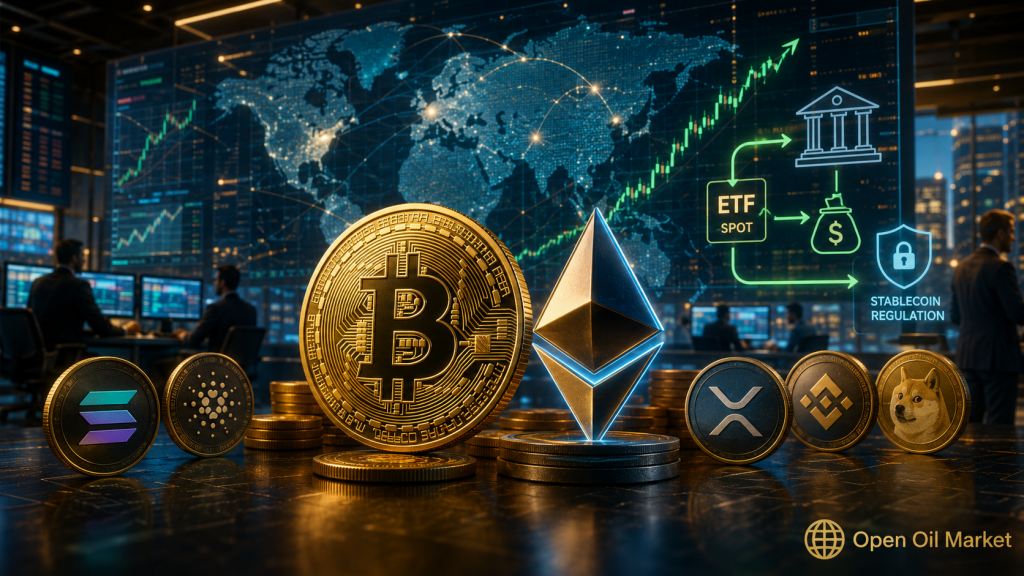
As of July 15, 2026, investors in the global market are primarily monitoring the largest and most liquid crypto assets. These cannot be seen as a homogeneous group: Bitcoin serves as a digital reserve, Ethereum as an infrastructural platform, USDT and USDC as dollar liquidity, while Solana, XRP, BNB, TRON, Dogecoin, and Cardano reflect different segments of demand for blockchain ecosystems.
- Bitcoin (BTC) — the primary asset in the crypto market and a benchmark for institutional demand.
- Ethereum (ETH) — the foundational network for DeFi, tokenization, smart contracts, and Web3.
- Tether (USDT) — the largest stablecoin and a key source of trading liquidity.
- BNB (BNB) — an asset of the Binance ecosystem and one of the largest exchange-linked tokens.
- USDC (USDC) — a regulated dollar stablecoin important for institutional settlements.
- XRP (XRP) — a crypto asset associated with cross-border payments and banking infrastructure.
- Solana (SOL) — a high-performance blockchain network for DeFi, meme coins, and consumer applications.
- TRON (TRX) — a network with high activity in stablecoin transfers and digital payments.
- Dogecoin (DOGE) — the most recognizable meme coin with a strong retail community.
- Cardano (ADA) — a blockchain project focused on scalability, research, and long-term development.
Altcoins: Solana, XRP, and BNB Remain in Focus, but Risk is Higher Than BTC
Altcoins are recovering alongside Bitcoin, but their dynamics remain more volatile. Solana is bolstered by activity in applications, high network speed, and interest in consumer blockchain scenarios. XRP continues to attract investor attention due to the topic of international payments and regulatory clarity. BNB remains a significant asset closely tied to exchange infrastructure and the liquidity of the global cryptocurrency market.
However, it is crucial for investors to consider that altcoin growth usually intensifies only when Bitcoin is stable and overall risk appetite improves. If BTC again enters a correction, the pressure on Solana, XRP, Dogecoin, Cardano, and other altcoins could be greater than that on the market leader. Therefore, holding altcoins in a portfolio requires more stringent risk management.
Crypto Companies and Public Treasury Models Face Market Scrutiny
Investor attention is particularly focused on public companies that have accumulated Bitcoin and other digital assets on their balance sheets. The digital asset treasury model became popular during market growth, but in 2026, it has faced scrutiny: declining cryptocurrency prices, rising capital costs, and pressure on liquidity compel such companies to reassess their strategy.
For investors, this is an important signal. Purchasing shares of crypto companies does not always equate to a direct bet on Bitcoin. The price of such stocks carries corporate risks: debt burden, capital servicing costs, premiums or discounts to net asset value, and management decisions regarding the sale or retention of cryptocurrencies. Thus, shares of crypto companies and the crypto assets themselves should be analyzed separately.
What Matters to Investors on July 15, 2026
Cryptocurrencies remain a high-risk asset class, but the current picture has become more constructive. Bitcoin has recovered from pressure, Ethereum is showing signs of strength, stablecoins are becoming part of the global payment infrastructure, and ETFs continue to dictate the mood of institutional capital. For long-term investors, the main question is not just the price of BTC today, but the sustainability of liquidity and the quality of the regulatory environment.
On July 15, 2026, investors should monitor several indicators:
- Bitcoin's consolidation above key levels following recovery;
- The dynamics of Ethereum relative to BTC and the altcoin market;
- Daily flows in Bitcoin ETFs and Ethereum ETFs;
- News regarding stablecoin regulation in the U.S., Europe, and Asia;
- Liquidity of USDT and USDC on major exchanges;
- Behavior of Solana, XRP, BNB, TRON, Dogecoin, and Cardano;
- The correlation of the crypto market with Nasdaq, the dollar, oil, and Federal Reserve rate expectations.
The base scenario for the cryptocurrency market indicates a cautious recovery while maintaining high sensitivity to macroeconomic data. If ETF flows become sustainably positive and stablecoin regulation is perceived by the market as a step toward institutionalization, Bitcoin and Ethereum could maintain their leadership. However, for global investors, a disciplined approach remains crucial: diversification, monitoring the crypto portion of the portfolio, and avoiding excessive leverage.