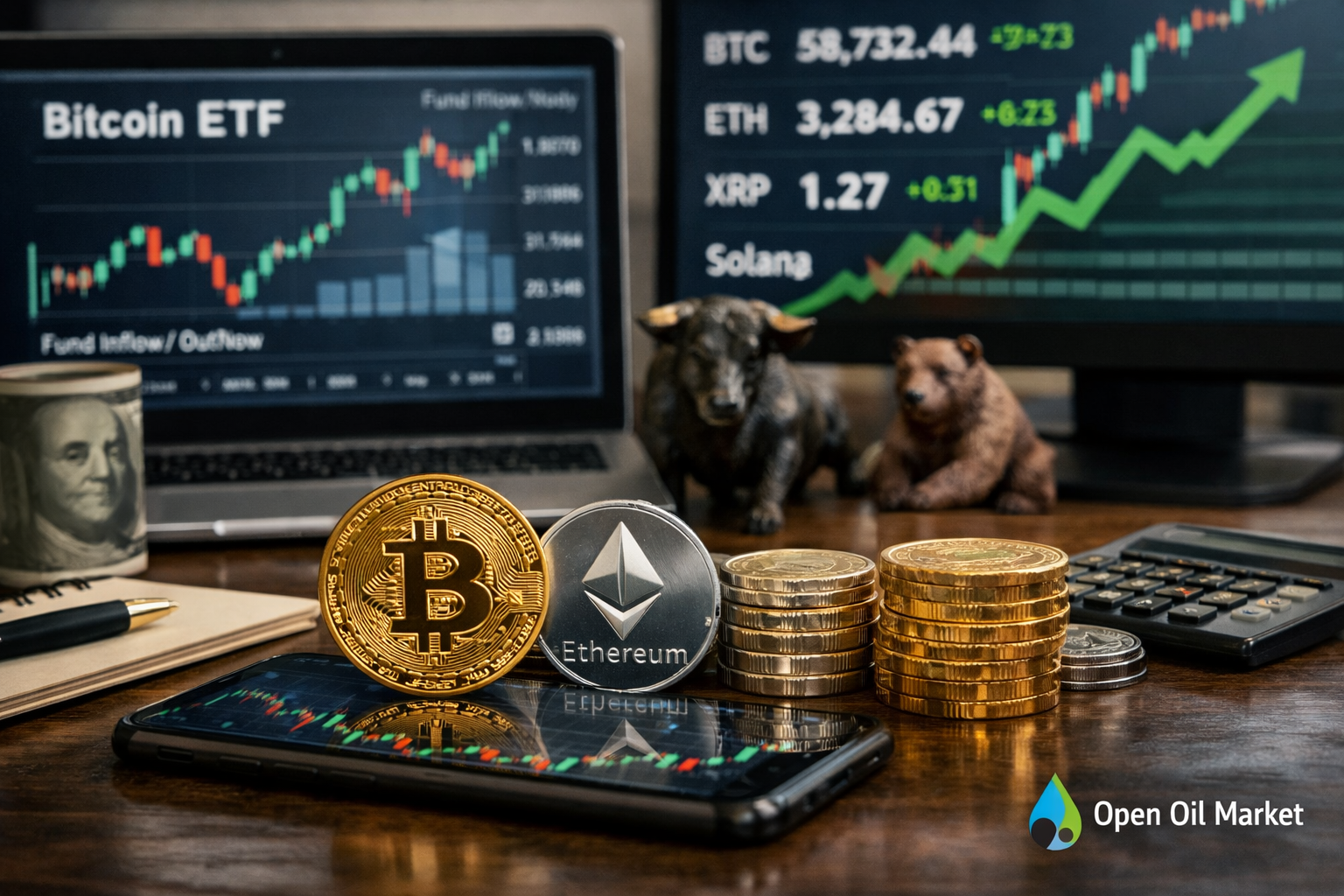
Cryptocurrency News for Friday, February 27, 2026: Bitcoin Dynamics, ETF Influence, Altcoin Volatility, and the Top 10 Most Popular Cryptocurrencies
The global cryptocurrency market enters the weekend in a heightened sensitivity mode: upward impulses often resemble technical bounces and short squeezes rather than a sustainable trend. For investors, this is a typical phase of "repricing expectations": money isn't leaving the asset class entirely but is becoming more tactical, with a shorter holding horizon. In practice, this manifests as increased intraday volatility, uneven sector dynamics, and a growing role of derivatives.
What this means for the portfolio:
- cryptocurrency news is viewed through the lens of liquidity and risk appetite rather than the "stories" of individual tokens;
- quality takes precedence: liquid assets and understandable catalysts (ETFs/regulation/network upgrades);
- altcoins react more strongly: both up on "short squeezes" and down when risk-off sentiment increases.
Bitcoin: ETF Flows Become the Main "Barometer" of Institutional Sentiment
Bitcoin remains the center of liquidity attraction: even when the dynamics appear "sideways," it is BTC that sets the pace for the entire cryptocurrency market. A key factor in 2026 is that a significant portion of demand/supply flows through the infrastructure of exchange-traded products. Flows into spot ETFs effectively become a daily indicator: when there is a series of outflows, the market quickly slips into a sell-off; when there are days with noticeable inflows, risk appetite returns, albeit unevenly.
Investors need to focus on three key metrics rather than the "noise" in the headlines:
- Series of inflows/outflows (multiple consecutive weeks matter more than a single day);
- Price reaction to the flows (if inflows do not lead to price increases, the market is "heavy");
- Sentiment spreads between BTC and altcoins (if BTC is stable while altcoins are weak, risk remains high).
Ethereum: Focus on Scalability and Security in the 2026 Roadmap
Ethereum continues to position itself as the foundational layer for financial applications and tokenization, but in 2026, investors view ETH pragmatically: the speed of scaling, user experience quality, and protocol security. Roadmap updates and development priorities amplify expectations that the network will enhance throughput and resilience—partly through increased limits and the development of censorship-resistant mechanisms, as well as long-term preparation for post-quantum risks.
For the market, this is an important signal: fundamental changes in Ethereum typically influence the entire L2 sector, DeFi, and infrastructure tokens. In practice, this could mean:
- Increased interest in ecosystem assets during stabilization periods for the overall market;
- Heightened competition among L2s for liquidity and users;
- Tighter project selection: narrative alone no longer suffices; metrics are necessary.
Altcoins: Rotation Occurs via Liquidations and "Short" Moves Rather Than a Long Trend
Altcoins are moving unevenly at the end of February: part of the market gains momentum from forced short position closures, while other parts remain under pressure due to a decline in risk appetite. For investors, this is an environment where "beautiful" daily candles may be the result of liquidations rather than fundamental demand. In such conditions, it is essential to have clear risk limits and disciplined rebalancing.
Practical tactics for investors include:
- not to confuse short squeezes with the start of a sustainable growth cycle;
- to separate the "core" (BTC/ETH) from "satellites" (altcoins) with different stop/loss rules;
- to maintain a liquidity reserve: in a volatile market, it's an option for opportunities.
Regulation and Compliance: Stablecoins Transition to "Payment Infrastructure" Mode
On a global scale, cryptocurrency regulation is becoming more applied: the focus is shifting to stablecoins, reserves, disclosures, and issuer requirements. This is changing the risk landscape for investors and businesses: on one hand, the "institutional suitability" of the market is increasing; on the other hand, compliance costs are rising, and segmentation by jurisdiction is becoming more pronounced.
Key implications for the cryptocurrency market include:
- Stablecoins are becoming closer to traditional payment instruments—reducing the risk of "bank runs" within the crypto ecosystem;
- The role of regulated platforms and custodians is increasing;
- For DeFi, there is a growing demand for transparent reserves and auditable liquidity.
Institutional Investors: Interest Persists but Has Become More "Portfolio-Oriented"
A significant portion of demand for cryptocurrencies in 2026 is coming through institutional channels, making the market both deeper and more "capricious." It is deeper because the infrastructure (ETFs, custodians, risk procedures) is emerging. It is capricious because decisions are made with portfolio logic: if macro conditions deteriorate, crypto exposure is reduced alongside other risk assets; if liquidity improves, exposure is quickly restored.
How investors can interpret this:
- Strong moves in BTC can occur "without news"—due to flows and hedging;
- Correlations with stock indices periodically strengthen;
- The rise of "quality" flows enhances the long-term resilience of the market, even if it adds pressure in the short term.
Top 10 Most Popular Cryptocurrencies: Market Structure and the Role of Each Asset
Below is a guide to the "core" of the cryptocurrency market, which often forms the foundation of global portfolios. The list reflects the most commonly held and liquid assets; specific rankings may change depending on the market cycle, but the relationship and roles remain consistent.
Top 10 (Practical Classification for Investors)
- Bitcoin (BTC) — the basic risk benchmark, the market's "digital reserve."
- Ethereum (ETH) — the key smart contract platform and ecosystem asset for DeFi/L2.
- Tether (USDT) — the primary US dollar stablecoin for trading liquidity.
- USD Coin (USDC) — a stablecoin with a strong compliance profile and institutional use.
- XRP (XRP) — an asset focusing on payments and infrastructure scenarios.
- BNB (BNB) — an ecosystem token of a major exchange infrastructure and network services.
- Solana (SOL) — a high-performance network that often benefits during altcoin "rotation" phases.
- Cardano (ADA) — a smart contract platform emphasizing formal approaches and sustainable development.
- Dogecoin (DOGE) — a high-beta asset sensitive to sentiment and liquidity.
- TRON (TRX) — a network widely utilized in stablecoin transactions and remittances.
Risks and Scenarios: What Investors Should Watch Ahead of the Weekend
The key question for the upcoming sessions is whether the cryptocurrency market can solidify its recovery after sharp movements or if volatility will remain "saw-toothed." In such a configuration, it is beneficial for investors to work scenically rather than trying to predict a single outcome.
Basic Scenarios:
- Stabilization: BTC maintains its range, ETF flows align, and altcoins grow selectively.
- Risk-off: Deteriorating macro sentiment returns outflows, with altcoins falling faster than the "core."
- Upward Momentum: A series of inflows and short liquidations accelerate growth, but require strict take profits.
Practical Risk Management: Split entries, lock in part of the profits during spikes, maintain portfolio drawdown limits, and avoid overloading altcoins in phases of uncertainty. For long-term investors, 2026 is increasingly shaping up to be a story of infrastructure (ETFs, regulation, protocol upgrades) rather than just price "stories."