Current Cryptocurrency News as of April 20, 2026, Including Bitcoin and Ethereum Dynamics and Key Market Trends
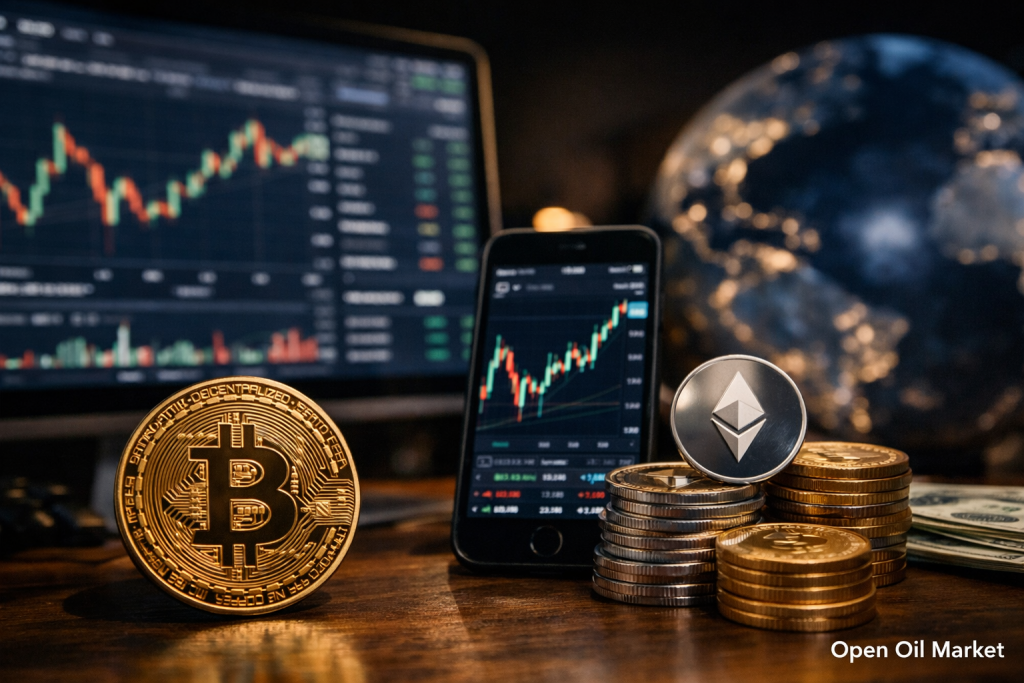
Cryptocurrency news as of April 20, 2026 revolves around three key themes: the recovery of the global cryptocurrency market after a weak first quarter, a new wave of institutional investor interest in Bitcoin and Ethereum, and the rapid emergence of stablecoins from a narrow crypto niche into the center of global financial competition. For investors, this means one thing: digital assets are increasingly becoming integrated into the international financial system and are less frequently viewed solely as a speculative segment.
At the start of the new week, the cryptocurrency market appears significantly more resilient than at the beginning of the year. However, this is not a return to unqualified euphoria, but rather a more mature phase where capital is moving primarily towards liquidity, regulation, and infrastructure. Consequently, Bitcoin, Ethereum, the largest stablecoins, and the top ten most popular cryptocurrencies remain in the spotlight for investors.
The Global Cryptocurrency Market Enters a New Week in a More Stable Condition
Following a tough correction in the first quarter, the cryptocurrency market approached a total capitalization of approximately $2.65 trillion by the weekend. This is a significant signal for global investors: the market has not yet returned to the historical highs of 2025, but it has ceased to resemble a segment in free fall. Moreover, Bitcoin's dominance remains high, and Ethereum's share maintains systemic significance, indicating a cautious yet constructive nature of recovery.
- Capital is returning primarily to the most liquid cryptocurrencies;
- The appetite for risk is improving, but the market is still sensitive to macroeconomics and geopolitics;
- Investors increasingly view crypto assets as part of a global portfolio rather than as a separate speculative venture.
Bitcoin Remains the Key Benchmark for the Cryptocurrency Market
Bitcoin once again confirms its status as the industry's main asset. Last week, it was BTC that accumulated the bulk of new regulated demand: American spot ETFs on Bitcoin saw nearly $1 billion in net inflows during the trading week, with Friday alone recording one of the strongest daily performances of the month. This is particularly important for the cryptocurrency market, as Bitcoin is once again serving as the primary entry channel for large funds.
From a strategic perspective, this indicates that institutional investors prefer to initiate or increase their exposure primarily through Bitcoin. As long as BTC maintains a high market share, cryptocurrencies, in general, appear more resilient. For the international investor audience, this remains a fundamental signal: if capital flows first into Bitcoin and only then spreads to large altcoins, the market retains a disciplined growth structure.
Ethereum Maintains Its Role as the Fundamental Infrastructure of Digital Finance
Ethereum appears less aggressive than Bitcoin in April, but its strategic role is only strengthening. ETH remains a key infrastructure for stablecoins, asset tokenization, decentralized finance, and a multitude of corporate and institutional blockchain solutions. Last week, spot ETFs on Ethereum also returned to positive inflows, indicating a revival of interest in the asset not only as a coin but also as a technology.
- Ethereum remains the core of the global smart contract ecosystem;
- A significant portion of digital settlements and on-chain liquidity is built around the ETH network;
- For long-term investors, Ethereum remains a bet on the development of next-generation financial infrastructure.
Institutional Investors Strengthen Their Positions Through ETFs, Brokers, and Exchange Infrastructure
The most important theme for the cryptocurrency market on Monday, April 20, 2026, is not only price movements but also the expansion of institutional participation. Over the week, digital investment products attracted approximately $1.1 billion in inflows, marking the best outcome since early January. Simultaneously, major players in traditional finance are accelerating their entry into the sector.
- On April 14, Goldman Sachs filed documents to launch its first bitcoin ETF product;
- Morgan Stanley previously launched its own Bitcoin Trust in early April;
- Charles Schwab announced the phased rollout of direct spot trading in Bitcoin and Ethereum for retail clients;
- Deutsche Börse deepened its partnership with Kraken through a $200 million investment in regulated crypto infrastructure.
This trend is not limited to the U.S. A recent Nomura survey in Japan found that 65% of institutional participants view crypto assets as a diversification tool, with the majority of those considering entry planning to add cryptocurrencies to their portfolios over the coming years. For the global market, this means that demand is becoming broader geographically and deeper in quality.
Cryptocurrency Regulation is Becoming a Driver, Not Just a Source of Risk
The regulatory agenda in 2026 has ceased to be exclusively a negative factor. In the U.S., the joint interpretation by the SEC and CFTC published in March has provided the market with clearer guidelines on how federal law applies to various types of crypto assets, including staking, airdrop models, and tokens that are not considered securities by themselves. Meanwhile, momentum in Washington continues to push for a broader legislative framework for digital assets.
This is important for investors for a simple reason: the clearer the rules of the game, the lower the regulatory discount and the higher the likelihood of attracting new institutional capital. The cryptocurrency market remains high-risk, but in 2026, its dynamics are increasingly determined not only by the mood of the crowd but by a combination of liquidity, law, and access to regulated investment channels.
Stablecoins are Emerging as a Central Element of Global Payment Competition
The stablecoin segment is today one of the most crucial parts of the global crypto market. In the first quarter, its total volume remained near $309.9 billion, despite an overall market decline. This confirms that stablecoins have become the primary layer of liquidity and settlements. At the same time, the market structure is changing: Tether maintains its leadership, USDC is gradually strengthening its position, and Europe is increasingly discussing its own alternatives to dollar dominance.
Last week, the French minister of finance publicly urged to accelerate the development of euro stablecoins, while major European banks, including ING, UniCredit, and BNP Paribas, continue preparing a joint project in this segment. Simultaneously, the Bank of England signals that international standards for stablecoins are progressing slower than expected. The takeaway for investors is clear: stablecoins are not just a tool for crypto exchanges but a part of the struggle for the future architecture of global payments.
Altcoins Are Growing Selectively, Rewarding Infrastructure and Liquidity
The altcoin segment is not exhibiting the classic wide "alt season," where almost everything is rising simultaneously. In 2026, capital behaves much more stringently. Investors prefer assets with clear functionality: payment tokens, exchange ecosystems, high-speed networks, and derivative infrastructure. As a result, XRP, BNB, Solana, and TRON are maintaining strong positions, and the emergence of Hyperliquid in the top ten shows that the market is increasingly valuing platforms related to trading and derivative liquidity.
It is worth noting Solana specifically. In the first quarter, the network maintained leadership in the volume of spot trading on decentralized exchanges, although in March Ethereum renewed its competitive edge. This is an important detail for investors: the cryptocurrency market is once again evaluating not only brands but also actual activity within ecosystems.
Top 10 Most Popular Cryptocurrencies
- Bitcoin (BTC) — the leading digital asset for institutional and long-term strategies.
- Ethereum (ETH) — the foundational infrastructure for DeFi, stablecoins, and tokenization.
- Tether (USDT) — the largest stablecoin and primary settlement asset for the crypto market.
- XRP (XRP) — one of the key payment tokens with high international recognition.
- BNB (BNB) — a systemic asset in the Binance ecosystem and a critical part of global crypto liquidity.
- USDC (USDC) — the second-largest dollar stablecoin with a strong reputation among institutions.
- Solana (SOL) — a high-speed blockchain platform with strong user and trading activity.
- TRON (TRX) — a significant network for transfers and stablecoin circulation, especially important for international settlements.
- Dogecoin (DOGE) — the most recognizable meme asset, still retaining substantial liquidity.
- Hyperliquid (HYPE) — a new entrant in the top ten, reflecting the growing interest in crypto derivative infrastructure.
Key Points for Investors for the Week of April 20, 2026
- Will strong inflows into Bitcoin and Ethereum spot ETFs continue?
- Will Wall Street continue to expand access to cryptocurrencies through new funds and brokerage services?
- Will new signals emerge regarding American regulation and the advancement of the market structure for digital assets?
- Will the theme of stablecoins as a global payment infrastructure gain momentum?
- Will capital shift from Bitcoin to large altcoins, or will the market maintain concentration in its leaders?
The week’s outcome for investors appears constructive. The cryptocurrency market continues to be volatile, but its structure is noticeably maturing: Bitcoin retains leadership, Ethereum maintains fundamental significance, institutional investors expand entry channels, and stablecoins are emerging as a strategic financial topic. For the global audience, this means that cryptocurrency news for Monday, April 20, 2026, is no longer just a story about prices, but a narrative about how the new architecture of the global capital market is being shaped.