Current Cryptocurrency News as of April 19, 2026: Market Analysis, Bitcoin, Ethereum, Institutional Demand, and the Top 10 Digital Assets
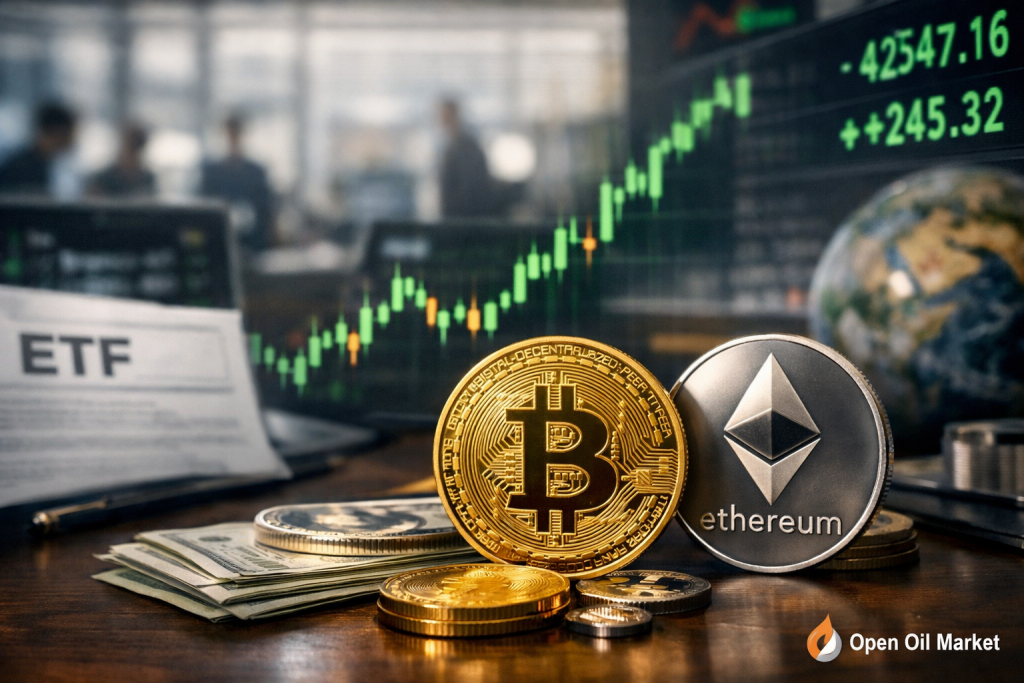
The global cryptocurrency market is entering Sunday in a more resilient state than it was a week ago. After the high volatility at the beginning of the year, digital assets are once again receiving support from global risk appetite, institutional products, and discussions surrounding new regulatory frameworks. For investors, this is an important signal: the crypto market remains sensitive to macroeconomic factors but is increasingly integrating into the traditional financial system.
Three main themes are currently coming to the forefront: Bitcoin's leadership within the market structure, the gradual strengthening of institutional presence through ETFs and banking products, and the struggle for the future of stablecoins and digital payment ecosystems. Against this backdrop, the largest cryptocurrencies maintain their status as key indicators of sentiment in the global capital market.
The Market Enters Sunday with Restored Risk Appetite
As of April 19, the cryptocurrency market appears significantly more stable. The primary momentum has come not only from within the industry but also from the broader financial market. Improved sentiment in American stocks, reduced nervousness surrounding geopolitics, and a renewed interest in risk assets have supported cryptocurrencies as well.
This is significant for the market for two reasons:
- Firstly, cryptocurrencies are once again moving in conjunction with the technological and risk segments of the global market;
- Secondly, capital is returning not only to Bitcoin but also to major liquid altcoins.
In other words, the crypto market is now living not in isolation but as part of a global financial ecosystem. For international investors, this means that key factors remain not only industry news but also the overall dynamics of inflation, interest rates, stock indices, and risk appetite.
Bitcoin Confirms Its Status as the Market's Main Asset
Bitcoin continues to be the center of liquidity attraction. It draws significant attention from institutional investors, funds, banks, and large private investors. This is clearly reflected in the market structure: Bitcoin holds a dominant position and remains the main barometer of trust in digital assets.
The strengths of BTC at this stage include:
- Maximum liquidity among all cryptocurrencies;
- The highest degree of institutional recognition;
- Perception as a digital equivalent of a safe-haven asset in long-term strategies;
- Priority in new ETF products and banking investment solutions.
For investors, this means that even in the market recovery phase, Bitcoin remains the primary benchmark. As long as BTC maintains its leadership in market capitalization and market share, the entire crypto market appears more stable. However, if its dominance begins to decline rapidly, it will signal a shift of capital into the more risky segment of altcoins.
Ethereum Retains Systemic Importance Despite More Modest Dynamics
Ethereum remains the second key asset in the market. Its role for investors extends beyond price dynamics. It serves as the foundational infrastructure for decentralized finance, asset tokenization, stablecoins, and a wide variety of blockchain applications. Therefore, interest in ETH represents a bet on both the cryptocurrency market and the development of digital financial infrastructure.
Currently, Ethereum resembles an asset that lags behind Bitcoin in terms of narrative strength but gains in practical significance. If the market continues to institutionalize, ETH could gain a new momentum as an infrastructural digital asset rather than just as a speculative tool.
This is especially important for investors in a global context: the stronger the theme of tokenization and digital payments grows, the higher the strategic value of Ethereum in portfolios with a horizon of more than one quarter.
Institutional Capital is Delving Deeper into Cryptocurrencies
One of the main narratives for April is the continued penetration of institutional investors into the crypto market. Major financial players are no longer limited to merely observing the sector. Banks, exchanges, and asset managers are building comprehensive investment products around cryptocurrencies.
This is currently manifesting in several forms:
- The expansion of ETF offerings tied to Bitcoin and other digital assets;
- The growth of partnerships between traditional exchanges and crypto platforms;
- The increasing interest in regulated liquidity, custodial solutions, and tokenized markets.
Institutionalizing the market changes its quality. While it does not eliminate volatility, it makes the sector more mature. For large investors, this transition means reduced infrastructural barriers. For retail participants, it translates into heightened competition for yield and a gradual shift in focus from meme-based stories toward the most liquid and regulated digital assets.
Regulation Becomes a Real Market Driver Rather Than a Background Concern
Another important topic for April 19 is regulation. For the crypto market, this is no longer merely a risk factor, but rather one of the main drivers of asset revaluation. The clearer the rules of the game become, the higher the likelihood that new institutional money will enter the sector.
Investors are currently keeping an eye on several directions:
- The discussion regarding the market structure of digital assets in the USA;
- New approaches to trading platforms, staking, and asset custody in the UK;
- European competition in the segment of digital payments and stablecoins.
The market thus receives mixed signals. On one hand, the regulatory framework is becoming broader and clearer. On the other, political delays and disagreements in the US indicate that a unified regulatory model is still incomplete. For investors, this means that in 2026, the regulatory factor will influence cryptocurrencies just as much as macroeconomic conditions.
Stablecoins Move to the Center of Financial and Geopolitical Competition
The stablecoin segment has definitely ceased to be a narrow technical niche. It is now a matter of control over digital transactions, cross-border payments, and the future architecture of the money market. This is particularly evident in Europe, where the topic of euro-stablecoins has become part of a broader discussion about financial sovereignty.
For the cryptocurrency market, this implies:
- Stablecoins are increasingly integrating into the real financial system;
- The competition is no longer just for trading, but for payment infrastructure as well;
- The demand for blockchain solutions will rise not only from crypto projects but also from banks.
If this trend strengthens, those blockchain ecosystems that can offer scalability, transaction reliability, and convenient infrastructure for issuing tokenized financial instruments will emerge victorious.
Major Altcoins Retain Significance, but the Market Remains Selective
In the altcoin segment, the situation appears heterogeneous. Investors are not rushing to evenly distribute capital across the market. The focus remains on the most liquid and recognizable assets: XRP, BNB, Solana, TRON, Dogecoin, and a number of infrastructural tokens.
Currently, several trends can be identified:
- XRP and BNB maintain strong positions due to the scale of their ecosystems and brand recognition;
- Solana continues to serve as one of the main instruments for betting on faster growth outside of Bitcoin and Ethereum;
- TRON is strengthening its position due to its role in payment and stablecoin flows;
- The market is becoming more open to new participants from the derivatives and exchange infrastructure segment.
This means that in 2026, the altcoin season no longer resembles a chaotic rise of everything indiscriminately. Investments are concentrating in assets with clear demand, high liquidity, and a real role in the ecosystem.
The Top 10 Most Popular Cryptocurrencies as of April 19, 2026
As of the start of April 19, the most popular cryptocurrencies by market capitalization and liquidity include:
- Bitcoin (BTC) — the main market benchmark and key asset for institutional strategies.
- Ethereum (ETH) — foundational infrastructure for smart contracts, DeFi, and tokenization.
- Tether (USDT) — the largest US dollar stablecoin and central settlement asset in the crypto market.
- XRP (XRP) — one of the most recognizable international payment tokens.
- BNB (BNB) — a systemic asset of the largest cryptocurrency ecosystem, Binance.
- USDC (USDC) — the second-largest US dollar stablecoin with a strong institutional reputation.
- Solana (SOL) — one of the main representatives of high-speed blockchain platforms.
- TRON (TRX) — a major network with a significant role in transfers and stablecoin circulation.
- Dogecoin (DOGE) — a meme cryptocurrency that retains mass recognition and liquidity.
- Hyperliquid (HYPE) — a new notable entrant into the top ten, reflecting the growing interest in crypto-derivatives infrastructure.
For investors, the mere fact of the updated top ten is significant. It showcases the market's transformation, where not only classic coins rise to prominence but also assets related to trading infrastructure and new liquidity segments.
What Matters to Investors on Sunday, April 19, 2026
The key takeaway at the beginning of Sunday is that the crypto market now appears as a mature risky asset class rather than a separate speculative universe. Bitcoin retains its leadership, Ethereum maintains fundamental significance, and top financial institutions continue building bridges between traditional markets and digital assets.
Investors should monitor several indicators:
- Whether Bitcoin's strength relative to the rest of the market remains;
- Whether the institutional expansion of ETFs and banking crypto products continues;
- Any new signals on regulation in the USA, Europe, and the UK;
- Whether the stablecoin segment can become a new driver of global demand for blockchain infrastructure.
If the current alignment of institutional demand, improved global risk appetite, and gradual regulatory clarity persists, cryptocurrencies could enter a new growth phase as early as the second quarter. However, for investors, this remains a market where stability begins not with hype but with discipline, liquidity, and accurate risk assessment.