Current Cryptocurrency News as of April 11, 2026, Including Analysis of Bitcoin, Ethereum, and the Top 10 Cryptocurrencies, Alongside Key Market Trends and Investment Signals
The cryptocurrency market is approaching April 11, 2026, in a state of cautious recovery. After sharp fluctuations at the end of the first quarter, investors are once again focusing on major assets, institutional flows, and regulatory signals from the U.S. and Asia. This is a critical moment for the global market: the speculative segment remains volatile, but the core of the sector is gradually shifting towards a more mature structure, where Bitcoin, Ethereum, stablecoins, exchange products, and infrastructure blockchains play key roles.
The main theme of the day is not only price movements but also the changing logic of the market. While previous cycles were primarily driven by retail investors, there is now a greater emphasis on ETF flows, institutional demand, bank experiments with stablecoins, and expectations for new rules. This is why the cryptocurrency news on April 11 is particularly important for investors who are assessing not just short-term volatility, but also the strategic trajectory of the entire digital market.
Bitcoin Resumes Leading Role in the Cryptocurrency Market
Bitcoin remains the main indicator of market sentiment. Following significant drops in early 2026, the market has transitioned into a phase of more stable consolidation. For investors, this signifies that capital is once again concentrated in the first echelon of digital assets, namely Bitcoin, as the most liquid and institutionally recognized cryptocurrency.
At this stage, several factors are important for BTC:
- continued interest from large funds and ETFs;
- sensitivity to macroeconomic conditions and global risk appetite;
- perception of Bitcoin as the primary protective digital asset within the crypto market;
- dominance over most altcoins in terms of liquidity quality and market depth.
The market has already demonstrated that even after a massive correction, institutional demand has not disappeared. This is an important signal for long-term investors: cryptocurrency news is now largely viewed through the lens of whether Bitcoin will retain its status as the industry's main asset. For now, the answer is likely positive.
Ethereum Maintains Systemic Importance, but Market Awaits Fundamental Acceleration
Ethereum remains the second most significant asset in the market and the primary infrastructure blockchain for smart contracts, DeFi, tokenization, and stablecoins. However, the sentiment around Ethereum is more subdued compared to Bitcoin. Investors acknowledge the fundamental importance of the network but want to see a more convincing acceleration in user activity, commission base, and new institutional demand.
Currently, Ethereum possesses several advantages:
- dominant role in the smart contract ecosystem;
- critical importance for the turnover of stablecoins;
- developed staking infrastructure;
- high integration with institutional products.
However, questions remain. Some market participants believe that Ethereum currently lags behind faster networks such as Solana in terms of narrative dynamics. Therefore, in the short term, ETH is perceived not as a purely momentum-driven story, but as a fundamental asset that needs to demonstrate actual acceleration in ecosystem growth.
Regulation Becomes a Driver for Crypto Asset Valuation Again
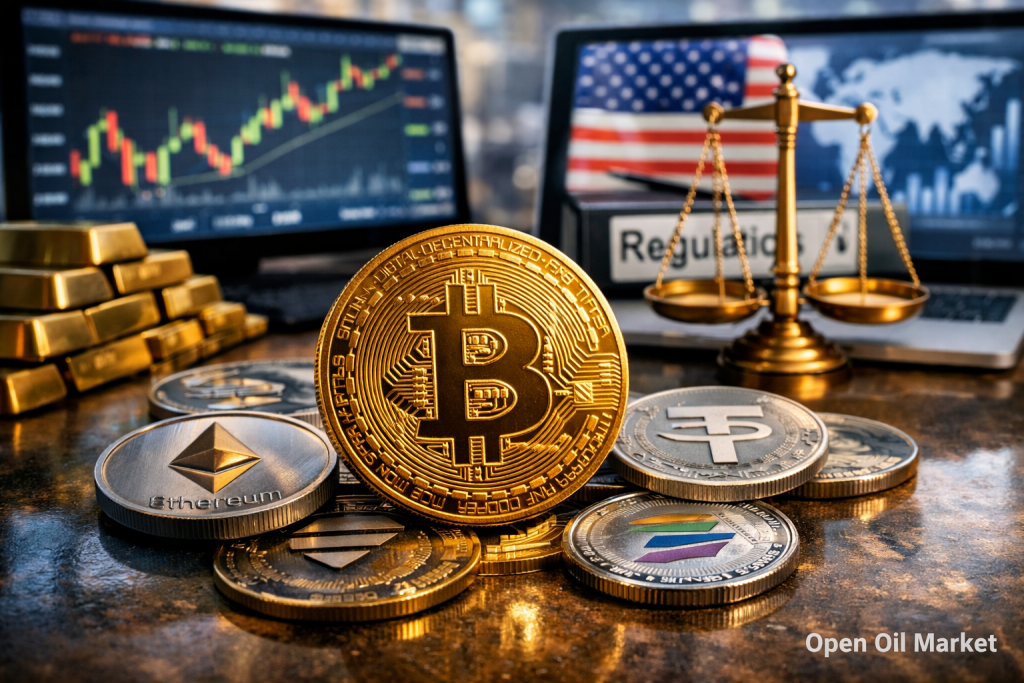
One of the key themes for the global cryptocurrency market remains regulation. Investors are closely monitoring how rules for digital assets are being formulated in the U.S., as the American market still sets the tone for institutional demand, ETF development, and the legalization of new products.
Currently, the regulatory agenda is influencing the market in three main areas:
- defining the legal status of crypto assets;
- prospects for expanding the range of exchange products;
- development of the regulated stablecoin segment.
For Bitcoin, this is a matter of the sustainability of the ETF channel and access to large capital. For XRP and Solana, it concerns the expansion of institutional packaging through new funds. For the entire crypto market, it is about reducing legal uncertainty, which has long limited the valuation of even quality projects.
From an investor's perspective, this means one thing: the cryptocurrency market in 2026 increasingly depends not only on technologies, but also on how quickly digital assets will be integrated into the official financial architecture.
Stablecoins Evolve into One of the Strongest Segments of the Industry
If stablecoins were previously viewed mainly as technical tools for trading, they now constitute a full-fledged infrastructure for digital transactions. This segment is currently witnessing one of the most significant transformations in the crypto market.
The rising importance of stablecoins is linked to the following factors:
- banks and large financial groups are testing their own digital currencies pegged to fiat money;
- regulators are increasingly establishing separate rules for this class of assets;
- stablecoins are solidifying their positions in cross-border transactions and digital payment scenarios;
- they support network effects for Ethereum, Tron, and other infrastructure blockchains.
This is especially important for the market because the growth of stablecoins signifies a transition from a purely speculative model to a more practical one. And it is this practical logic that could emerge as one of the key drivers for the next phase of cryptocurrency development.
What's Happening with the Top 10 Most Popular Cryptocurrencies
As of April 11, 2026, investors' attention is primarily focused on the largest and most liquid assets. Below is the current snapshot of the top 10 most popular cryptocurrencies that the market is particularly closely monitoring.
- Bitcoin (BTC) — approximately $72,900. The market's main benchmark and key indicator of institutional demand.
- Ethereum (ETH) — approximately $2,240. The critical infrastructure for DeFi, tokenization, and stablecoins.
- Tether (USDT) — approximately $1. The principal settlement asset within the crypto market.
- XRP — approximately $1.35. Remains in the spotlight due to regulatory issues and expectations surrounding exchange products.
- BNB — approximately $606. One of the most stable large altcoins due to its own ecosystem.
- USD Coin (USDC) — approximately $1. One of the main regulated stablecoins for the global market.
- Solana (SOL) — approximately $84.80. One of the most discussed infrastructure projects among large altcoins.
- TRON (TRX) — approximately $0.318. Strengthening its position as a network with a significant role in the turnover of stablecoins.
- Dogecoin (DOGE) — approximately $0.094. Maintains its status as a barometer of interest in the high-risk segment of the market.
- Cardano (ADA) — approximately $0.255. Investors continue to evaluate it as a bet on the long-term development of the ecosystem.
For the global audience of investors, the importance lies not only in the list itself but also in its structure. It is dominated by three groups of assets:
- core market leaders — Bitcoin and Ethereum;
- stablecoins — USDT and USDC;
- large platform and payment altcoins — XRP, BNB, Solana, TRON, Dogecoin, Cardano.
Altcoins Have Not Disappeared, but the Market Has Become Much More Selective
One of the main distinctions of the current phase is the sharply increased selectivity of the market. Investors no longer buy a broad range of altcoins merely based on expectations of overall sector growth. Capital is choosing projects that possess at least one of three characteristics:
- clear infrastructural function;
- potential for institutional packaging;
- real liquidity and scalable ecosystem.
This is why Solana, XRP, BNB, and TRON appear more confident compared to a significant portion of the remaining market. Each of these assets has its own investment logic: For Solana — a bet on network performance and institutional interest, for XRP — a regulatory pivot and payment history, for BNB — an ecosystem model, and for TRON — a stable presence in transactions involving stablecoins.
Against this backdrop, Dogecoin and Cardano represent different risk styles. The former is more dependent on speculative sentiment, while the latter is reliant on investor patience and fundamental development expectations.
What Risks Should Investors Be Aware of Right Now
Despite a noticeable improvement in the news background, the cryptocurrency market remains highly volatile. Investors need to consider that even a positive news flow does not eliminate structural risks.
- Macroeconomic risk. Cryptocurrencies still react to interest rates, the dollar, inflation expectations, and global risk appetite.
- Regulatory risk. Any delay or change in rules can quickly shift sentiment regarding ETFs, stablecoins, and major altcoins.
- Market risk. After sharp downturns, strong rebounds are possible, but they do not always indicate a sustainable reversal of trend.
- Sector risk. Not all cryptocurrencies will benefit from the maturation of the industry: assets with strong liquidity and real applications will have the advantage.
For global investors, this means the necessity for stricter filtering of ideas. In 2026, the market rewards not merely for presence in cryptocurrencies, but for the accurate choice of segment and asset quality.
Conclusion: The Cryptocurrency Market is Moving Towards Maturity, but Leadership Remains with the Largest Names
The cryptocurrency news on April 11, 2026, reveals an important point: the market is maturing. The center of gravity is shifting from chaotic speculation to a more understandable model, where institutional flows, infrastructure, regulation, and usage scale hold significance. This does not render the sector safe, but it makes it more analyzable.
The main takeaways for investors are as follows:
- Bitcoin remains the core asset of the crypto market;
- Ethereum retains a strategic role, although the market awaits a more significant impulse from it;
- Stablecoins are becoming one of the key drivers of the industry;
- Major altcoins will compete not with promises, but with the quality of their ecosystem and access to institutional capital.
If the current trend persists, the coming months may become a period of not total growth for all tokens, but of capital redistribution in favor of the most quality digital assets. For professional investors, this may be an even stronger signal than a typical price rally.