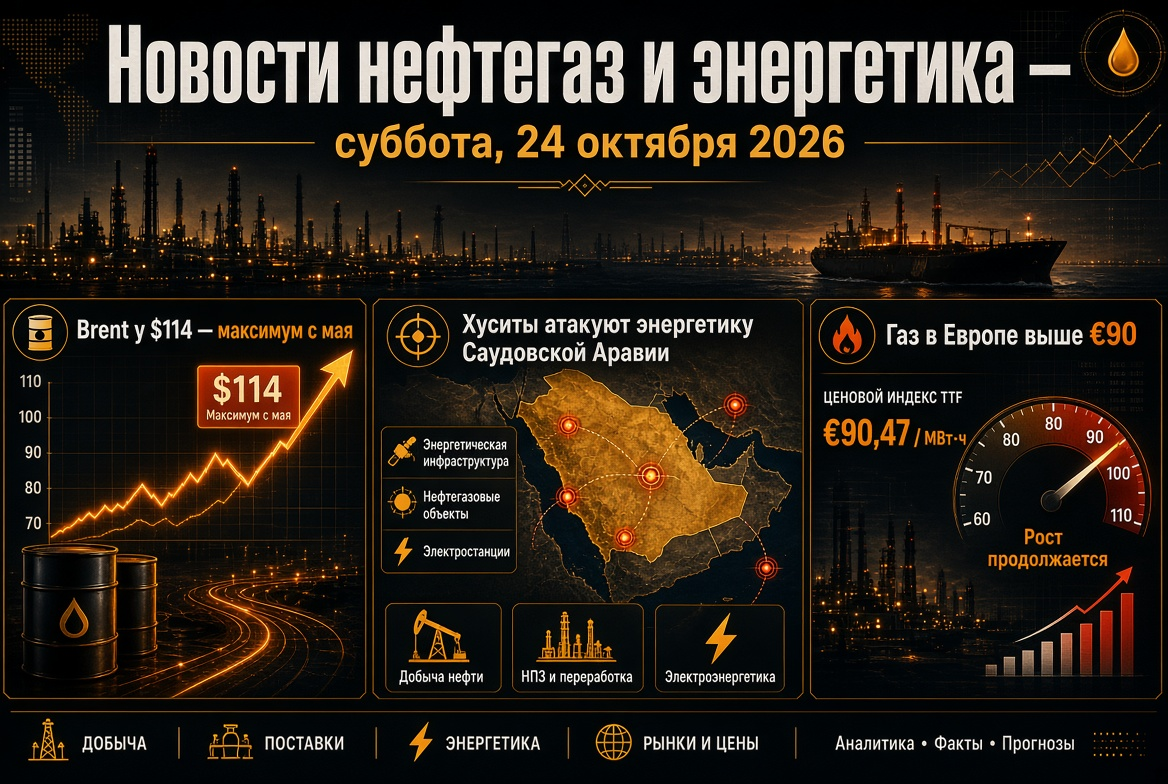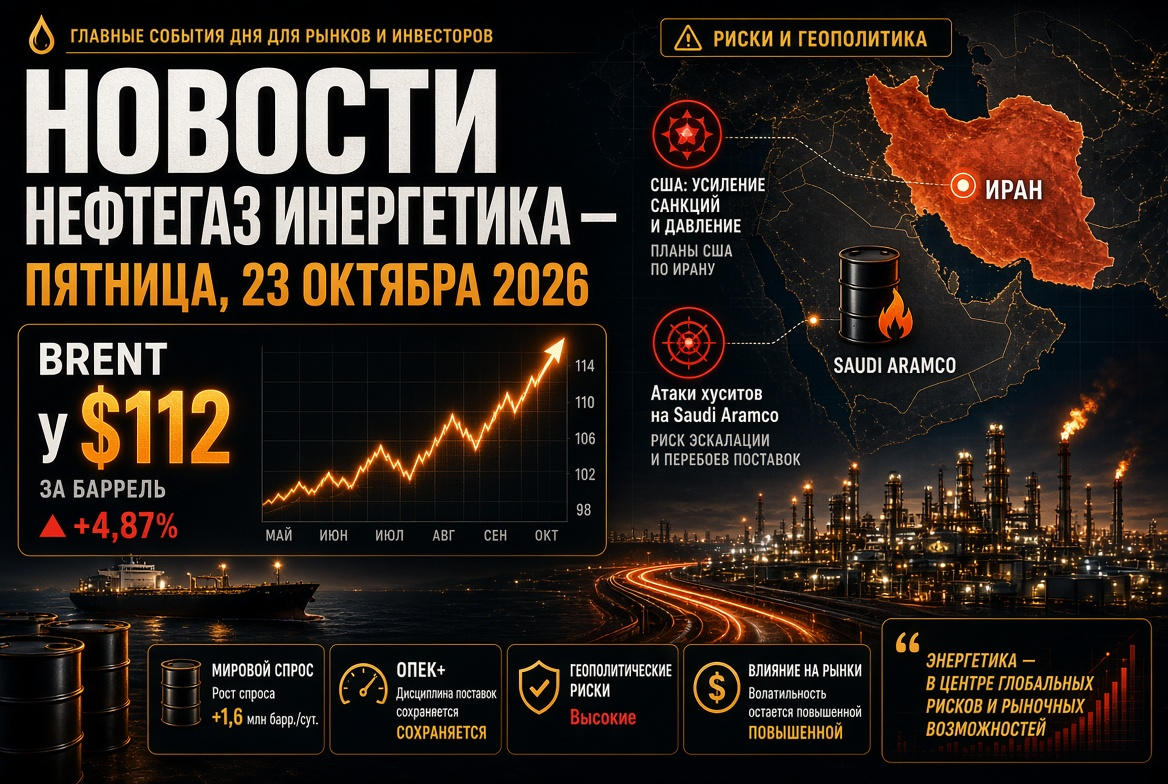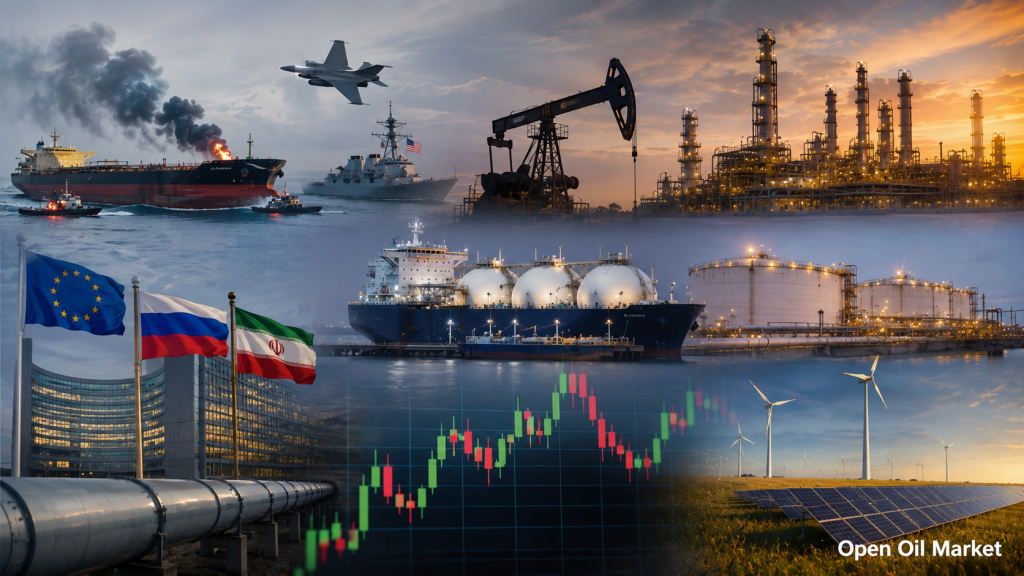
Oil and Gas News and Energy on July 24, 2026: Brent Surpasses $100 per Barrel Amid Mine Warfare in the Strait of Hormuz, EU Approves 21st Sanctions Package with Price Cap Freeze, TTF Gas Prices Surge by 50%, Market Overview of Oil, Gas, LNG, Refining, Electricity, RES, and Coal for Investors and Energy Sector Participants
The global energy market has entered its most acute phase since spring 2026. On Thursday, July 23, Brent crude prices surged more than 7%, surpassing $101 per barrel for the first time since May 22, while American WTI climbed above $92. The trigger was the explosion of an oil tanker on mines in the southern part of the Strait of Hormuz, coupled with a statement from the Iranian Revolutionary Guard Corps declaring that this vital artery of global oil trade would remain closed. Concurrently, the European Union approved its 21st sanctions package against Russia, and European gas prices at the TTF hub have increased by approximately 50% over three weeks. For investors, fuel and oil companies, energy market participants, product traders, and refinery operators, July 24 marks a pivotal moment for re-evaluating foundational scenarios—ranging from freight costs to the cost of electricity in Europe and Asia.
Oil Market: Geopolitical Risk Premium Returns to Pricing
The oil market has experienced the sharpest one-day jump in recent months. Trading dynamics on July 23 were consistently upward: in the morning, Brent surpassed $98, reaching $99 by midday, then $100, and ultimately closing above $101 per barrel in the evening. WTI crossed the $90 mark for the first time since June 11, reaching $92.4.
Key factors driving oil price increases include:
- Physical blockade of the Strait of Hormuz. Prior to the escalation, about a quarter of global maritime oil trade and roughly 20% of LNG supplies passed through this route. Mining shipping routes transforms insurance risk into actual operational damage.
- Escalation of conflict concerning maritime communications. Attacks on tankers have been recorded not only in the Persian Gulf but also in the Red Sea, elongating logistics lines and pushing up freight rates.
- Increased U.S. military presence in the region and ongoing series of night strikes on Iranian infrastructure, including port and missile facilities.
- Lack of negotiation track. Tehran signals unpreparedness for a deal, depriving the market of a quick de-escalation scenario.
It is crucial for energy market participants to understand that the current risk premium is logistical rather than speculative: it is not oil production that is under threat, but the ability to transport raw materials from the planet's largest export hub.
Strait of Hormuz: From Threat to Blockade
The situation in the Strait is developing according to the most stringent scenarios discussed. Reports indicate that three oil tankers attempted to cross the mined section in the southern part of the Strait; one of them exploded and caught fire. Iranian military officials state that they control the entry and exit to the Strait and that it will remain completely closed while American strikes continue.
The U.S. Central Command rejects this interpretation, insisting that the international waterway remains open for transit, and that the Revolutionary Guard is merely trying to force vessels to follow the route they designated. The divergence of official positions itself is a factor of price risk: shipowners and insurers are guided not by political statements but by actual incidents.
Implications for the Oil Product and Freight Market
- Sharp increase in military insurance premiums for tankers heading to the Persian Gulf.
- Extended routes and increased fleet turnaround—effectively reducing the effective tanker supply.
- Widening spread between Middle Eastern and Atlantic oil grades.
- Pressure on margins of Asian refineries that critically depend on Middle Eastern raw materials.
OPEC+: Cautious Increase of Quotas amid Supply Shortages
The alliance's policy appears conservative against the backdrop of the price surge. For the August period, seven OPEC+ countries—Russia, Saudi Arabia, Iraq, Kuwait, Algeria, Kazakhstan, and Oman—agreed to increase quotas by 188,000 barrels per day, similar to decisions made in June and July. The combined quota for the alliance in August stands at approximately 36.02 million barrels per day. Quotas for both Russia and Saudi Arabia increase by around 62,000 barrels per day each.
Significant structural changes in the alliance's configuration include:
- The UAE's exit from the organization reduced the number of countries participating in monthly production management.
- Iraq is publicly seeking a revision of quotas upward.
- Actual OPEC+ production fell to 33.13 million barrels per day in May, down from 42.77 million barrels per day in February—the gap between quotas and physical deliveries remains dramatic.
- Compensatory obligations for overproduction remain for Kazakhstan and Oman.
A practical takeaway for investors: the alliance currently lacks sufficient free capacity to quickly compensate for a drop in Middle Eastern exports—thus, the mechanism of price stabilization through quotas is functioning with limitations.
Gas Market: Europe Risks Not Filling Storage Ahead of Winter
The European gas market finds itself in its most vulnerable position in several years. The price of the benchmark TTF futures on July 22 surpassed €62 per MWh—approximately 49% higher than the end of June levels and close to the highs seen during the early days of the Iranian conflict. In dollar terms, prices reached around $700 per thousand cubic meters, with the maximum during the conflict recorded on March 19 at $853.7 due to a drastic reduction in LNG production by Qatar.
Storage Issues in Gas Underground Storage
The 2025–2026 heating season concluded for the EU with extremely low storage levels: as of April 1, underground storage was filled to only 27.66%—13.4 percentage points below the average over the previous five years. Summer injections are progressing more slowly than anticipated:
- As of July 19, storage levels stood at 53.7%—15.7 percentage points below the five-year average.
- Daily stock replenishments fell from 308 million cubic meters in June to 270 million cubic meters in July.
- In the previous year, the average mid-summer replenishment was about a quarter higher—approximately 338 million cubic meters per day.
Competition for LNG Intensifies
The Asian benchmark JKM climbed by about 25% in July—less than the European TTF—allowing Asia to nab spot cargoes. A telling situation has emerged in France: in July, the country expects only 13 LNG shipments—the lowest monthly volume in over five years—while eight shipments initially planned for August have been redirected to other markets. A mitigating factor remains structural adaptation: over the past four years, Europe has reduced its annual gas consumption by approximately 20% and constructed additional regasification terminals.
An additional horizon of risk involves the timeline for phasing out Russian energy resources: a complete withdrawal from Russian LNG is scheduled for January 1, 2027, and from pipeline gas by September 30, 2027.
Sanctions: EU Approves 21st Sanctions Package
On July 23, the European Union officially approved its 21st sanctions package against Russia, which the head of European diplomacy described as the largest in four years—featuring a total of 218 items. The package covers energy, financial services, cryptocurrencies, and trade.
Key energy and financial components include:
- Oil price cap. Frozen for a year at approximately $44 per barrel—meaning Russia will not benefit from the current spike in global prices.
- Banking block. Prohibiting transactions with 32 Russian credit institutions; overall restrictions will affect more than one hundred banks and crypto companies.
- Shadow fleet. Sanctions against over 40 vessels assisting with transportation. Prior to the adoption of this package, the total number of tankers under direct restrictions by the U.S., EU, and UK amounted to 886 units from a fleet estimate of 800–1200 ships.
- Refining. Several refineries in Russia and Belarus are now under restrictions.
- Trading platforms. Platforms trading oil and cryptocurrencies have been added to the prohibited transaction list.
Notably, the new package does not directly affect Russian LNG, and oil trading remains partially open. Experts point out a paradoxical effect: a stringent frozen price cap can lower the discount and, in some cases, support the price of Russian oil, as the market has already adapted to transportation by vessels registered outside the EU.
Russian Oil Product Market: Shortages, Imports, and Extension of Export Bans
Russia's domestic fuel market is experiencing one of its most strained seasons. According to Rosstat, the decline in oil product production has reached 21.8%—a direct consequence of forced shutdowns and repairs of refineries.
Causes of Tension
- Repair works at oil refineries prompted by drone attacks.
- High summer demand: vacation season, road tourism, and agricultural fieldwork.
- Logistical constraints in southern regions.
- High export volumes of oil products during the preceding period.
State Regulatory Measures
- Export restrictions. A ban on gasoline exports has been in place since April 2026, and as of July, restrictions have expanded to a broader range of market participants in diesel fuel. A complete ban on the export of diesel, marine fuel, aviation kerosene, and gas oils has been implemented. Discussions are ongoing regarding an extension of the ban until October.
- Maximizing refinery utilization. Planned repairs at Siberian refineries have been postponed to autumn 2026, with the timelines for current repairs shortened, and the potential of medium and small refineries is being utilized.
- Exchange regulation. The mandatory market sale norm for gasoline has been reduced from 15% to 10%, and the price fluctuation step is limited to one hundredth of the transaction amount.
- Fuel imports. Belarus has redirected gasoline volumes to the Russian market to alleviate local shortages; discussions are underway for supplies from India.
- Regional limits. In several regions, restrictions have been introduced on fuel sale in canisters and daily sales limits per customer.
The internal market provision situation has begun to improve after the introduction of export restrictions, however, price growth risks remain. A key variable is the operational stability of refineries: analysts indicate that solutions to processing issues may lead to price reductions within two to three months.
Electric Power and RES: Low-Carbon Generation Overtakes Coal
Against the backdrop of hydrocarbon turbulence, the renewable energy sector is demonstrating a structural shift. For the first time in recorded history, global electricity consumption—a growth of approximately 3% year-on-year—was entirely met by low-carbon sources. Renewable energy, alongside hydropower, has collectively surpassed coal in the structure of global production, with solar generation increasing by around 30%.
The regional picture is uneven:
- China achieved record results in wind and solar generation introduction while increasing emissions by only 0.3%.
- India increased the share of RES by nearly 24%, while emissions rose by 0.9%.
- Germany reached a share of RES in electricity consumption of 58% by the end of the first half of 2026.
- Japan faces difficulties in offshore wind energy, with major players exiting projects.
For investors, the practical effect is significant: with gas prices around €62 per MWh, the economics of solar power plants with storage and virtual power plants combining small hydropower stations with lithium-ion batteries become substantially more attractive. An additional demand driver is the rapid growth in data center energy consumption due to artificial intelligence needs, which has tripled in the past year.
Coal: Stabilizing Role Amid Gas Crisis
Despite losing its leadership in the global energy balance, coal retains its function as a balancing resource. High gas prices in Europe objectively enhance the competitiveness of coal generation during peak loads and calm weather conditions. In the Asia-Pacific region, coal-fired power plants remain the backbone of energy supply: in India, they still account for a significant portion of generation, while China maintains production at a level covering the lion's share of domestic demand.
For the coal market, the current situation means support for demand from European and Asian energy companies seeking to minimize their dependence on expensive LNG in the upcoming heating season.
Key Benchmarks for Investors and Energy Market Participants
In the coming weeks, the following indicators will be decisive:
- Status of navigation in the Strait of Hormuz. Restoration of transit could rapidly remove a $10–15 risk premium from pricing; new incidents involving tankers, conversely, could push prices above $105.
- Speed of gas injection into European underground storage. An ongoing 15+ percentage points lag from the five-year norm by September will make a winter price peak virtually inevitable.
- Competition between the EU and Asia for spot LNG cargoes and the dynamics of the TTF–JKM spread.
- OPEC+'s decision on September quotas and the alliance's ability to convert quotas into physical deliveries.
- Implementation practices for the EU's 21st sanctions package—primarily regarding the shadow fleet and banking transactions.
- Restoration of Russian refinery capacities and decisions regarding the duration of the export ban on gasoline and diesel fuel.
Conclusion of the Day: Market Has Shifted to Risk-Based Pricing Mode
As of July 24, 2026, the global energy market operates under a paradigm where the determining factor for the prices of oil, gas, oil products, and electricity is not the balance of supply and demand, but the reliability of transport corridors. Oil prices above $100, gas prices in Europe 50% higher than a month ago, the largest sanctions package from the EU in four years, and fuel shortages in the Russian domestic market—these are all different manifestations of one phenomenon: the fragmentation of global energy logistics.
For oil and fuel companies, this means a need to revisit hedging strategies and freight contracts. For energy companies, it calls for accelerated generation diversification and investments in energy storage systems. For investors, it indicates a period of heightened volatility in which supremacy benefits assets with control over logistics and refining, rather than merely over raw material inventories.